.png)
Blaue Balje
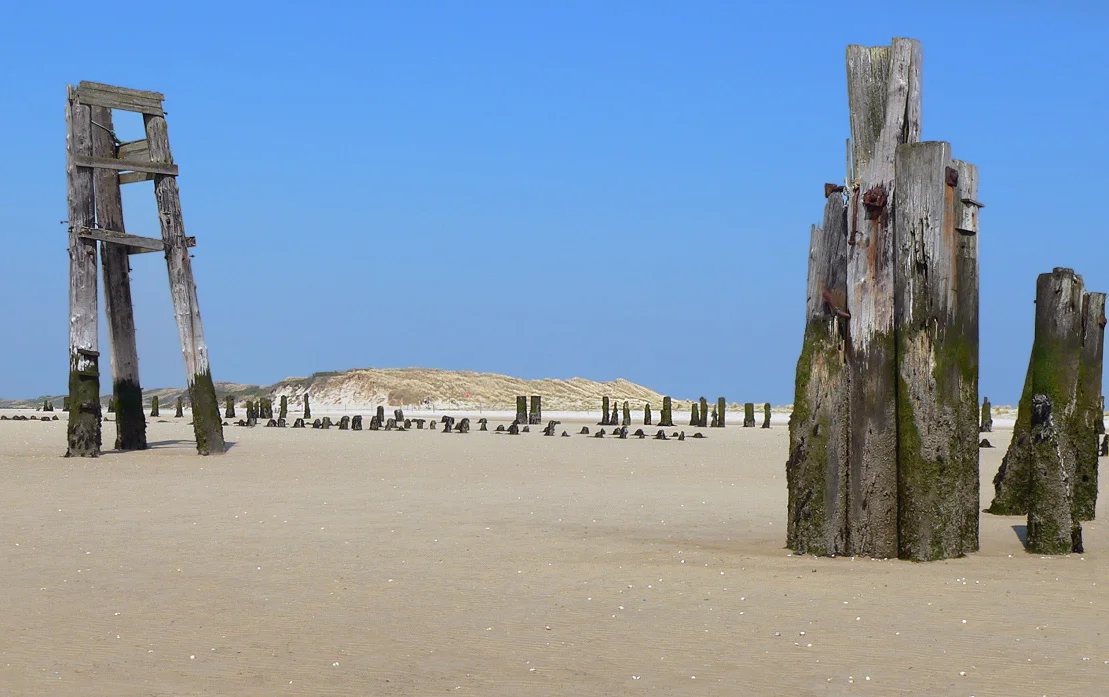
The pier stumps come up out of the water at low tide like the teeth of something half-buried. From 1905 to 1958 they held up the East Pier of Wangerooge, the main landing stage of an East Frisian holiday island and the terminus of its narrow-gauge railway. Then the channel that runs past it - the Blaue Balje, the Blue Channel - began doing what tidal channels always do, and slowly buried the pier in sand. By 1958 the dredging cost more than the pier was worth, and the trains stopped coming. The stumps are all that remain, in a strait that refuses to stay in one place.
A Strait of Shifting Sand
The Blaue Balje runs north to south between the islands of Wangerooge and Minsener Oog, draining the outer reaches of the Jade estuary into the open North Sea. The name means simply Blue Channel. Its main thread divides as it heads south into three sub-channels - the Telegraphenbalje, the Mittelbalje, and the Minsener Balje - each one a separate maze for skippers to read. Nothing here stays where it is for long. The location and the depth of the navigable water through the Blaue Balje change constantly. German maritime authorities publish updated soundings in their monthly notices to mariners, and the printout from one month is often useless by the next.
The East Pier
On the eastern tip of Wangerooge a wooden landing stage was built early in the twentieth century, and from 1905 onward the East Pier was the main link between the island and the mainland fleet of small ferries. The island's narrow-gauge railway ran out to it, picking up arriving passengers and their luggage and trundling them west to the village. Like the other East Frisian Islands, Wangerooge drifts east with the prevailing currents, and the entire eastern side of the island slowly accumulates sand. The Blaue Balje silted up around the pier faster than crews could keep the channel clear. By 1958 the calculation no longer made sense. The pier was closed, the eastern stretch of railway dismantled, and the structure was left to weather and tide.
What the Tide Reveals
At low water, the line of stumps still stands above the wet sand, dark against the pale flats. Sandwich terns and herring gulls work the receding water for stranded fish. The channel itself, just east of the stumps, has by now wandered some distance from where the pier reached. Mudflat hikers crossing from Schillig to Minsener Oog on guided summer walks sometimes glimpse the old posts on the horizon - the only obvious sign that this part of the Wadden Sea once had a railway running through it. The pier was abandoned for an unromantic reason. The sea had simply moved on, and dredging money is finite. But the stumps remain, half a century later, in a long quiet argument with the tide that put them out of work.
Reading the Channel
Today's mariners approach the Blaue Balje with the same caution that earlier captains used. The strait carries some leisure shipping - sailboats running between the islands, small charter craft heading for Wangerooge - and the navigable depth changes from month to month. Across the gap, on Minsener Oog, a radar tower watches the southern approach to the Jade and the much bigger commercial channel that leads to the JadeWeserPort and Wilhelmshaven. The Blaue Balje is the smaller cousin to that channel, and yet for the few centuries of the East Pier's existence it was busier with human traffic than the deeper waters to the south. The traffic has gone elsewhere. The blue water remains.
From the Air
53.77N, 7.98E. Best viewed from 2,000-4,000 ft at low tide, when the pier stumps and the channel structure are most visible. The Blaue Balje sits inside the Lower Saxony Wadden Sea National Park; respect the no-fly buffer over sensitive bird-breeding zones on Minsener Oog and the eastern tip of Wangerooge. Wangerooge has its own small airfield (EDWG); Bremerhaven (EDWB) is the nearest larger field about 50 km southeast. Coastal fog typical morning and evening; clearest air mid-day in early autumn.
Nearby Stories
- Baltrum 3.2 km away
- SMS Hela 9.5 km away
- Leaning Tower of Suurhusen 11 km away
- Wiesmoor 12 km away
- Gode Wind Farm 25 km away
- Valentin submarine pens 25 km away
- Teufelsmoor 56 km away
- Lilleø 223 km away