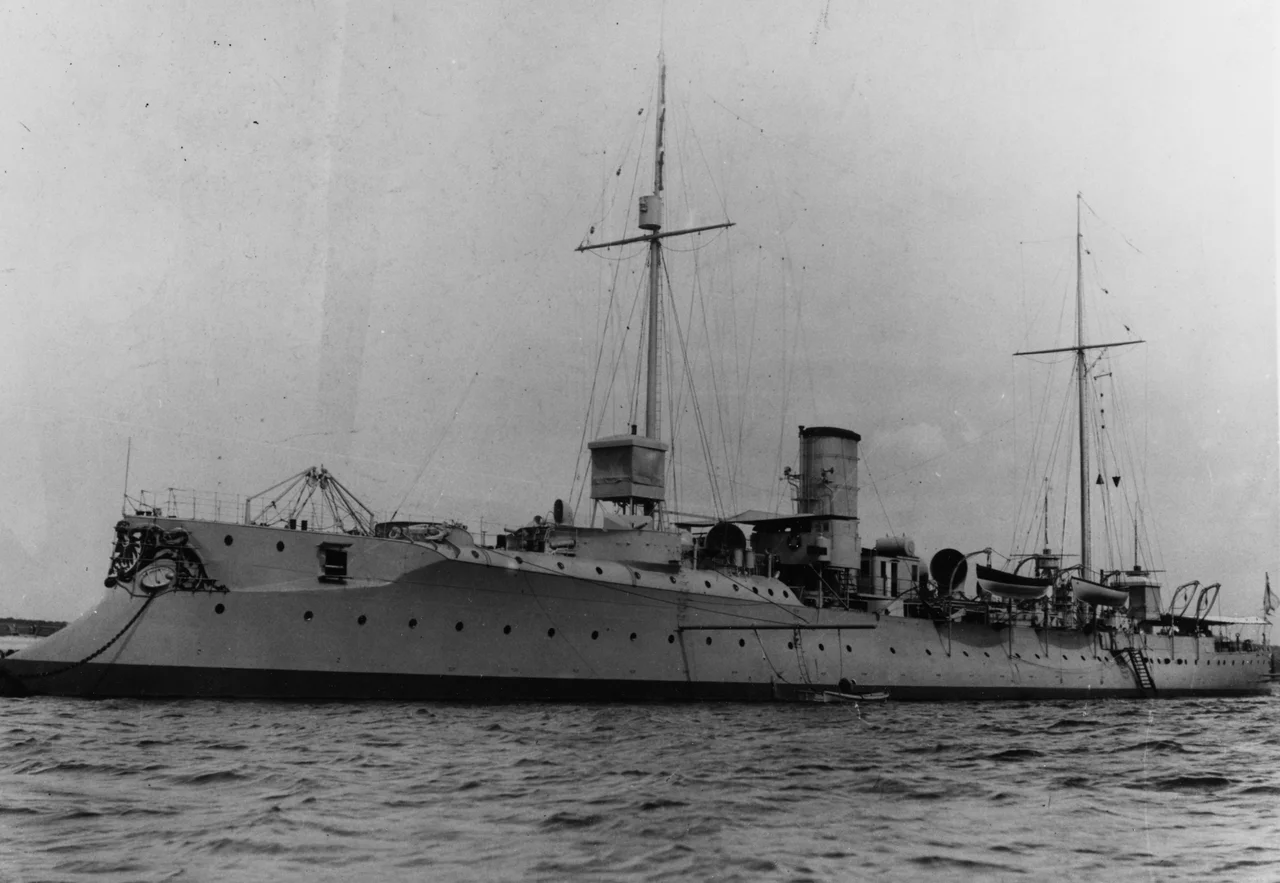

SMS Hela
It took two torpedoes, a stern hit, and roughly thirty minutes. That was all the time the cruiser SMS Hela had on 13 September 1914 between the moment a British periscope appeared off her quarter and the moment she slipped beneath the North Sea, six nautical miles southwest of Heligoland. Her crew was almost entirely saved - all but two men, plucked from the water by a U-boat and a patrol boat - but the loss itself was historic. Hela was the first German warship sunk by a British submarine in the First World War. Within days, the German Imperial Navy ordered every ship conducting training exercises to relocate to the Baltic. The submarine had arrived. The North Sea was no longer safe.
A Ship Between Categories
Hela had been built in 1893-95 at AG Weser in Bremen as the last of a type the Germans called an aviso - a fast, lightly armed scout, midway between a torpedo boat and a proper cruiser. By the time she was completed, the naval world had moved on. Her four 8.8 cm guns and three torpedo tubes were not enough to fight, and she rolled badly in head seas because the designers had built her slightly bow-heavy. Engine trouble during her sea trials in 1896 sidelined her for nearly two years before she joined the fleet. Her real role, German naval architects later admitted, was to be the prototype that pointed the way to the true light cruiser. Everything they got right on Hela - high speed, armored deck - they combined with the heavy armament of the unprotected cruisers to produce the next class. Hela was a stepping stone, and the navy never quite knew what to do with her after that.
Imperial Errands
Her career reads like a tour of imperial Germany's preoccupations at the turn of the century. She escorted Kaiser Wilhelm II's yacht Hohenzollern to Norwegian fjords in 1898 and to the Mediterranean later that year. She sailed to Dover in 1899 to mark Queen Victoria's eightieth birthday. In 1900, when the Boxer Uprising broke out and the German ambassador Clemens von Ketteler was murdered in Beijing, Hela was assigned to the expeditionary force sent to reinforce the East Asia Squadron. She patrolled the mouth of the Yangtze, contributed a landing party of four officers and seventy-four men to the assault at the Shanhai Pass, and was briefly commanded by Maximilian von Spee, the future hero and casualty of the Battle of the Falklands. She came home in 1901, was deemed too weakly armed for front-line work, and was reduced to a gunnery training ship.
The Periscope at 0700
When war came in July 1914, Hela was brought back to active service and assigned to IV Scouting Group, supporting the torpedo boats that formed the outer ring of patrols in the German Bight. On 28 August, when British cruisers attacked the patrol line in the Battle of Heligoland Bight, Hela turned east to join the fight - then received a confused report that the British were retreating, reversed course, and missed the action entirely. Two weeks later, on the morning of 13 September, she was running a training exercise in waters the navy considered safe. A British E-class submarine, E9, under Lieutenant Commander Max Horton - a man who would rise to admiral by the next war - had slipped past the German patrols. Horton surfaced, spotted Hela, dove again, and fired two torpedoes. One struck her stern. He took E9 up to periscope depth fifteen minutes later. Hela was sinking. Fifteen minutes after that, she was gone.
A Gun on the Shore
Two of Hela's sailors did not survive. The rest - roughly two hundred officers and enlisted men - were pulled from the cold water by U-18 and a coastal patrol vessel. The lesson the German navy took from the sinking was rapid and absolute: training in the Bight was over. Every exercising ship moved east into the Baltic, where British submarines could not yet reach. The submarine war the rest of the world is still arguing about - convoy systems, unrestricted warfare, the lonely terror of merchant captains crossing the Atlantic - had its overture in that quick half-hour off Heligoland. One of Hela's 8.8 cm guns was later retrieved from the wreck. It stands today at Fort Kugelbake in Cuxhaven, pointing out toward the water where she went down.
From the Air
The wreck of SMS Hela lies in the southern North Sea at roughly 54.05°N, 7.92°E, about six nautical miles southwest of Heligoland (Helgoland). The nearest airport is Helgoland-Dune (EDXH) on the small sand island east of Heligoland proper. The naval town of Cuxhaven, where one of Hela's surviving 8.8 cm guns is preserved at Fort Kugelbake, lies about 30 nm south at the mouth of the Elbe; the historic Imperial dockyard at Wilhelmshaven is further south. Recommended viewing altitude 2,000-4,000 feet for an overview of the engagement zone, the Heligoland archipelago, and the line of German coastal defenses.
Nearby Stories
- Blaue Balje 5 km away
- Baltrum 6.8 km away
- German Bight 19 km away
- SMS Ariadne 20 km away
- Amrumbank West 27 km away
- Stalag X-B 62 km away
- Teufelsmoor 91 km away
- Lilleø 207 km away