
North Kowloon Magistracy
On 7 December 1998, an elderly street vendor set himself on fire inside the North Kowloon Magistracy. He had just been convicted of illegal hawking, fined HK$400, and had his jade trinkets confiscated. He died two days later. His case — minor enough to be handled here, consequential enough to kill him — captures something essential about what this seven-storey granite building at No. 292 Tai Po Road was for: it was where Kowloon's ordinary life met the law, in all the dignity and heartbreak that involved.
Granite and Order
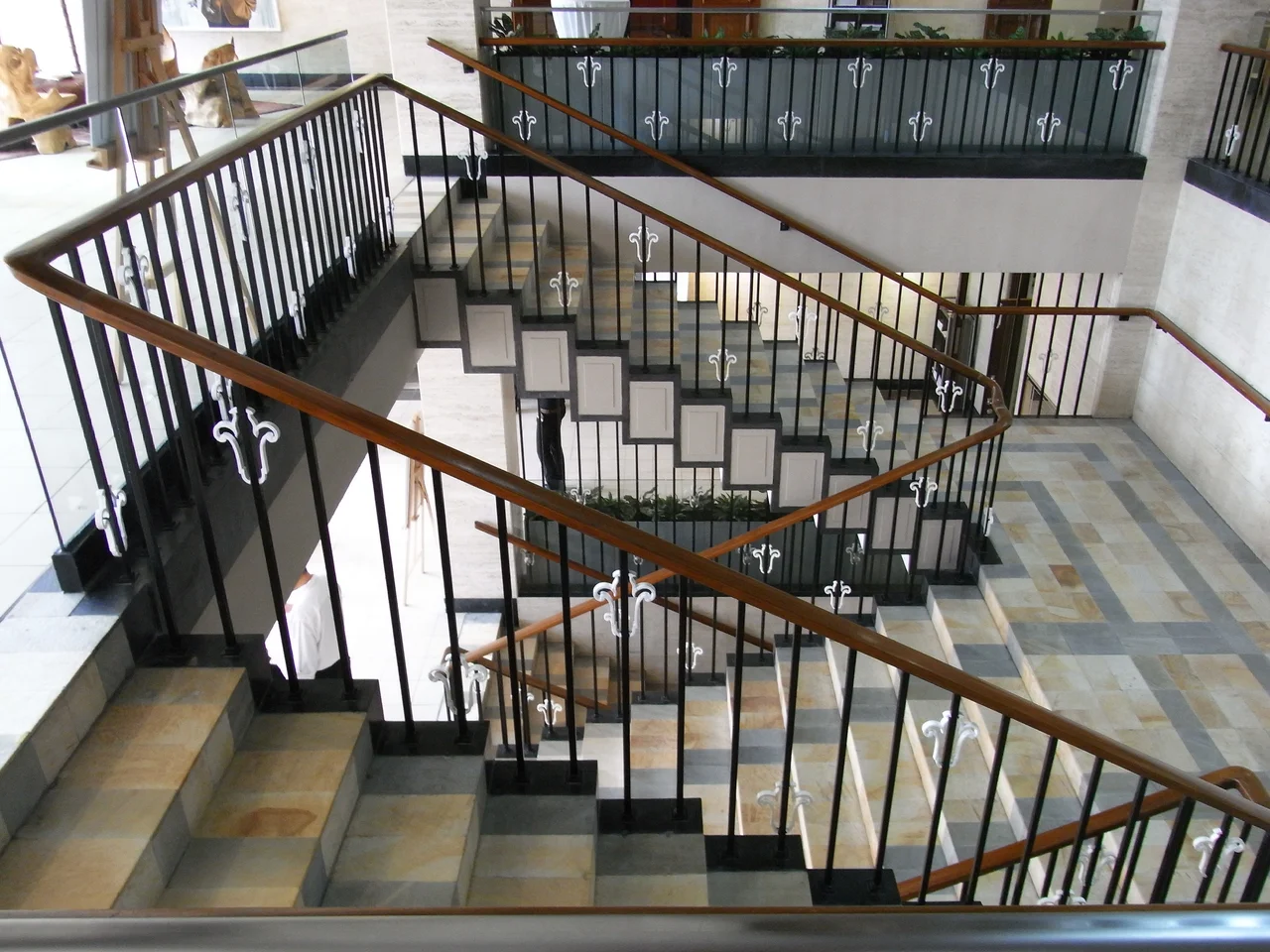
The North Kowloon Magistracy was built in 1960 and designed by Palmer and Turner, one of Hong Kong's most prominent architectural practices. The firm chose granite ashlar blocks — solid, permanent — and organised the facade around the principles of Stripped Classicism: the proportions and structural logic of classical architecture without its ornamental fussiness. Tall, narrow windows climb the front in symmetrical rows. A central projecting bay anchors the composition. Dark blue glazed ceramic tiles and grey walls give the building a restrained authority that courthouse architecture tends to require. Inside, the 7,345 square metre floor plan divides into three circulation systems kept deliberately separate: one for the public, one for magistrates and staff, one for police and prisoners. A central atrium rises through the building. The arrangement is practical and, viewed from the staircase where lawyers and defendants traditionally faced each other in Hong Kong television dramas, theatrical.
Kowloon's Busiest Courtroom
The magistracy served a catchment that covered Mong Kok, Sham Shui Po, Shek Kip Mei, Cheung Sha Wan, and Ho Man Tin — densely populated districts where a courtroom handling prostitution, illegal hawking, and littering citations could expect a heavy daily docket. During the Cultural Revolution of the 1960s, people who crossed from mainland China and reached the magistracy were granted permanent residency in Hong Kong, an arrangement that added another human dimension to the building's function. In 2000, when the older Kowloon Magistracy on Gascoigne Road closed, North Kowloon became the sole judicial court for the entire district. It handled that responsibility until 2004, when its own closure was announced and cases shifted to Kwun Tong, Kowloon City, and Sha Tin. By then the building had accumulated enough history to make its future a matter of public concern.
The Siege and the Singer
Not everything that passed through the magistracy was routine. In December 2003, Kwai Ping-hung — known as the King of the Gangsters — appeared facing charges of illegal possession of firearms and causing grievous bodily harm to two police officers. Because Kwai was the most-wanted person the Hong Kong Police Force had been seeking, more than a hundred armed officers surrounded the building on the trial date. The magistracy held. Then came the revitalisation competition — and the controversy no one expected. Liza Wang Ming-Chun, the celebrated Cantonese opera star who led the Chinese Artist Association of Hong Kong, submitted a proposal to convert the building into a Cantonese opera training and performance centre. When the government announced that an American design school had won instead, Wang went public: she claimed the result was already fixed, said she wanted to cry, and threatened to raise the matter directly with the Chief Executive. The outburst drew days of media coverage. It was later reported that Wang's proposal had scored comparably to the winner but fell short at the interview stage.
Art School, Then Silence
The Savannah College of Art and Design — based in Savannah, Georgia, with additional campuses in Atlanta and Lacoste, France — opened its first Asian campus here in September 2010. The renovation preserved the old law courts and prisoner passages as part of the student experience. The anticipated annual enrolment was 130,000 headcounts in the early years. The building held students, studios, and design critiques where cross-examination had once taken place. It was SCAD Hong Kong's campus until 1 June 2020, when the school closed permanently. Ownership returned to the government on 1 August 2020. The building has been included in Batch VI of Hong Kong's Revitalising Historic Buildings Through Partnership Scheme, and it stands vacant, waiting. The staircase where defendants and lawyers once faced off — the one recognisable from countless Hong Kong crime films, most recently from the 2023 courtroom thriller A Guilty Conscience — is still there.
From the Air
The North Kowloon Magistracy stands at 22.335°N, 114.163°E in Shek Kip Mei, inland Kowloon. From the air, the building sits at the junction of Tai Po Road and the surrounding low-rise residential blocks — its grey granite facade visible among the denser urban fabric. The nearest airport is Hong Kong International (VHHH), approximately 22 km to the west. At 2,000 feet, Kowloon's grid is clear; the Lion Rock ridge to the north provides a navigation landmark. The building is roughly equidistant between Sham Shui Po MTR station and Mei Ho House, the nearby Grade I heritage estate block.
Nearby Stories
- Chapel of St. Francis Xavier 3.5 km away
- Cuiheng 4.1 km away
- 2015 Shenzhen Landslide 16 km away
- Shunde 31 km away
- Wanshan Archipelago 37 km away
- Nanxiong Formation 96 km away
- Heyuan 149 km away
- Checheng Fu'an Temple 629 km away