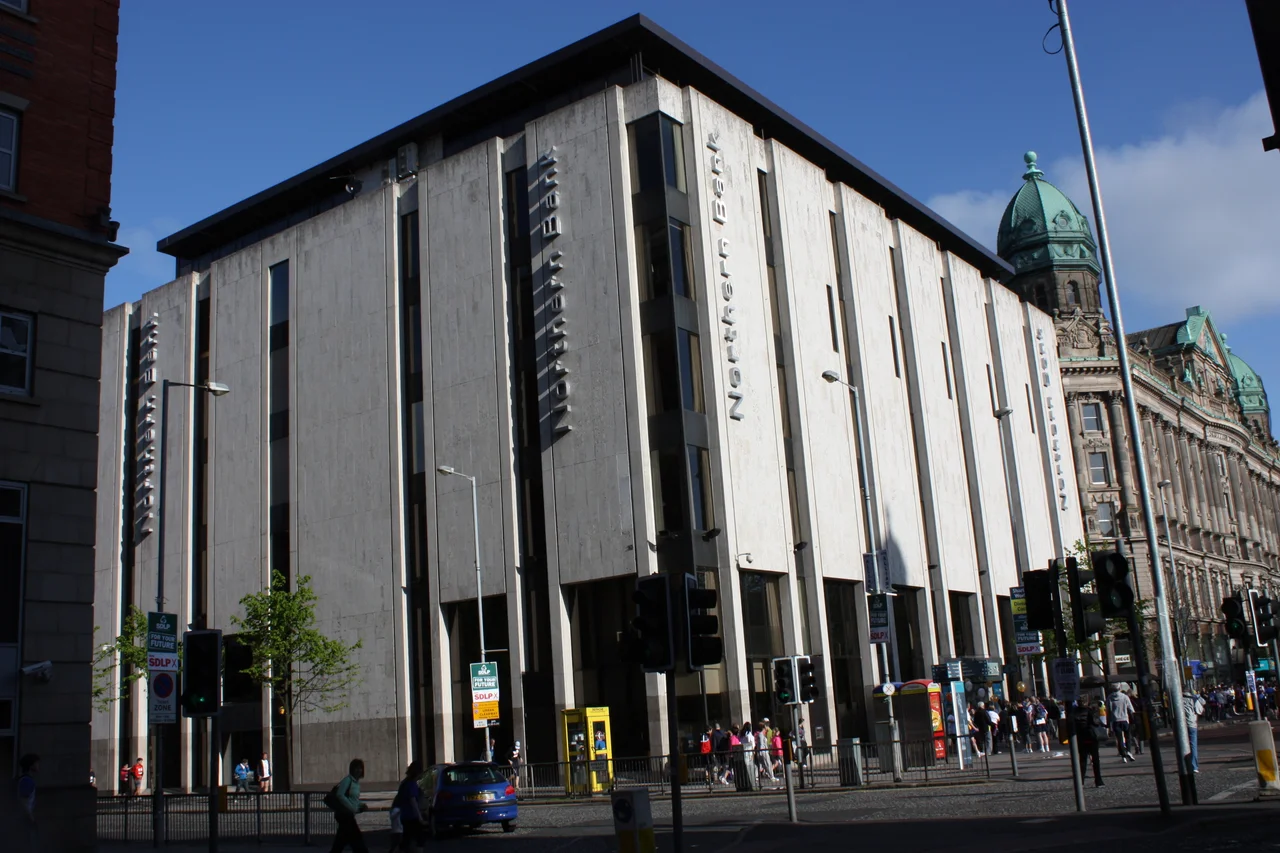

Northern Bank robbery
The plan needed two ordinary Monday mornings. On Sunday 19 December 2004, two armed gangs - disguised as Police Service of Northern Ireland officers in uniform - simultaneously knocked on the doors of two suburban Belfast homes. At one house in County Down they took the family of bank official Chris Ward hostage. At another in Poleglass they took the family of his supervisor Kevin McMullan. The hostages were held overnight by gunmen. On Monday morning the two men were sent to work at the Northern Bank's headquarters on Donegall Square West, just behind Belfast's City Hall, with instructions to behave normally and to remain after closing time. That evening they loaded crates of pound-sterling banknotes onto trolleys and helped wheel them to a waiting white Ford Transit van. The van made two trips. By midnight the gang had taken £26.5 million - the largest cash theft in United Kingdom history at the time. Nobody has ever been convicted of the robbery itself.
Why Belfast Could Be Robbed for £26.5 Million
Northern Bank, now Danske Bank, was at the time the largest retail bank in Northern Ireland with 95 branches. It was one of four banks - the others were Bank of Ireland, First Trust, and Ulster Bank - permitted to print its own sterling banknotes in denominations from £5 to £100. The Donegall Square West headquarters held cash reserves to supply branches across the region. Of the £26.5 million stolen, around £16.5 million was in new, uncirculated notes - £9 million in £20s, £7.5 million in £10s - whose serial numbers the bank could and did publish immediately, making them effectively useless. The other £10 million was in used notes. Those were untraceable. The gang knew this. The selection of denominations, the choice of date - the Monday before Christmas, when staff numbers were low and large cash movements were normal - and the simultaneous house-snatches were the signatures of an operation that had been planned for months.
Who Did It (Almost Everyone Agrees)
The Police Service of Northern Ireland, the Independent Monitoring Commission, the British government, the Irish government, and the then-Taoiseach Bertie Ahern all publicly named the Provisional IRA as responsible. PSNI Chief Constable Hugh Orde issued an interim report on 7 January 2005, just two and a half weeks after the heist, blaming the Provisional IRA. The IRA denied it. So did Sinn Fein. Martin McGuinness called Orde's accusation politically biased. Irish Justice Minister Michael McDowell went further, naming Gerry Adams, McGuinness, and Martin Ferris as IRA Army Council members. A 2021 BBC documentary by journalists Darragh MacIntyre and Sam McBride named the late Bobby Storey - the IRA's intelligence chief - as the heist's planner, an accusation MP David Burnside had made under parliamentary privilege in the House of Commons years earlier. Storey was never charged. The IRA's denial remains on the record. The investigations continued without ever producing a conviction for the robbery itself.
Money in Compost, Money in a Pub Toilet
What investigators did find was money. In February 2005, Garda Siochana raids in County Cork led to the discovery of £2.3 million buried in compost at the home of a financial adviser named Ted Cunningham. Another Cork man handed in £175,000; three businessmen handed in £225,000; all claimed Cunningham had asked them to hold the cash. On the same weekend, the PSNI recovered £50,000 in unused Northern Bank notes from the toilet cisterns at the Newforge Country Club - a social club used by serving and retired police officers in south Belfast. Three men arrested at Heuston Station in Dublin included one carrying €94,000 hidden inside a box of Daz washing powder. Cunningham was convicted in 2009 of laundering over £3 million from the heist, had his conviction quashed in 2012 on a technical search-warrant issue, and pleaded guilty at retrial in 2014 to laundering about £275,000 - receiving a five-year suspended sentence on health grounds. The money was forfeited. The robbery convictions never came.
The Kafka-esque Farce
In November 2005, Chris Ward - one of the two bank officials whose family had been taken hostage - was arrested by the PSNI and charged with robbery and using a firearm. The prosecution case rested on a suspicious work-rota change, inconsistencies in his original statements, and his actions in the days before the raid. Ward maintained he had been the victim of the robbery, not its accomplice. He had spent more time in police detention, he pointed out, than the gang had held his family hostage. When his trial finally reached a Diplock court in September 2008, the prosecution offered no evidence. The judge acquitted him of all charges and discharged him. The prosecution accepted that the work-rota change which had underpinned their entire case had in fact been a chance decision by management. Ward's defence lawyer called the case 'a Kafka-esque farce.' By the end of 2007 the PSNI's last hopes of charging anyone with the robbery itself had quietly dissolved.
The Cost to the Peace
The robbery's largest casualty was the Good Friday Agreement's momentum. In the months after December 2004, the Northern Ireland power-sharing institutions remained suspended; Sinn Fein-DUP negotiations stalled; American Sinn Fein fundraising was suspended by the Bush administration for most of 2005. The January 2005 murder of Catholic civilian Robert McCartney by a group of IRA men in a Belfast pub - and the subsequent campaign by McCartney's sisters for justice - compounded the political damage. Bertie Ahern's relationship with Adams and McGuinness, central to the Northern peace process, did not recover quickly. Northern Bank reissued every banknote it had in circulation, in new colours with new logos and altered serial numbers - an enormously expensive measure designed to make the stolen used notes traceable. The robbery itself, as a financial event, has been overtaken: the 2006 Securitas depot robbery in Kent took £53 million. But the Northern Bank job remained, in 2026, the largest unsolved cash theft in the history of these islands.
From the Air
The Northern Bank headquarters stood at 4-8 Donegall Square West, Belfast, at 54.596°N, 5.932°W - on the western side of Donegall Square, immediately across from Belfast City Hall's southern facade. The building is now occupied by Danske Bank (Northern Bank's successor). From the air, look for Belfast City Hall - a domed Edwardian Baroque building completed in 1906, sitting in a roughly square plaza at the centre of the city - the bank building is on the western edge of that square. Belfast City Airport (EGAC) is 2 nautical miles east-north-east; Belfast International (EGAA) is 13 nautical miles west-north-west. Recommended viewing altitude: 1,500-2,500 feet for the City Hall dome and the surrounding civic and financial district where the heist took place.
Nearby Stories
- Larne 1.2 km away
- Ahoghill 3.5 km away
- Castleskreen 4.9 km away
- Lough Neagh 6.1 km away
- Kingsmill Massacre 14 km away
- Pasages (steam trawler) 23 km away
- Ballantrae Lifeboat Station 34 km away
- St Patrick's Isle 39 km away