
Nottingham Contemporary
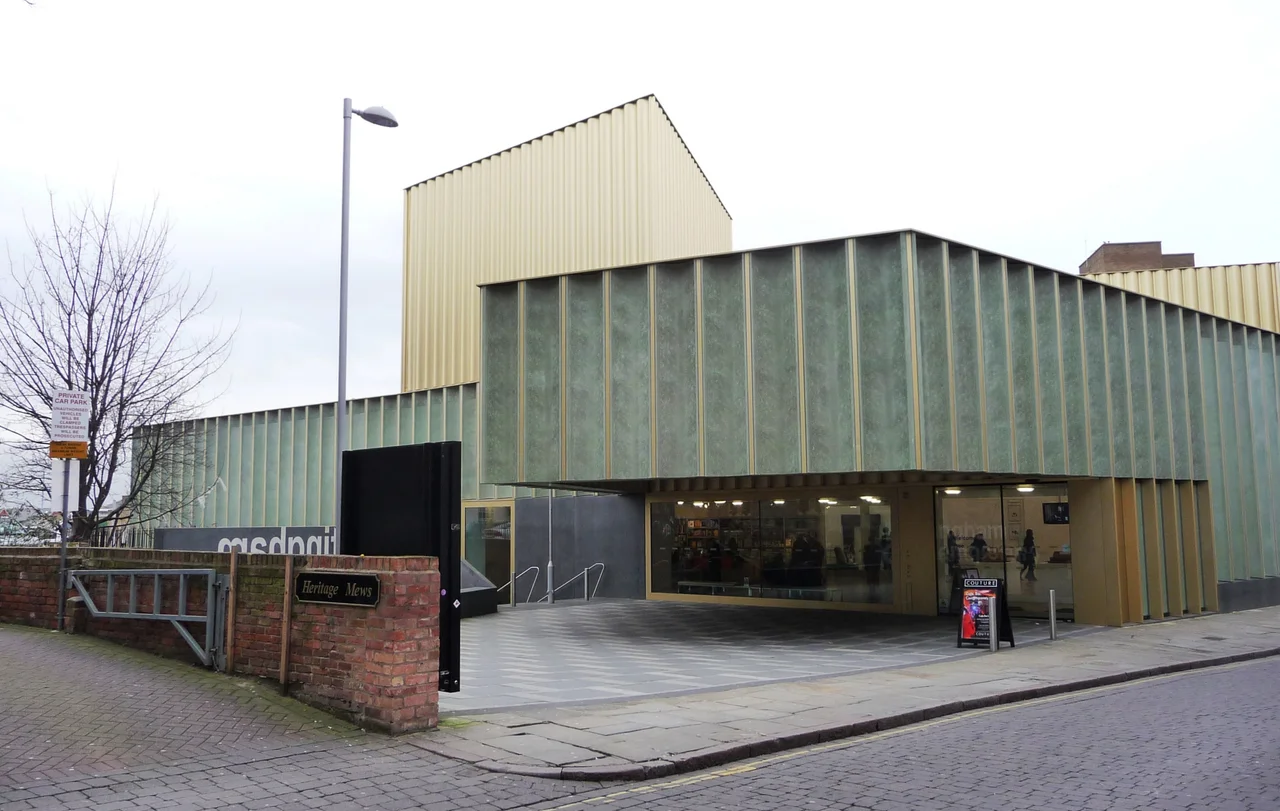
Look at the cladding from across the street and the pattern resolves: lace. Not painted on, not printed — cast into the concrete itself, each panel a verdigris-green slab embossed with a traditional Nottingham lace design. The building is Nottingham Contemporary, opened on 14 November 2009, and it sits on what its directors call the oldest occupied site in the city: a sandstone outcrop above Garners Hill where the Saxons built a fort, where medieval Nottingham built its town hall, where caves were dug into the rock long before either, and where the Victorians eventually swept all of it away to drive a railway line through. The concrete was Caruso St John's idea — the London architects whose building, the critic Owen Hatherley wrote, might, irrespective of the leaky roof, be the first masterpiece of British architecture of the twenty-first century.
Lace, Cast in Concrete
Nottingham was a lace city — by the late nineteenth century it was the centre of the world's machine-made lace industry, its Lace Market crowded with warehouses where reels of fine cotton thread were patterned, washed, finished, and shipped. Most of those warehouses still stand, converted to bars and apartments. Nottingham Contemporary's homage is not nostalgic. The traditional lace pattern is set into the precast panels of the exterior at a scale that makes it visible from across a wide street. The colour is a deliberate verdigris green, the colour of weathered copper. Large windows cut into the panels offer direct views from the pavement into the galleries inside. The trick of the design is that it lets the architecture do two jobs at once: declare its place in a specific local tradition while making no concession at all to local convention.
The Site Beneath
What is now the gallery's site has been many things. Caves were dug into the soft sandstone of Garners Hill in the medieval period, part of the network that still riddles the ground under central Nottingham. A Saxon fort once stood here. So did a medieval town hall. The Victorians removed the lot in the nineteenth century to make space for the Great Northern Railway line that ran below the cliff toward London Road station. The railway closed long ago and the cliff was left as an awkward, sloping stub of urban land that nobody had quite found a use for. Caruso St John's building — completed for around £19 million after significant cost overruns — drapes itself across that slope, with the public entrance at street level on the upper side and exhibition spaces stepping down toward the old railway cut.
What Has Gone On Inside
The gallery opened with a David Hockney show drawn from his early work and a parallel exhibition of recent pieces by the Los Angeles artist Frances Stark, both with loans from the Tate. Since then the programme has aimed at four or five major exhibitions a year, with an ambition that consistently outruns the size of the city. The 2017 exhibition The Place is Here was a landmark survey of Black British art that toured to London afterwards. States of America the same year was the largest survey of American photography ever staged in the UK. Glenn Ligon's Encounters and Collisions in 2015 brought the New York-based artist's work into direct conversation with the works that had shaped him. From Ear to Ear to Eye in 2017 and 2018 explored the politics of listening across the Arab world. With over 3,000 square metres of floor space, the building is among the largest contemporary art centres in the UK and one of the very few outside London with the scale to mount this kind of programme.
Concrete, Light, and a Free Door
Admission to Nottingham Contemporary is free. This matters in a city where the average household income is significantly below the national average, and where the gallery's location at the foot of the Lace Market puts it on the edge of one of the more economically mixed neighbourhoods in the East Midlands. Inside, the rooms are tall and white and quiet, the daylight coming in through carefully cut openings rather than the long glass walls of the street facade. The architects have been criticised for a roof that leaks — Hatherley's joke became one of the few things widely quoted about the building — but the criticism has the texture of those things people say about beloved objects. The lace cladding has weathered. The verdigris has deepened. The galleries keep filling up. Founding director Alex Farquharson ran the gallery from 2007 to 2015 before being appointed director of Tate Britain. The building goes on.
From the Air
52.951 N, 1.146 W, on Weekday Cross at the south edge of the Lace Market in central Nottingham. View from 1,500 to 3,000 ft AGL; the verdigris concrete cladding is hard to pick out from above but the building's L-shaped footprint on the cliff above the old railway cut is visible. Nottingham Castle sits half a mile west on the same sandstone ridge. East Midlands (EGNX) is 10 nm SW; Nottingham/Tollerton (EGBN) is 4 nm SE.
Nearby Stories
- Rutland Railway Museum 2.4 km away
- Welbeck Abbey 5 km away
- Lichfield rail crash 6 km away
- Peveril Castle 8.8 km away
- Grantham Rail Accident 11 km away
- Croxden Abbey 11 km away
- RAF Scampton 11 km away
- Leicester Abbey 11 km away