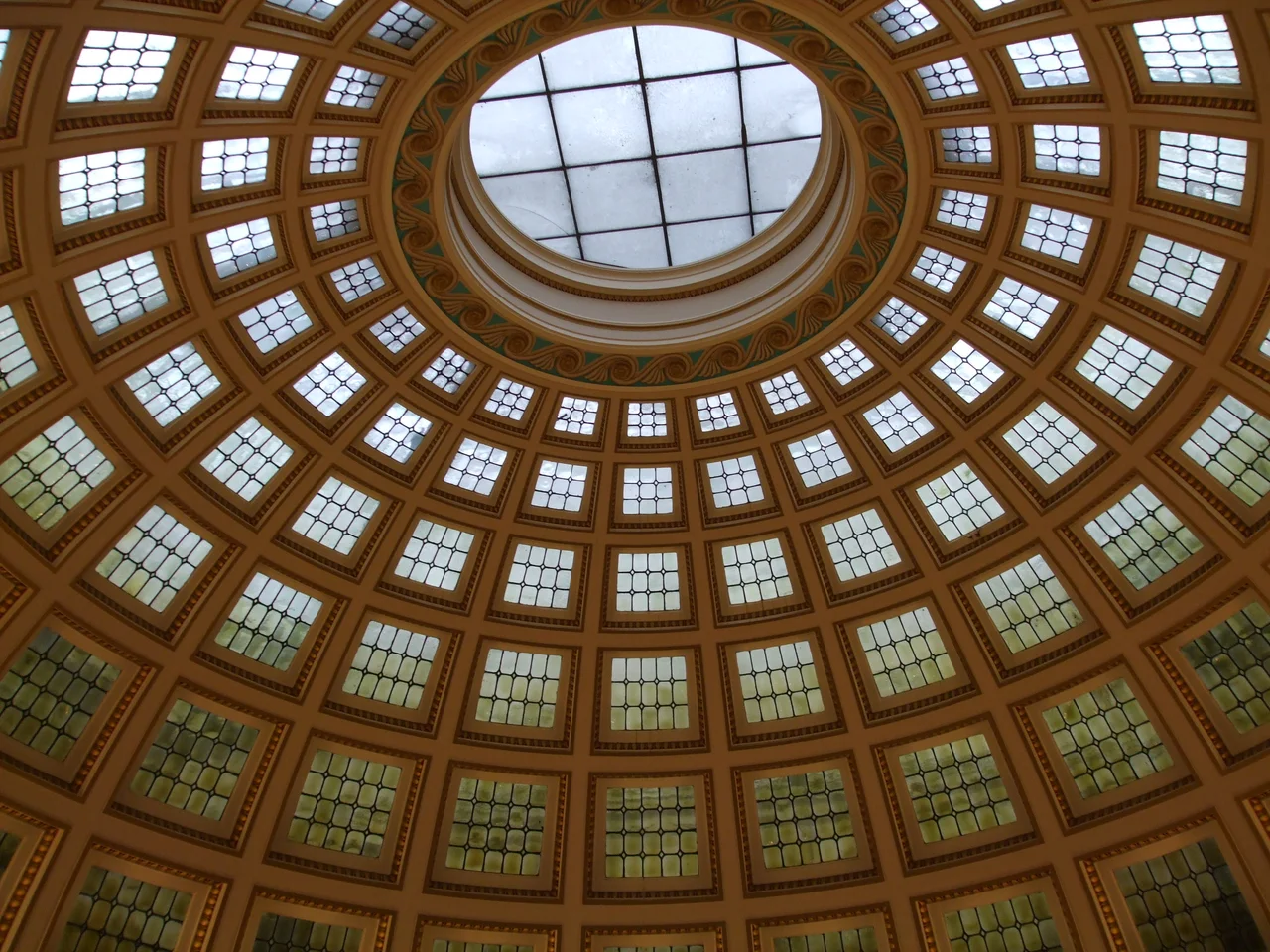

Nottingham Council House
Meet me by the lions. That phrase, half-instruction and half-promise, has been part of Nottingham's dialect since the building opened in 1929 - and Agamemnon and Menelaus, the two art-deco lions sculpted by Joseph Else, are still where their creator left them, guarding the entrance to the Council House from either side of the steps. Above them rises a 200-foot dome of Portland stone, quarried from the same beds Christopher Wren used for St Paul's Cathedral. Below them, the Old Market Square goes about its business, just as it has for centuries.
A Dome for the Depression
When Alderman Herbert Bowles laid the foundation stone on 17 March 1927, Britain had not yet tipped into the Great Depression - but the slide was beginning. The Council House was an act of confidence in difficult times. Thomas Cecil Howitt designed it in a confident neo-Baroque style, replacing the older Nottingham Exchange and providing a new civic centre for the city. The full cost came to £502,876 when the doors opened in 1929, a figure that ballooned to £620,294 by the time the bills were finally cleared in 1981. To help fund the project, retail space was built into the ground floor - a then-novel idea that paid the corporation's bills throughout the Depression. The shopping arcade remains today, rebranded as 'The Exchange' but still called by its original name, Exchange Arcade, by anyone who grew up here.
Little John in the Belfry
Tucked inside the dome's belfry hangs a bell with a name and a job. 'Little John' is the affectionately-named hour bell - the deepest-toned non-swinging clock bell in the British Isles, cast in 1928 by the famed John Taylor & Co. foundry of Loughborough. When Little John strikes the hour in its E♭ tone, the sound carries for seven miles across the Trent valley. Beside it, four smaller bells ring the Westminster Chimes on the quarter hour. The clock itself is mechanical - a 13-foot pendulum with a four-second period, governed by a double three-legged gravity escapement - and a keeper still climbs into the tower once a week to wind it by hand. The 9-foot dial sits 150 feet above the pavement, watching over Old Market Square like a Midlands answer to Big Ben.
The Painted History Inside
Step through the entrance loggia and into the marble hall. Italian marble lines the walls and floor, the city's arms inlaid as a mosaic at the centre. Climb the sweeping staircase and you arrive at 'Welcome', a bronze figure with arms outstretched, presented to Nottingham by Sir Julien Cahn in 1931. Look up, and the curve of the inner dome carries four painted murals by local artist Noel Denholm Davis: the Danes capturing Nottingham in 868, William the Conqueror ordering the building of the castle in 1068, Robin Hood and his Merry Men, and King Charles I raising his standard at the start of the Civil War in 1642. Davis used local celebrities as models. Notts County goalkeeper Albert Iremonger stands in for Little John, and Howitt himself appears as William the Conqueror's surveyor - a quiet joke pencilled into the city's story by the people telling it. Water damage nearly destroyed Robin Hood; restorers brought him back in 2018.
Cups and Coronations
The balcony above the lions has had a busy century. The Prince of Wales (later Edward VIII, later still the Duke of Windsor) opened the building from there on 22 May 1929. In 1959, Forest's FA Cup was hoisted from it; in 1979 and 1980, so was the European Cup, twice. The interior is built for ceremony - the ballroom modelled on Versailles, with a sprung parquet floor of oak, walnut and ebonised pearwood; the council chamber lined in Ancona walnut with fabric panels containing seaweed, an old trick to soften the acoustics. Since 2010, when the city council's day-to-day work moved to Loxley House, the building has functioned mostly as a ceremonial space and the city's chief register office, where Nottinghamians come to be born, married, and remembered.
Critics and Lovers
Nikolaus Pevsner, surveying Nottinghamshire in 1951, was not impressed. He called the Council House a 'neo-Baroque display' at a moment when modernism had moved on, and grumbled that 'Wren has to answer for much, once the connection between Greenwich and this dome (via the Old Bailey?) is noted'. The locals were unmoved. Generations have arranged their lives around the lions - 'meet you by the left one, by Leo' - and the dome remains the city's most recognisable silhouette. In a 2007 vote, an Anish Kapoor sculpture won Nottingham's favourite landmark; in any honest accounting, the lions and the dome are a close second, and have been holding their own since 1929.
From the Air
Nottingham Council House sits at 52.9534 N, 1.1484 W in the centre of Nottingham, England, with the dome rising to roughly 200 feet above street level. From the air it forms the brightest landmark in the city centre, the Portland stone catching the light against the surrounding terracotta and brick. Recommended viewing altitude is 2,000-3,500 ft AGL, with the dome easily framed against the Old Market Square. Nearest airports are East Midlands (EGNX) about 11 nm south-west, with regular jet traffic, and the small Nottingham/Tollerton aerodrome (EGBN) about 4 nm south-east. The River Trent runs east-west just south of the city centre; Trent Bridge cricket ground and the City Ground football stadium make a useful visual anchor for orientation.
Nearby Stories
- Rutland Railway Museum 2.4 km away
- Welbeck Abbey 5 km away
- Lichfield rail crash 6 km away
- Peveril Castle 8.8 km away
- Grantham Rail Accident 11 km away
- Croxden Abbey 11 km away
- RAF Scampton 11 km away
- Leicester Abbey 11 km away