
Nottingham Industrial Museum
The stable block at Wollaton Hall has not held horses for a long time. Instead, the seventeenth-century stalls now shelter a stocking frame from 1589, an operational beam engine that once pumped fresh water to the entire city, and a working model of a Robey stationary engine puttering away beside a 00-gauge railway. Most curators would call this an eccentric inheritance. The volunteers who run the Nottingham Industrial Museum call it Tuesday.
Saved by the Volunteers
The museum has had two lives. The first ended in 2009 when Nottingham City Council withdrew funding, and the doors closed on the collection that had accumulated over decades. It might have stayed closed - many regional industrial museums did not survive the austerity years - but a £91,000 government grant and a stubborn cohort of volunteers prised it back open in 2012, this time on weekends and bank holidays only. In 2012 they won the Nottinghamshire Heritage Site of the Year Award, an honour issued by the Nottinghamshire Heritage Forum, and they have been running the place themselves ever since. The model is simple. Knowledgeable people who love this stuff show up, fire the engines, talk to visitors, and go home tired.
The Stocking Frame Revolution
In 1589, William Lee of Calverton, a Nottinghamshire curate, watched a woman knitting and decided to mechanise her work. His framework knitting machine could produce stockings far faster than hand knitting, and by the 1760s some 20,000 of these machines were clacking in cottages across the East Midlands, centred on Nottingham. The whole region became a vast distributed factory before the word factory existed. The museum's textiles gallery preserves examples of Lee's frames and the later lace-making machines that grew out of them - the technology that gave Nottingham its long century of prosperity, and gave the world the soft white nets that drape grandmothers' windows from Brisbane to Boston.
Steam in the Stables
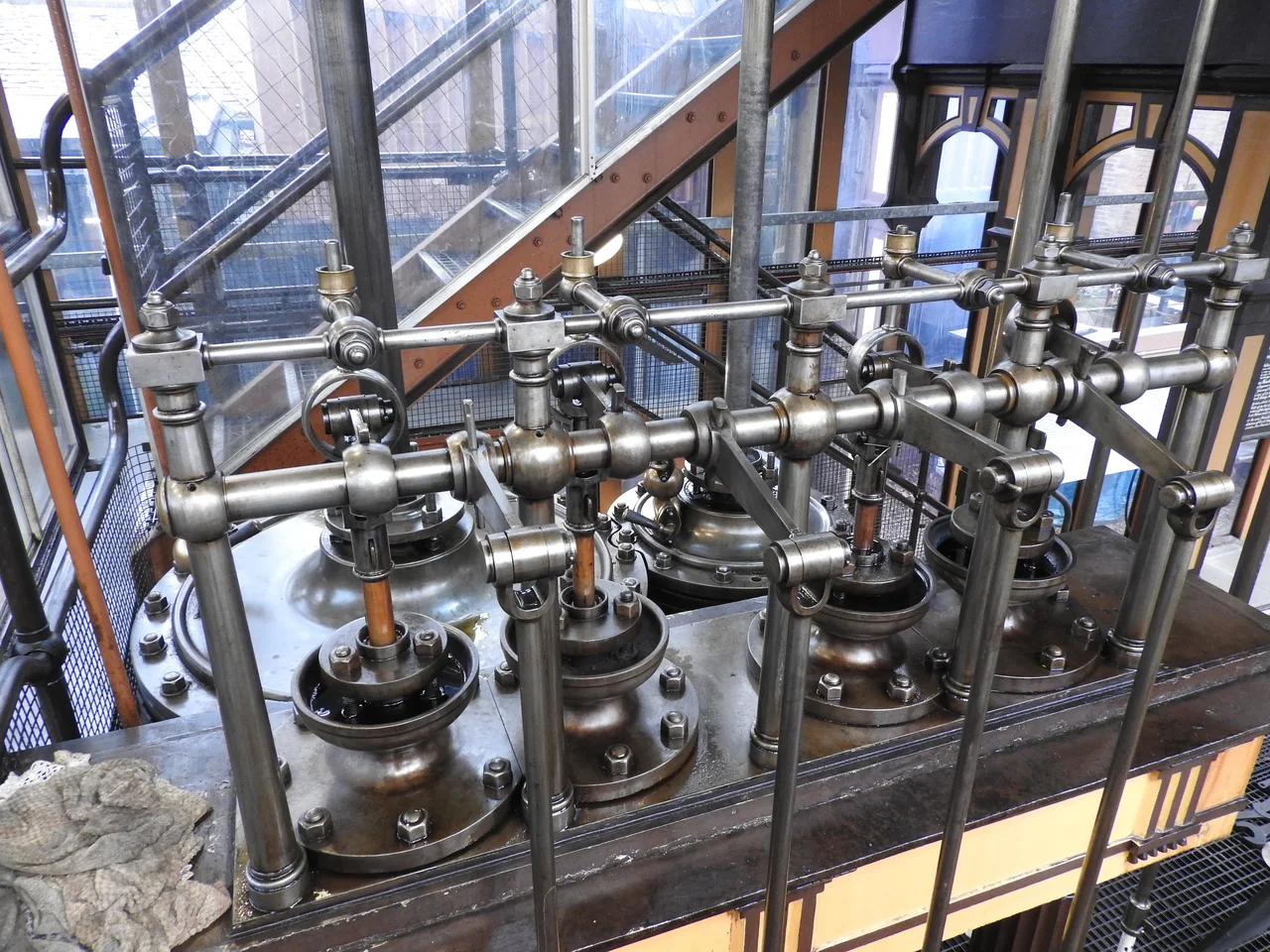
Push through to the Steam Gallery and you meet the Basford Beam Engine, one of a pair built in 1858 by R. W. Hawthorn in Newcastle upon Tyne. It was installed at Basford Pumping Station to lift water 110 feet from the sandstone aquifer below, supplying fresh water to Nottingham until 1965. The volunteers moved it here, fired it again in 1975, and it has been running on steam-up days ever since. Beside it stand two ploughing engines from John Fowler & Co. of Leeds - the very last two production engines the foundry ever made, with consecutive registration numbers - alongside a J. T. Marshall portable engine built at Sandiacre in 1886. Stand close on a steaming day. You can hear the iron speak, feel the hot oil on the air, and watch a piece of industrial history breathe.
The Other Inheritances
Walk through the rest of the building and the Midlands assembles itself in fragments. A coal truck from Clifton Colliery, last used when that mine fed Wilford Power Station on what is now a retail park. A vintage Brough Superior car, sister marque to the motorcycle T. E. Lawrence rode to his death. Thomas Humber's own bicycle. A Standard Fordson and a Field Marshall Series 2 in the tractor yard. Restored radios and gramophones from the 1920s let visitors tap their own Morse code messages. There are items from Boots the Chemist, Players Cigarettes and Stanton Ironworks - companies that once defined the city - and a carved stone crest from Nottingham's first railway station, opened by the Midland Counties Railway in 1839. None of it was built to be admired. It was built to work, and most of it still does.
From the Air
The Nottingham Industrial Museum sits in the stable block at Wollaton Hall, 52.946 N, 1.208 W, about 3 nm west-southwest of Nottingham city centre. Wollaton Park's open expanse and the Elizabethan hall itself make the easiest visual landmark - the parkland surrounded by suburban housing, with the four prominent towers of Wollaton Hall visible from altitude on a clear day. Recommended viewing altitude is 1,500-2,500 ft AGL. East Midlands Airport (EGNX) lies about 8 nm south-west, and Nottingham/Tollerton (EGBN) about 6 nm south-east. The M1 motorway passes 2 nm to the west, providing additional orientation for any aircraft transiting north or south through the area.
Nearby Stories
- Rutland Railway Museum 2.4 km away
- Welbeck Abbey 5 km away
- Lichfield rail crash 6 km away
- Peveril Castle 8.8 km away
- Grantham Rail Accident 11 km away
- Croxden Abbey 11 km away
- RAF Scampton 11 km away
- Leicester Abbey 11 km away