
Nova Lima
Walk through Nova Lima's historic center today and you will find a neighborhood still called Bairro dos Ingleses - the Quarter of the English. Most of the descendants of those original miners have moved on. The Anglican Church they founded, however, still stands. The football club the company built in 1908, Villa Nova Atlético Clube, still plays in the Minas Gerais first division. And the aqueduct the British built to wash their gold - the Bicame - still threads through the old quarter in weathered stone. This city of 87,000 people, 20 kilometers south of the state capital Belo Horizonte, is what happens when a mine becomes the organizing logic of a place.
From Campos de Congonhas
Before it was Nova Lima, this place had three other names in sequence - Campos de Congonhas, then Congonhas de Sabará, then Villa Nova de Lima - before the current form was officially adopted in 1923. The progression reads like a typical mining-district genealogy in colonial Minas Gerais. The original eighteenth-century slave-worked workings gave the place its first name. As the ownership and jurisdiction shifted, so did the name. The final 1923 update was a clean-up in the Brazilian spelling reforms of that era, similar to what happened to nearby Muriahé becoming Muriaé. The town lives today in the mesoregion of Metropolitana de Belo Horizonte, and the microregion shares the capital's name - Nova Lima is effectively a southern suburb now, close enough that families commute daily into Belo Horizonte offices while the old mines keep working below.
The British and Their Town
In 1834 the Saint John Del Rey Mining Company of London bought the Morro Velho mine and set about building a British company town around it. About 150 families came over from Britain to work the mine, manage it, and service its infrastructure. They brought Victorian churches. They brought cricket that never caught on, and football that thoroughly did. In 1908, English staff helped found the Villa Nova Atlético Clube, today the second-oldest football club in Minas Gerais still active. The club dominated state championships from the 1930s to the early 1950s, winning five Campeonato Mineiro titles in that period, and produced two Brazilian World Cup players - José Perácio in 1938 and Luiz Carlos Ferreira, known as Luizinho, in 1982. The quiet English colony in the hills above Rio turned out to be a small but important node in the genealogy of Brazilian football.
The Hole That Never Closes
Morro Velho, the Old Hill mine, reaches 2,700 meters below the surface today - making it one of the deepest mines on Earth, and the oldest continuously worked mine on the planet, in operation since 1725. Alongside Morro Velho, Nova Lima hosts the Mostardas and Rio de Peixe mines. The ore here yields gold principally, but also silver, arsenic, and iron. The city has other economic pillars now - services, commerce, real estate for the wealthy Belo Horizonte commuters who have built gated subdivisions on the hillsides - but mining remains central to its identity and its tax base. The MBR mining company partners with the State Forestry Institute to manage the 912-hectare Mata do Jambreiro Private Natural Heritage Reserve, a small ecological counterweight to the underground work.
Parks Within the City Limits
Nova Lima includes significant protected land within its municipal boundaries. Part of the 3,941-hectare Serra do Rola-Moça State Park, created in 1994, lies within the city. A small portion of the 31,270-hectare Serra do Gandarela National Park, created in 2014, is also here. These parks protect high-altitude cerrado grasslands, remnant Atlantic Forest, and the watershed that feeds much of the metropolitan Belo Horizonte water supply. The Mata do Jambreiro reserve adds another layer of protection. The paradox is visible from the air: an industrial mining town of international scale, surrounded and interspersed with some of the most ecologically important protected areas in central Minas Gerais.
The Historic Center
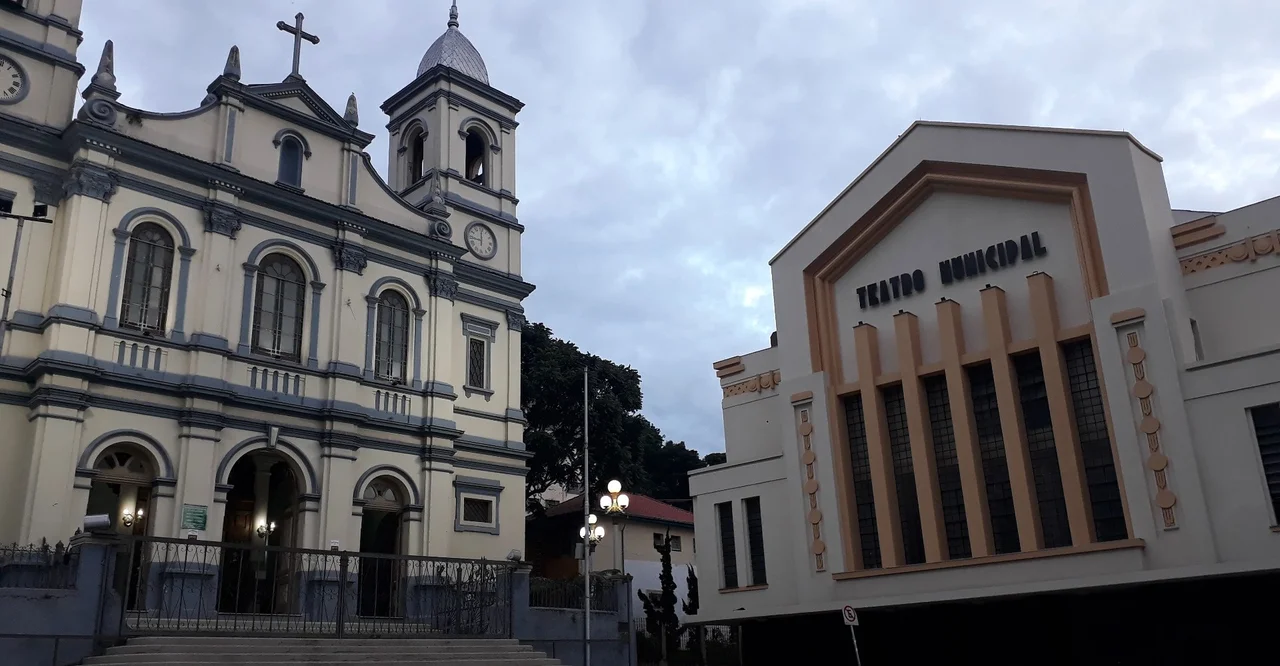
The civic heart of Nova Lima still carries its nineteenth-century bones. The Teatro Municipal sits near the Praça Principal. The Matriz do Pilar church is photographed at night by everyone who passes through. Hospital Nossa Senhora de Lourdes, built during the mining boom years, still serves as a community landmark. The Bicame aqueduct, constructed by the English to wash gold, winds through the old quarter in dressed stone, one of the largest surviving works of colonial-industrial engineering in Minas Gerais. The neighborhood of the English remains, though English is no longer spoken there. The houses once built for British foremen are now occupied by Brazilian families whose grandparents married into the town. What the company created as a foreign outpost has long since become a Brazilian city with a particular accent of memory.
From the Air
19.99°S, 43.85°W. Nova Lima lies 20 km south of Belo Horizonte in the Iron Quadrangle region of Minas Gerais. Recommended viewing altitude 3,500-5,000 m AGL to see the mining scars, the protected state parks, and the dense urban subdivisions in the north. Nearest airports: SBBH (Pampulha) 25 km north, SBCF (Belo Horizonte/Confins) 50 km northeast. Dust haze from active mining sometimes reduces visibility; early morning offers clearest views.
Nearby Stories
- Crucilandia 19 km away
- Sumidouro State Park 25 km away
- Iron Quadrangle 28 km away
- Paraopeba 47 km away
- São Gonçalo do Pará 59 km away
- Robert Quayle (1814 ship) 61 km away
- Serra dos Cocais 64 km away
- Coronel Fabriciano 80 km away