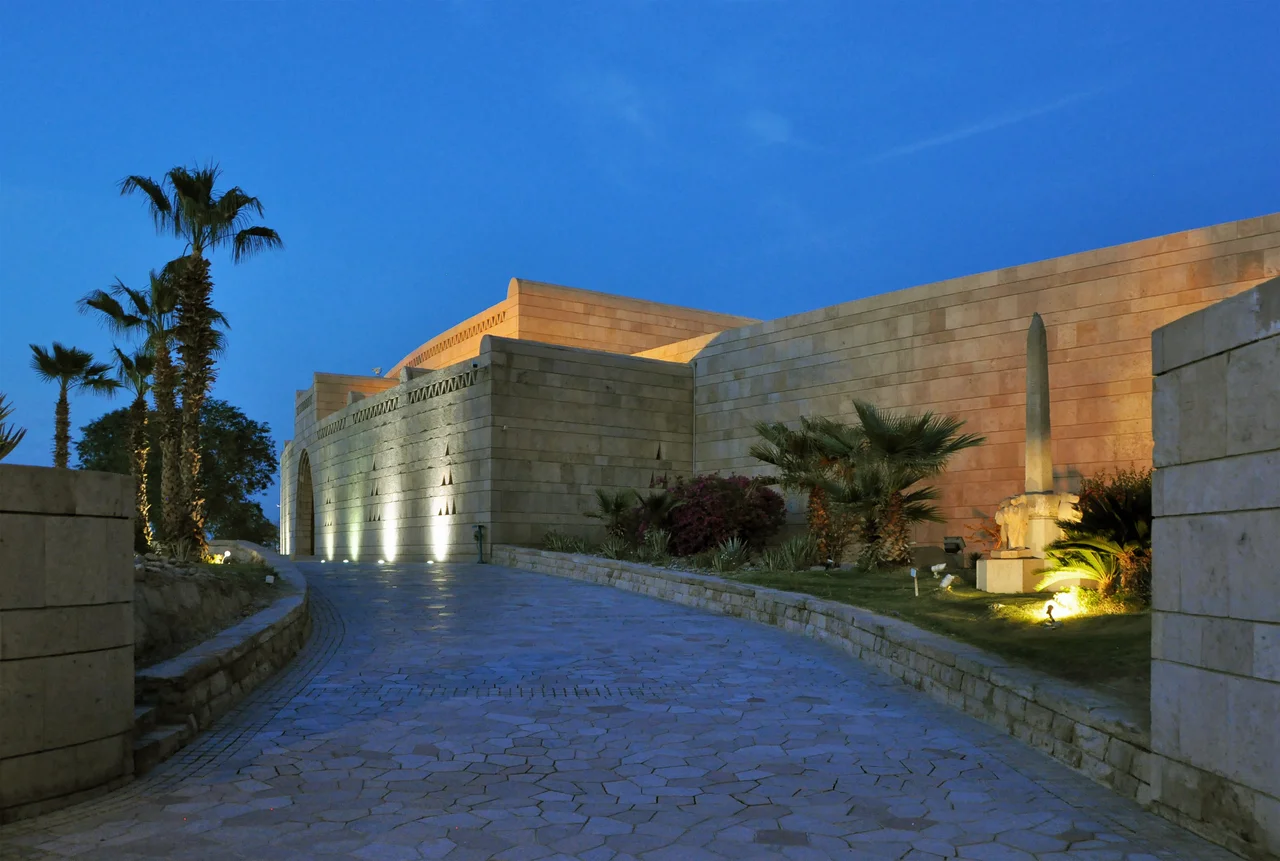

Nubian Museum
A culture cannot be relocated the way a temple can. You can saw a sandstone shrine into numbered blocks and rebuild it on higher ground, but you cannot crate up a way of life, a riverbank, a thousand villages and their accumulated memory. When Lake Nasser swallowed the Nubian homeland in the 1960s, the temples were saved and the world celebrated; the living culture that had surrounded them was scattered to resettlement villages. The Nubian Museum in Aswan, opened in 1997, exists to answer that imbalance. Built into a cliff above the Nile, it is a deliberate act of remembering, a place to hold what the rising water displaced.
Born from a Rescue
The museum's origins trace straight back to the flood. As early as 1960, with the High Dam still under construction, the Egyptian government asked UNESCO to help create a home for the heritage that the reservoir would uproot, part of the same International Campaign to Save the Monuments of Nubia that lifted Abu Simbel and Philae out of the water's reach. It took decades to realize. When the International Museum of Nubia finally opened its doors on the 23rd of November 1997, it gave a shared and permanent address to a history that spans modern borders, reaching up the Nile from Egypt through Sudan toward Ethiopia, a civilization that had never fit neatly inside a single nation.
A Building Shaped Like the River
The architect Mahmoud El-Hakim set the museum on a steep cliff and designed it to harmonize with the slope and the desert color around it, an approach that won the Aga Khan Award for Architecture in 2001. The choice was not merely scenic. The grounds are laid out to evoke the course of the Nile itself, from its distant sources in Ethiopia and Sudan down to Egypt, so that the geography of Nubia is written into the site's very plan. A botanical garden of Egyptian flora surrounds the building, and an open-air section lets monumental pieces stand under the same sky they once knew, while the interior galleries carry the story indoors.
Three Thousand Pieces of a People
Inside, the collection runs through every age the land has seen. Some three thousand antiquities are arranged across geological, pharaonic, Roman, Coptic, Islamic, and Nubian periods. The open-air exhibition holds ninety rare monumental works; the internal halls keep fifty pieces reaching back to prehistory, more than five hundred from the pharaonic era, and well over a hundred each from the Coptic and Islamic ages, alongside a dedicated body of Nubian-era objects and hundreds more telling the history of Aswan itself. Taken together, the display does what no single rescued temple could: it presents Nubia not as a scatter of monuments but as a continuous civilization with its own deep arc.
A Living Institution
The museum was never meant to be only a vault for the past. It works hard to belong to the Aswan around it, opening special hours for local residents, bringing in schoolchildren to learn how research is done and what their ancestors built, and lending its halls for community events and gatherings. The building also houses a documentation center devoted to Nubia, recording the rescue of the monuments and the memory of the villages that vanished. That outward turn matters here in a way it might not elsewhere. The dam displaced somewhere between 90,000 and 120,000 Nubians, scattering hundreds of villages and the farmland that families had worked for generations. For a people whose homeland was submerged and whose communities were dispersed, a museum that hosts the living, rather than merely displaying the dead, becomes something closer to a cultural anchor, a fixed point that says this heritage is studied, honored, and very much still here.
From the Air
Located at roughly 24.08 N, 32.89 E on a cliff above the Nile in Aswan, Egypt, near the southern end of the city and not far from the Aswan Low Dam. Nearest airport: Aswan International (ICAO HESN), about 20 km away. From the air the museum reads as a low sandstone-toned complex set against the rock on the river's east side, surrounded by garden greenery amid the surrounding desert; the Nile, Elephantine Island, and the cataract region lie just to the west. High-visibility desert skies prevail year-round, with possible midday haze in summer.
Nearby Stories
- Temple of Dendur 40 km away
- Edfu 80 km away
- Qasr Ibrim 125 km away
- Wadi Allaqi 150 km away
- Wadi El Gemal National Park 168 km away
- Lake Nasser 173 km away
- Kharga Oasis 212 km away
- Berenice Troglodytica 213 km away