.JPG)
Nunhead Cemetery
From the upper slopes of Nunhead Cemetery, framed by overgrown laurel and ivy-strangled tombs, the dome of St Paul's Cathedral floats above the rooftops of southeast London four miles away. It is one of the strangest and most unexpected views in the capital - cathedral and cemetery, the city's grandest sacred space framed by its most forgotten one. Nunhead is the least-celebrated of London's Magnificent Seven Victorian cemeteries. That is what makes it remarkable.
A Ring of Cities of the Dead
In the 1830s London was burying more people than its parish churchyards could decently accommodate. Bodies were stacked in shallow graves, decomposition fouled water supplies, the smell drifted into neighborhoods that had been respectable. Parliament responded by encouraging private companies to lay out vast new cemeteries on the then-outskirts of London, sufficiently far from inhabited streets to contain the problem. Seven were created, eventually nicknamed the Magnificent Seven: Kensal Green, West Norwood, Highgate, Abney Park, Brompton, Tower Hamlets, and Nunhead. Nunhead was consecrated in 1840, with an Anglican chapel by Thomas Little and monumental gates by James Bunstone Bunning - the same architect who would later design the Coal Exchange in the City. At fifty-two acres it became the second-largest of the seven.
The First and Last to Be Buried Here
The first grave dug at Nunhead, in October 1840, belonged to Charles Abbott, a 101-year-old grocer from Ipswich. The last burial was of a volunteer soldier who had become a canon of Lahore Cathedral - a small detail that says everything about how Victorian London held the world together with imperial threads. In between, in the decade 1868 to 1878, an average of 1,685 burials happened here each year, 1,350 in consecrated ground and 335 in unconsecrated. Among the named dead are Sir Frederick Abel, co-inventor of cordite; the engineer Bryan Donkin, who developed a working paper-making machine and a food-canning process that helped make industrial food possible; the typefounder Vincent Figgins; Sir Charles Fox, civil and railway engineer; the music hall performer Jenny Hill; and Thomas Tilling, the bus tycoon whose name still graced double-deckers into the 1960s.
Elegant Wilderness
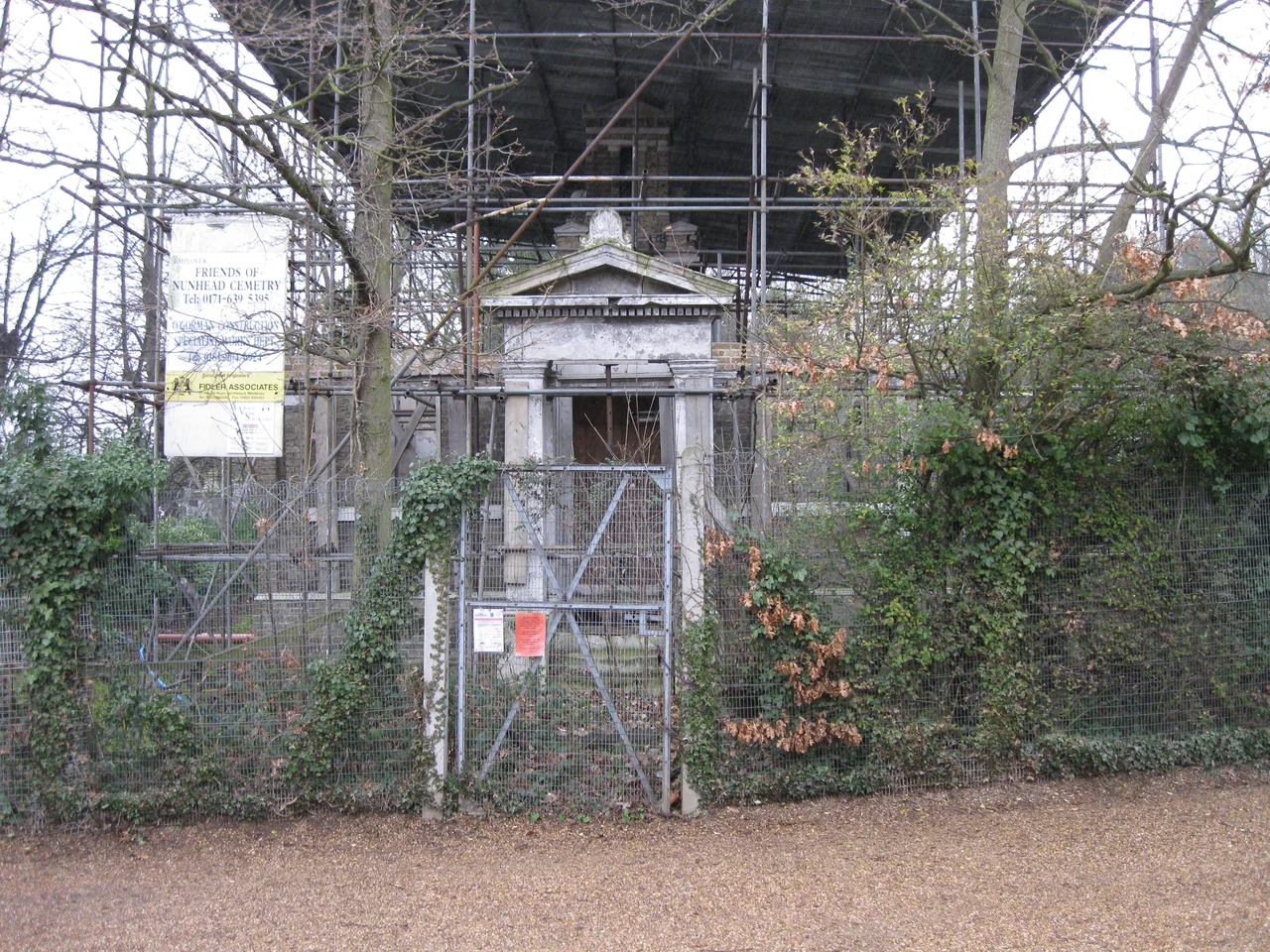
By the middle of the twentieth century the cemetery was full. The United Cemetery Company abandoned it. Without maintenance, lawn became meadow and meadow became woodland. Vandals pulled apart memorials. Tombstones leaned, then fell. Roots cracked open mausoleums. By the 1970s Nunhead was, in the affectionate phrase of local people, an elegant wilderness - a cemetery returning to forest under its own quiet pressure. The Friends of Nunhead Cemetery formed in the early 1980s to fight back. After two decades of fundraising and clearance work, the cemetery reopened in May 2001 following a major restoration project paid for by Southwark Council and the Heritage Lottery Fund. Fifty memorials were brought back from ruin; the Anglican Chapel was made safe. The Victorian core of the cemetery, though, remains gently overrun - a designated local nature reserve and Site of Metropolitan Importance for wildlife, populated by songbirds, woodpeckers, and tawny owls. Foxes use the older paths.
The Scottish Martyrs
Just inside the North Gate, on the right of Dissenters' Road, an obelisk rises from the undergrowth. It is the Scottish Political Martyrs Memorial, the second monument of its kind - the original stands in Edinburgh. It commemorates Thomas Muir, Maurice Margarot, Thomas Fyshe Palmer, and other leaders of the Friends of the People Society who were transported to Australia in 1794 for advocating parliamentary reform. The London memorial was erected in 1851 and 1852 by the radical MP Joseph Hume. A second poignant monument honours nine Sea Scouts who drowned in the Leysdown Tragedy off the Isle of Sheppey in 1912, including twelve-year-old Percy Baden Powell Huxford - named after, but unrelated to, Lord Baden Powell. The original memorial was designed by Sir Giles Gilbert Scott, the architect later responsible for Battersea Power Station and the red telephone box. Most of it was vandalized; the present replacement dates from 1992.
War Graves Among the Trees
Tucked into the cemetery's quiet plots are 592 First World War Commonwealth service burials and 110 from the Second World War. The First World War graves cluster in three plots - 266 in the United Kingdom plot (Square 89), 23 in the Australian plot, and 36 in the Canadian plot, which also holds South African and New Zealand servicemen. Those whose individual graves cannot be marked with headstones are remembered on a Screen Wall memorial inside the cemetery's main entrance. There is also a single Belgian war grave from the First World War. The remains of others were moved here in 1867 and 1933 from the demolished churchyard of St Christopher le Stocks in the City of London. Nunhead is not a place you visit for one reason. It is a place you wander, looking up at the dome of St Paul's between the leaves, reading names you do not know, and feeling the deep cool of a forest that grew where mourners once laid flowers.
From the Air
Coordinates 51.4642 N, 0.0530 W in Nunhead, London Borough of Southwark, southeast London. From altitude look for a roughly oval patch of dense woodland surrounded by residential streets - the cemetery's mature tree canopy makes it stand out from the surrounding urban grid. Nearest airport London City (EGLC) about 5 nm northeast; London Heathrow (EGLL) about 17 nm west. Clear days reveal St Paul's Cathedral and the City cluster about 4 nm to the northwest.
Nearby Stories
- Battle of Britain, Northfleet 1.1 km away
- Bayham Old Abbey 5.4 km away
- Catharine Macaulay 6.4 km away
- Hatfield rail crash 8.8 km away
- Chequers 8.9 km away
- Chelmsford Cathedral 10 km away
- Queen Victoria Hospital 13 km away
- Fishbourne Roman Palace 36 km away