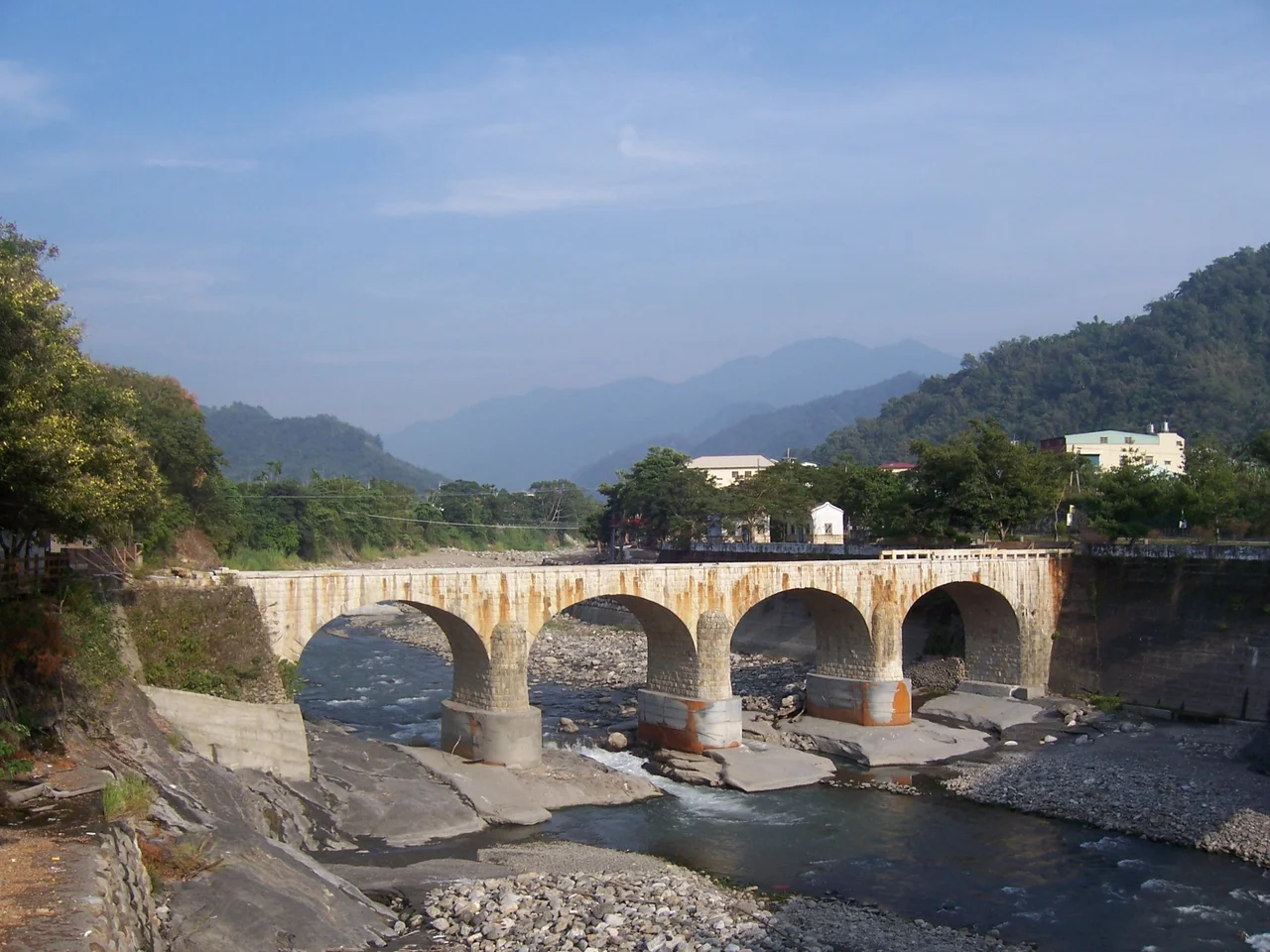

Nuomi Bridge
The mortar holding Nuomi Bridge together is edible — or at least it was, before it set. The builders combined lime with glutinous rice and brown sugar, a technique practiced in Taiwan and across East Asia for centuries, to create a binding agent that hardened slowly but proved remarkably durable. "Nuomi" means glutinous rice in Mandarin; the bridge is named for what holds it up. Completed in 1940 in the mountains of Guoxing, Nantou County, during Japan's colonial rule of Taiwan, this masonry arch bridge has stood through decades of floods, typhoons, and a magnitude 7.3 earthquake. The recipe, it turns out, was reliable.
A Military Road, a Missing Bridge
Before 1940, the Beigang River at this location was crossed by a simple wooden bridge — serviceable enough for everyday traffic, but not what the Imperial Japanese Army Air Service had in mind. During Japan's rule over Taiwan, military planners wanted to shorten travel time between two airfields: one at Tōsei, now known as Dongshi, and one at Hori, now known as Puli. A new road was cut through the mountainous terrain of central Nantou to connect them, and that road required a proper crossing of the Beigang River, one of the headwaters of the Dadu River, near Beigang Village. A wooden bridge would not carry military traffic reliably through a mountain environment. A masonry bridge would. The decision to build in stone reflected both the military importance of the route and a practical reality: when the Japanese built infrastructure in Taiwan's interior, they built it to last.
Rice and Stone
The construction of Nuomi Bridge posed a logistical problem. Beigang Village in the 1930s was isolated — no ready supply chains, no easy access to manufactured cement. The Japanese builders solved this with traditional materials. Stone was quarried from the nearby hills southwest of the village. The mortar was made the old way: lime slaked from locally available limestone, combined with glutinous rice and brown sugar. Sticky rice mortar, as this mixture is known, is not a folk curiosity. It has been used in construction across East Asia for centuries, including in sections of the Great Wall of China and in Taiwanese fortress and temple construction. The rice paste fills gaps and adds binding strength; the sugar slows the setting process, allowing the mortar to flow and adhere more thoroughly before it hardens. Local laborers did the work, using materials that the surrounding landscape provided. What they produced has outlasted most of what was built around it.
What Floods and Earthquakes Left Standing
A bridge in a mountainous river valley in Taiwan faces considerable adversity. The Beigang River rises fast in typhoon rains, carrying heavy sediment loads and enough force to move boulders. The 921 earthquake of September 1999, whose fault rupture occurred just a few kilometers to the west, subjected the bridge to severe shaking. Nuomi Bridge survived both. According to Liberty Times reporting from 2021, the bridge withstood flood damage that tested its foundations and remained structurally sound. The survival is a modest vindication of traditional construction: the sticky rice mortar, the hand-set stone, the arch form that distributes load efficiently — all of it held. The bridge is now classified as a protected monument in Nantou County, recognized for its historical and technical significance. Restoration work in the early 2000s repaired flood damage and stabilized the structure, and the surrounding area has been developed as part of the Guoxing scenic corridor.
A Small Bridge, A Long Story
The Nuomi Bridge spans the Beigang River near Beigang Village — not a grand crossing, but an intimate one. The arch is low and elegant, the stone fitted tightly, the whole structure scaled to its mountain setting. What gives it weight beyond its size is the layering of histories it carries. There is the pre-colonial history of mountain transit and river crossing. There is the Japanese colonial period, with its infrastructure ambitions and its military logic. There is the traditional knowledge of sticky rice mortar, preserved by local laborers who built in the only way available to them. There is the earthquake and the floods, and the fact that the bridge is still here. Visitors walking across it today are following a route that Japanese army planners surveyed in the 1930s, held together by a recipe that is far older than any of them.
From the Air
Nuomi Bridge is located at approximately 24.06°N, 120.91°E in Guoxing Township, Nantou County, in the mountainous interior of central Taiwan. From altitude, the Beigang River valley is visible as a narrow green corridor cutting through the forested hills east of the Taichung basin. Taichung International Airport (RCMQ) is approximately 35 km to the west-northwest; flying east from RCMQ at 6,000–8,000 feet, the terrain rises steadily as the flat basin gives way to the Nantou foothills. The Puli basin — a landmark in its own right — is visible approximately 10 km to the southeast. Nuomi Bridge itself is small and tree-canopied, best appreciated on a low-altitude pass of 1,500–2,500 feet over the Beigang River valley in clear conditions.
Nearby Stories
- Shigang Dam 2.7 km away
- Taixi, Yunlin 4.9 km away
- Xitou Nature Education Area 7.2 km away
- Lintianshan Forestry Culture Park 11 km away
- Taroko National Park 20 km away
- Smangus 36 km away
- China Airlines Flight 611 56 km away
- Taiwan Strait 69 km away