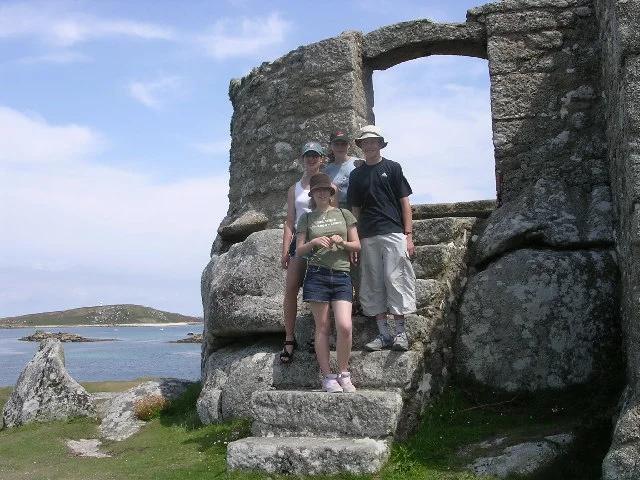

Old Blockhouse
On a rocky knuckle above Old Grimsby harbour, three squat stone walls hold the shape of a vanished gun platform. This is the Old Blockhouse, raised between 1548 and 1551 under the young king Edward VI as part of a hurried Tudor effort to bolt the back door of England against a French invasion that never quite came. The cannons it was built to fight stayed silent for a century. Then, in April 1651, the guns finally spoke - not against the French, but against a Parliamentary fleet sent to crush the last Royalist holdouts of a civil war. The fort is one of the very few coastal defences in England ever to have actually fought.
Edward's Worry
Henry VIII had built artillery castles around England's southern coast in the 1530s and 40s, alarmed by the long-range cannons that were starting to outclass medieval walls. When Henry died and his nine-year-old son Edward VI inherited the throne, his ministers continued the work. A survey of the Isles of Scilly concluded the islands were dangerously exposed. From here, a French force could threaten the western approaches and the Cornish coast. Tresco, the second largest island, needed two new forts - one at the western harbour and one above Old Grimsby on the east. The Old Blockhouse, with a square gun platform for two or three artillery pieces, was the eastern half of that plan. Funds were tight. Between 1548 and 1552 the Crown spent £3,123 on Scilly's defences before pulling the plug. The fort was completed; the larger plan was not.
The Fight Above the Harbour
After the English Civil War, the Scilly Isles became the unlikely last redoubt of the Royalist cause. The islands sheltered privateers who preyed on Parliamentary shipping, and there were rumours that the Dutch might seize the archipelago as a base against England. In April 1651, Parliament sent Sir Robert Blake with a naval task force to retake them. Blake's first landing party rowed for the wrong island and had to be recalled to the ships. The second landing met fierce resistance, and the gunners at the Old Blockhouse turned their cannons on the boats coming ashore at Old Grimsby. They could not win the fight. Blake's heavier naval guns outranged the fort, and after hours of exchange the blockhouse was taken. It had defended the harbour for a single day after a hundred years of waiting. Parliament soon rechristened it the Dover Fort in surveys, and kept a garrison and a battery of guns there until at least the 1750s.
Slow Decay, Quiet Rescue
When the Duke of Marlborough sent Christian Lilly to inspect the Scilly defences in 1715, the engineer found the blockhouse "very much decayed," only the walls still standing. He recommended £28 in repairs and the addition of windows and a fireplace so the troops could actually live there. By the end of the 18th century the cannons were gone, the platform was empty, and the building was a ruin again. The islands changed hands - leased to the Godolphin family, then to the Smith dynasty in 1831, and tended by their successors the Dorrien-Smiths through the Victorian and Edwardian decades. In 1922 Arthur Dorrien-Smith placed the blockhouse into state guardianship. It survived because nobody needed the stone for anything else.
What Remains
Walk out from New Grimsby across Tresco and follow the coast path north-east, and the Old Blockhouse comes into view above the small curve of Old Grimsby beach. The square platform that held the guns is roofless now, its rubble walls weathered to the same grey as the boulders below. The view it commands is unchanged: the entrance to Old Grimsby harbour, St Helen's Pool and its tidal anchorage to the north, the open Atlantic beyond. The cannons that swung here in 1651 are long melted down. The platform they sat on is still pointing at the channel they were meant to defend, and on a windy April day, with the sea grey and white below the walls, it is not hard to picture Robert Blake's boats coming in.
From the Air
Coordinates 49.9585°N, 6.3275°W, on the northeast coast of Tresco in the Isles of Scilly. Best viewed at 1,000 to 2,000 feet AGL, with Old Grimsby harbour as the key visual reference. The fort sits on a rocky promontory just north of the harbour entrance and is visible as a small square outline of grey stone. Nearest airport is St Mary's (EGHE), about two nautical miles south-east across the lagoon. Land's End Airport (EGHC) is roughly 28 nm east-northeast on the mainland. Tresco is private but the coast path is open; expect Atlantic gusts and rapid weather changes.
Nearby Stories
- Penlee lifeboat disaster 5.8 km away
- SS Georgia (1890) 18 km away
- Great Wheal Charlotte 28 km away
- 1979 Fastnet Race 37 km away
- Wheal Coates 66 km away
- SM U-27 93 km away
- HMS Affray 151 km away
- Tower of Hercules 719 km away