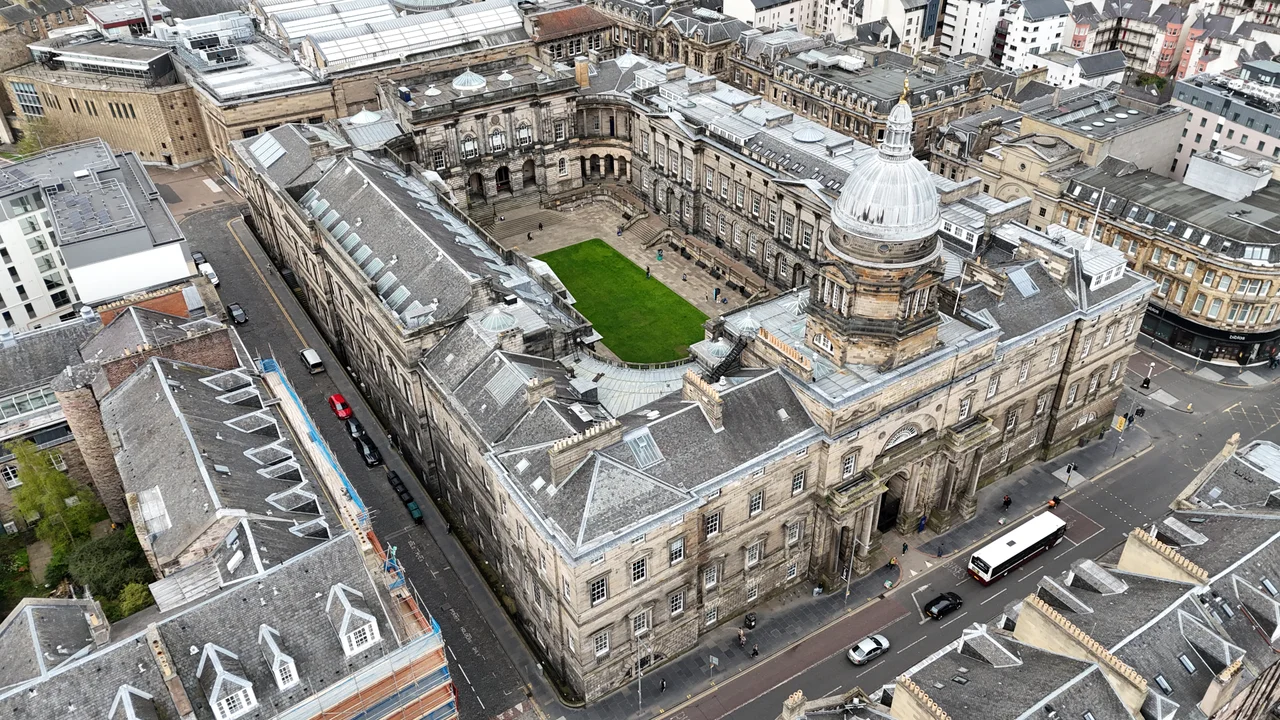

Old College, University of Edinburgh
On the roof of the Old College, a gilded bronze figure of a naked youth holds a torch above Edinburgh. The figure marks the apex of the dome, and the dome was added almost a century after the foundation stone was laid. Below it sits one of the great neoclassical buildings of Britain, designed by Robert Adam in 1789, abandoned when Adam died and the wars came, finished by William Henry Playfair in the 1820s, and finally crowned with its dome in 1887. Nothing about this building happened on schedule. The result is still one of Edinburgh's most beautiful courtyards.
Tounis College
The University of Edinburgh's origin lies in a royal charter granted by King James VI of Scotland in 1582 to the city's town council. The result, the Tounis College, was so called because it was a civic foundation rather than a royal one. James himself visited in 1617 and proposed the name King James's College, which became official, but the older title clung on. By 1763, the university was internationally famous. The buildings, however, were a mess. Centuries of patching had produced a warren of inadequate teaching rooms and rotting timbers on the site of the former Kirk o' Field collegiate church - the same Kirk o' Field where, in 1567, Lord Darnley had been murdered, sending Mary, Queen of Scots, into a crisis that ended her reign.
Shaming the Burghers
Reform took decades. Principal William Robertson warned of dilapidation. A 1768 pamphlet called for subscriptions and was ignored. Then, in 1784, the city decided to build South Bridge across the Cowgate, cutting through the College Gardens. In a December letter that year, classics professor Andrew Dalzell wrote with characteristic Enlightenment bluntness: it had been decided to build the bridge between the College and the Infirmary, and once the posteriors of the College were exposed to public view, people would be shamed into building a new College. The shaming worked. In 1789 taxes were raised to fund a new building. Robert Adam, Scotland's most famous architect, designed it.
Adam, Death, and the Anatomist's Stone
Adam's plan was sweeping: a main entrance from South Bridge into a First Court, then a square Great Court ringed with halls and lecture rooms. The foundation stone was laid on 16 November 1789 not by a mayor or a duke but by Professor of Anatomy Alexander Monro, secundus, the second of three generations of Monros to hold the same chair. Monro's new Anatomical Theatre came into use in October 1792. Roofs were still incomplete. Then Adam died in 1792, the Napoleonic Wars broke out, the Doric columns of the South Bridge portico went up, and the money ran out. By 1793 all work had stopped. The half-built college sat exposed for the next twenty-two years.
Playfair Finishes the Job
In 1815 fresh funds were raised. Nine architects submitted proposals. The commission went to William Henry Playfair, who would shape much of Edinburgh's neoclassical core. Playfair stayed faithful to Adam's vision but simplified it, combining the two planned courts into a single large quadrangle. By 1827 the building was virtually complete, except for the library and the dome that Adam had proposed at the east end. The library opened a few years later. The dome was left out as a cost saving. It would remain absent for sixty years until 1887, when Sir Robert Rowand Anderson designed the present version, funded by a donation from the Gorgie industrialist and politician Robert Cox. The Figure of Youth on its summit, sculpted by John Hutchison, was added at the same time.
The Quadrangle Today
What was once called the New College became the College, and in the early 20th century, after the Free Church College of 1843 took over the title New College on the Mound, this building became Old College. It now houses parts of the University's administration, the Edinburgh Law School, and the Talbot Rice Gallery. The courtyard itself was unfinished even at the building's nominal completion, and only in 2011 was it paved properly, in honey-coloured Hazeldean sandstone chosen to match the original Craigleith stone. Sir Robert Lorimer's bronze war memorial of 1922, sculpted by Pilkington Jackson the following year, anchors the west end. On graduation days, the quad fills with families and gowns and falling rain, and the Figure of Youth keeps holding his torch.
From the Air
Coordinates 55.9476 N, 3.1866 W, on South Bridge in Edinburgh's Old Town, half a mile southeast of Edinburgh Castle. The distinctive green-bronze dome topped with the gilded Figure of Youth is identifiable from the air at lower altitudes. The building forms a complete neoclassical quadrangle with porticoed entrance facing South Bridge. Edinburgh Airport (EGPH) lies about 8 nm west. The Royal Mile runs immediately north, and the National Museum of Scotland sits two short blocks south on Chambers Street. Best viewed at 2,000 to 4,000 feet AGL in clear conditions.
Nearby Stories
- Ardoch Roman Fort 2.2 km away
- Craignethan Castle 3.1 km away
- Haddington 3.8 km away
- Balvaird Castle 4.3 km away
- Battle of Kilsyth 9.4 km away
- Siege of St Andrews Castle 9.9 km away
- Neidpath Castle 11 km away
- Melrose Abbey 15 km away