.jpg)
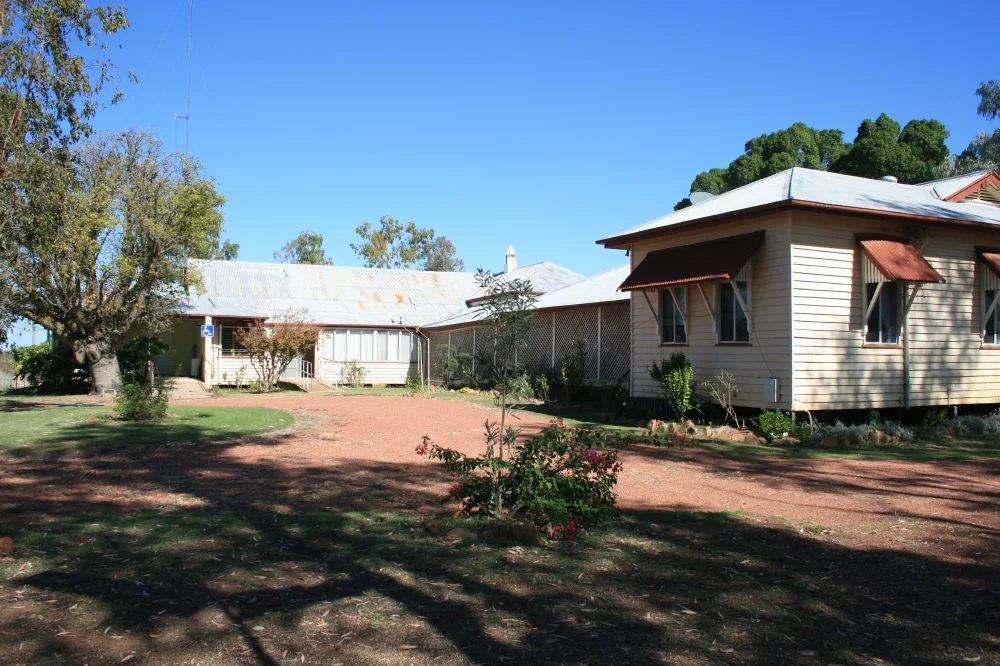
Old Isisford District Hospital
In October 1892, the people of a remote Barcoo River town advertised for a head nurse and a single male helper. That small notice opened the doors of the Isisford District Hospital - a timber-framed, corrugated-iron building that would carry the medical hopes of a whole pastoral district for the next 118 years. Out here, the nearest large town was days away by horse and dray. When a shearer was crushed in the yards or a mother went into labour through the night, this modest building on St Agnes Street was the only help for a hundred kilometres in any direction.
Built by Need, One Ward at a Time
The hospital grew the way the town grew - slowly, and only when it had to. The original 1892 building was joined by a female ward in 1909, a maternity ward in 1924, a morgue and operating theatre in the 1950s, and a kitchen extension in 1961. Each addition is a small monument to changing times: new health practices, new government rules, and the simple arithmetic of more people needing more care. The Isisford maternity ward survives as one of the most intact standard maternity wards of its kind in Queensland, a rare window into how outback women gave birth before the age of the flying doctor and the regional referral.
Medicine at the End of the Line
Western central Queensland is a hard place to be sick. Summers bake past 40 degrees, dust storms swallow the horizon, and floods can cut the roads for weeks. For most of its life this hospital answered all of it with a handful of staff, a wood-fired stove, and rooms that breathed through louvres and wide verandahs rather than air conditioning. It functioned as a full hospital until 1970, then carried on as a clinic until 2011 - keeping a thread of professional care stitched into a town that, even at its peak, held only a few hundred people.
The Town That Needed a Hospital
By the time the hospital opened, Isisford had earned one. The pastoral economy pushed south along the Barcoo, drawing drovers, teamsters, and shearers as wool production swelled through the 1880s. The railway crept inland from Rockhampton, reaching Jericho in 1885 and Barcaldine in November 1886 - each stage shortening the distance between this isolated district and the wider colony, and each carrying more workers into country that could break a body fast. A town of a few hundred could not lean on a city's infirmary days away. It needed its own, and the people who advertised for that first head nurse in 1892 were making a statement of intent: we are staying, and we will look after our own.
What the Timber Remembers
Added to the Queensland Heritage Register on 9 September 2014, the complex is valued not for grandeur but for honesty. It is a textbook example of how a Queensland district hospital evolved from the 1890s onward, its growth rings legible in the joinery and rooflines. The original 1892 building, the 1909 female ward, the 1924 maternity ward, the mid-century theatre and morgue, the 1961 kitchen - read in sequence, they trace the changing needs of a developing community and the slow tightening of the rules that governed how the bush was cared for. The hospital was the human cost of the wool boom made visible: the place where the bodies worn out by distance and labour were patched up, or laid to rest.
From the Air
The old hospital stands at 6 St Agnes Street in Isisford, at 24.26°S, 144.44°E, a low timber-and-iron complex among the town's grid of streets on the south bank of the Barcoo River. From the air it reads as part of the small cluster of tin roofs set against open plains; a recommended viewing altitude of 2,000–4,000 ft AGL in clear conditions frames the town and the green river line together. The nearest sealed airfields are Longreach (YLRE, about 120 km north) and Blackall (YBCK, roughly 110 km east). Isisford has a local airstrip for light aircraft. Visibility across the flat country is excellent in the dry season; morning light best reveals the building's verandahs and corrugated rooflines.
Nearby Stories
- Alice River (Barcoo River tributary) 6.1 km away
- Wellshot Station 25 km away
- Yaraka 39 km away
- Lochern National Park 49 km away
- Welford National Park 62 km away
- Blackall, Queensland 64 km away
- Bladensburg National Park 176 km away
- Cheepie, Queensland 225 km away