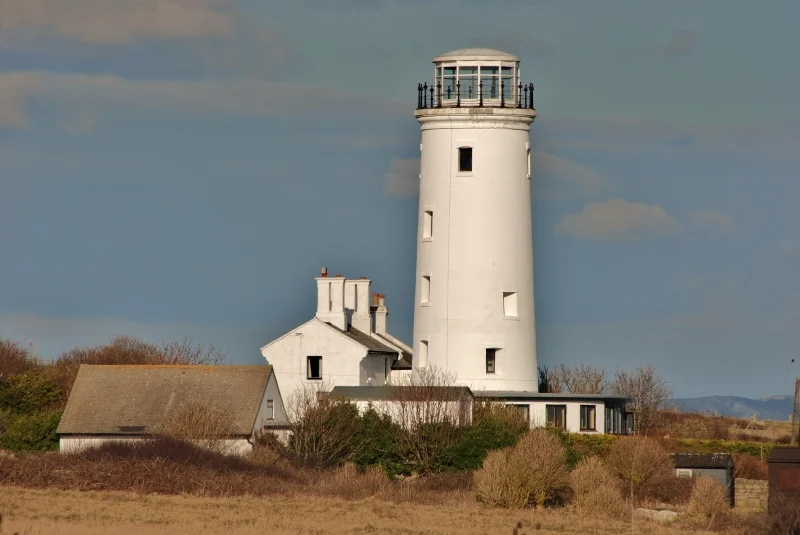

Old Lower Lighthouse
In 1789, a Weymouth builder named William Johns set up scaffolding on a low ledge at the southern tip of Portland and demolished a perfectly serviceable seventy-three-year-old lighthouse. He was rebuilding it for one reason: an inventor named Thomas Rogers had been experimenting with glass lenses set into lighthouse windows, and Trinity House had decided to try them here. The lenses Rogers installed worked. They were the first time anyone, anywhere, had used glass optics to focus a working lighthouse beam. They didn't last more than a few years - but they began something that every lighthouse in the world would eventually adopt.
A Petition Won at Last
Sailors had been begging Trinity House for lights at Portland Bill since the late seventeenth century, and Trinity House had been refusing them. The coast was famously dangerous - the Shambles sandbank, the tidal race, the long line of Chesil Beach that swallowed ships in storms - but the great corporation of pilots and naval-supply officers in London insisted that lighthouses encouraged careless navigation. They were finally overruled. George I granted the patent on 26 May 1716, authorising the construction of two round stone light-houses upon Portland, in the County of Dorset, distant about two-thirds of a mile from the Bill of Portland. The Old Higher Lighthouse went up on Branscombe Hill. The Lower stood closer to the cliff edge on land less steep. Together they gave mariners a leading-line into the safer water east of the Shambles.
The First Lenses
By 1789 the Lower Lighthouse needed rebuilding, and Trinity House saw a chance to experiment. Thomas Rogers had been working with what would later be called dioptric optics - lenses ground to focus a divergent flame into a tight, directional beam - and the Lower was made his test rig. William Johns built the tower; Rogers installed his glass into the lantern. For a few years, Portland Bill operated the world's first lensed lighthouse. The technology was crude by later standards and the lenses came back out after a short trial. But the principle had been proved, and within fifty years Augustin-Jean Fresnel in France had refined the idea into the Fresnel lens, which would dominate lighthouse engineering for the next century and a half. The Lower had been the experimental first step.
Improvement and Obsolescence
In 1824 Trinity House upgraded both lights again: the Higher was given a revolving mechanism while the Lower stayed fixed but considerably brighter. In 1869 both towers were rebuilt once more, this time each fitted with a large first-order fixed optic designed by the engineer James Chance - the founder of the firm that would supply most of Britain's lighthouse optics for the following century. The tower visible today dates from this 1869 rebuild. It served only thirty-six years in this final form. By 1905 Trinity House had completed a new combined lighthouse at the very tip of Bill Point, and both the Old Higher and Old Lower were retired. The Lower, located on a smaller plot with no quarters worth keeping, drifted into an unhappy half-century of mixed civilian uses.
Tea Gardens and Empty Years
During the First World War, the disused lighthouse housed the Longstone Ope Tea Gardens - the kind of seaside enterprise that briefly thrived along every English coast before the war narrowed leisure considerably. The building also served as a family home in this period. After the Second World War it sat empty, derelict, gradually slumping into the cliff. The lantern that had once held Rogers's experimental glass stared out over the Channel without purpose. The headland it stood on was busier than ever - the cliffs of Portland Bill were already a destination, and the strip-field system between here and Southwell still showed the Anglo-Saxon land divisions - but the building itself had no work to do.
A Bird Observatory
In the 1950s a small group of ornithologists started visiting Portland to study the migrating birds that funnel down the headland each spring and autumn. They needed somewhere to base themselves. Helen Brotherton and her family stepped in: she purchased the lighthouse and her family helped fund the conversion to give the ornithologists a permanent home. In March 1961, Sir Peter Scott - the conservationist who had co-founded the World Wildlife Fund a few months earlier - officially opened the Portland Bird Observatory and Field Centre. The lighthouse has been a bird observatory ever since, the oldest such station on the south coast and one of the busiest in the country. The building that pioneered focused light now focuses on movement: tens of thousands of warblers, pipits, finches, raptors and rarities, ringed and recorded each year by people who keep coming back to the same windswept rock.
From the Air
50.5197°N, 2.4511°W on the eastern flank of Portland Bill, near the southern tip of the Isle of Portland. The tower is visible from the air as a smaller white-painted lighthouse just inland of the current Portland Bill Lighthouse. Nearest aviation reference is Bournemouth (EGHH) about 31 nm east. Best viewed at 1,500-2,500 ft AGL on a westerly approach across Portland Harbour; the three Portland lighthouses (the new one at Bill Point, the Old Higher inland on Branscombe Hill, and this Old Lower) form a triangle that's recognizable from any reasonable altitude.
Nearby Stories
- Needles Lighthouse 18 km away
- Lyme Bay Canoeing Disaster 19 km away
- HMS Formidable (1898) 19 km away
- National Motor Museum, Beaulieu 22 km away
- Sherborne Castle 22 km away
- Muchelney Abbey 24 km away
- German Submarine U-672 29 km away
- Battle of Cherbourg (1864) 58 km away