
Old Parliament House, Canberra
On the day the building opened in 1927, an uninvited man stood among the dignitaries on the lawn. Jimmy Clements, a Wiradjuri elder some called King Billy, had walked roughly a week from Brungle mission to be there - not to celebrate, but to assert what he described as his sovereign rights to the land the new Parliament now occupied. He was one of only two Aboriginal people present as the Duke of York unlocked the front doors with a golden key and Dame Nellie Melba sang. Nearly a century later, the lawn in front of this white, low-slung building remains contested ground. The Aboriginal Tent Embassy, pitched here in 1972, is now the longest continuous protest for Indigenous land rights anywhere on Earth.
Built to Be Temporary
Old Parliament House was never meant to last. Designed by the Commonwealth's chief architect John Smith Murdoch - who privately thought the whole project a waste of money - it was officially "provisional," intended to serve for a maximum of fifty years until something grander could be raised. Murdoch worked in a restrained Stripped Classical style: no columns, no pediments, just the orderliness and symmetry of those forms reduced to their bones. Construction began in 1923 and the building effectively doubled the population of the tiny, dispersed town of Canberra. The workers and their families lived in camps, enduring the capital's harsh weather. The final cost ran to about £600,000 - more than three times the original estimate, a fitting overture for a parliament.
Red Chamber, Green Chamber
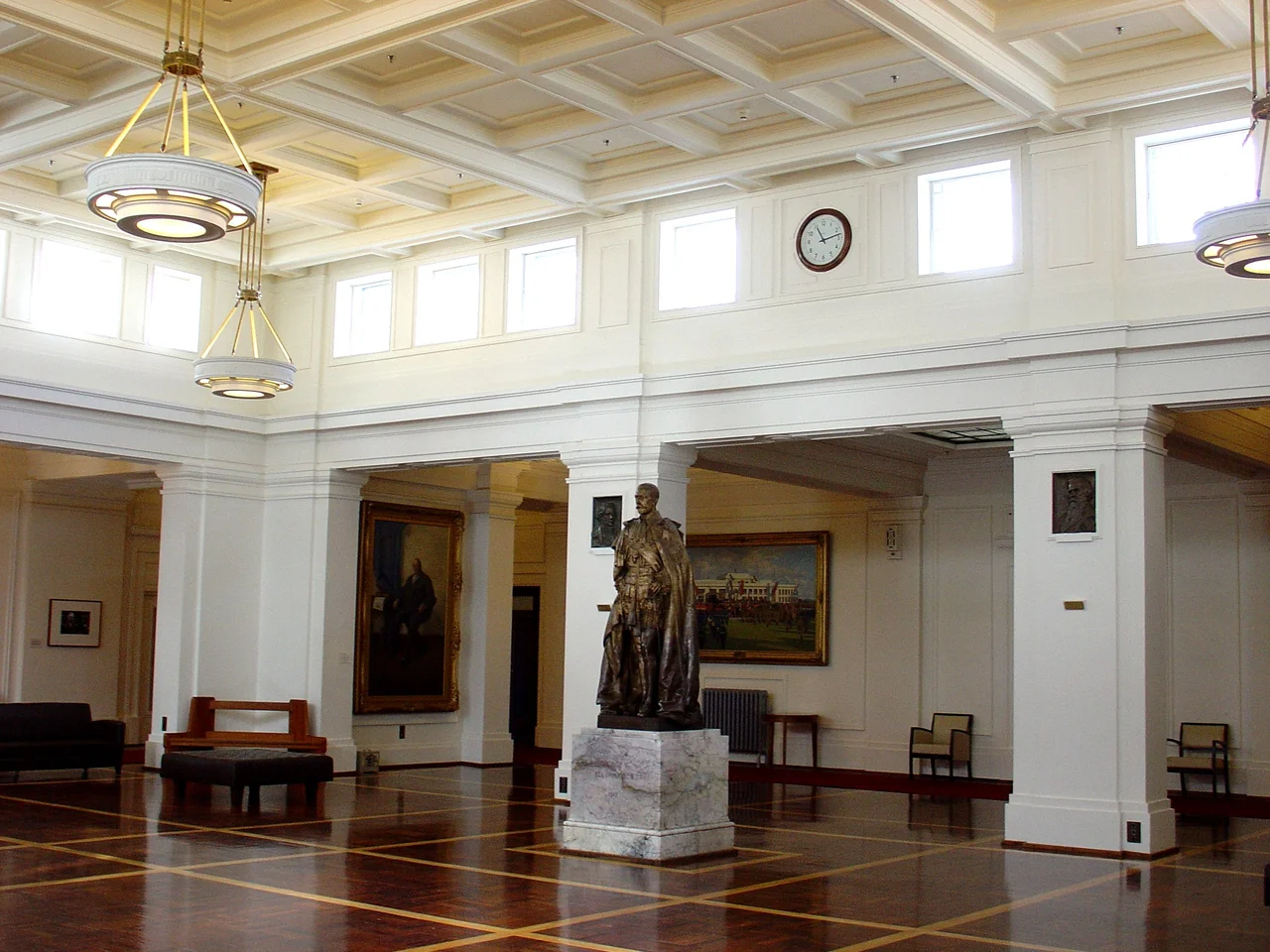
Inside, the building speaks in colour and timber. At its centre is King's Hall, lit from above through clerestory windows, its floor laid in jarrah and silver ash, dominated by a bronze statue of King George V. To one side lies the Senate, draped in the deep red of the upper house in the Westminster tradition; to the other, the House of Representatives in House of Commons green. The chambers are panelled in Australian black bean and Tasmanian blackwood, and the carpets are woven with patterns of eucalyptus leaves and wattle. The Speaker's Chair is a copy of the one in the British Commons - and when an air raid destroyed the London original in the Second World War, Australia gave Britain a replacement carved from this very design.
Where History Happened
For sixty-one years, the nation's defining moments unfolded in these rooms. Australia declared war on Germany and Japan here. Prime Ministers John Curtin and Ben Chifley lay in state in King's Hall. And on 11 November 1975 came the most extraordinary scene of all: after the Governor-General dismissed the Whitlam government, an official read the proclamation of Parliament's dissolution from the front steps. Gough Whitlam, deposed, turned to the crowd and delivered a line now burned into the country's memory - "Well may we say God save the Queen, because nothing will save the Governor-General." The steps of this modest building had become the stage for a constitutional crisis that Australians still argue about today.
A Museum of Democracy
By the 1980s the provisional building was bursting and worn, and Parliament finally moved to its permanent home on Capital Hill in 1988. The question then was whether to demolish it. Walter Burley Griffin himself had objected to its placement decades earlier, complaining it blocked the grand vista and was like "filling the front yard with outhouses." But its weight in the nation's history won out, and in 2009 it reopened as the Museum of Australian Democracy. The story is not always gentle. In December 2021 the historic front doors were badly burned in fires lit during protests - condemned by the very Tent Embassy whose name the protesters had invoked - and repairs ran past 5.3 million dollars. The building endures, scorched and restored, still telling the messy story of how a country governs itself.
From the Air
Old Parliament House stands within Canberra's Parliamentary Triangle at about -35.3022, 149.1297, on the southern side of Lake Burley Griffin. From the air, identify the long, low white building on the land axis, directly between the lake and the much larger new Parliament House with its towering flagpole on Capital Hill behind it - the two are deliberately aligned, with the Australian War Memorial completing the axis across the water to the northeast at the foot of Mount Ainslie. Best viewed at 1,500-2,500 ft AGL. This sits inside the restricted airspace over the Parliamentary Triangle; consult NOTAMs and Canberra's control zone. Canberra Airport (YSCB / CBR) lies roughly 5 km east. The Kings Avenue and Commonwealth Avenue bridges frame the Triangle on the lake.
Nearby Stories
- Mount Kosciuszko summit trails 69 km away
- Hive shipwreck 79 km away
- Snowy Mountains Scheme 89 km away
- Wollongong 119 km away
- Murray River 179 km away
- Royal National Park 191 km away
- Warangesda Aboriginal Mission 250 km away
- 2003 Fiordland Earthquake 1800 km away