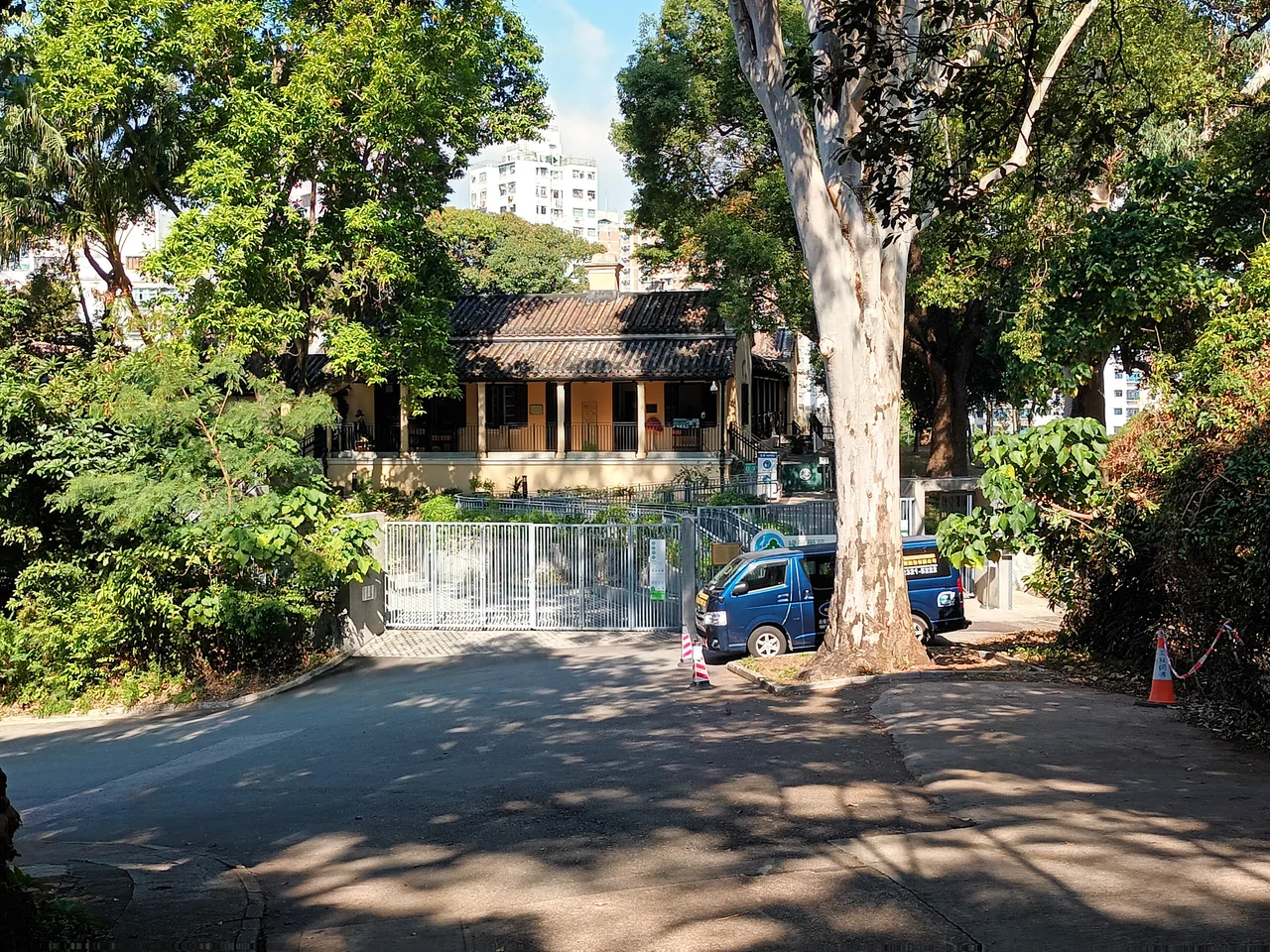

Old Tai Po Police Station
The British signed the Convention for the Extension of Hong Kong Territory in June 1898, acquiring a 99-year lease on the New Territories from China. Within twelve months, they had built a police station on the hill above Tai Po Wan to enforce that lease. That urgency says something about priorities: before roads, before schools, before much else, there needed to be a station. The Old Tai Po Police Station, constructed in 1899, was not just the first police station in the New Territories. It was, for a time, the first police headquarters — the administrative nerve centre of British law over an entirely new territory.
A Station on the Hill
The site chosen was Wan Tau Tong Hill above the old market town of Tai Po — today known as Flagstaff Hill — a position that gave the station commanding views over the surrounding district. The address is No. 11 Wan Tau Kok Lane, and the building sits near what became the Old District Office North, another early colonial administrative structure. The architecture reflects the practical aesthetic of British colonial construction in the region at the turn of the twentieth century: solid, functional, designed to project authority in a landscape that the administration was only beginning to map. For the New Territories' first decades under British administration, this cluster of buildings on the hill constituted the visible face of government for much of the surrounding countryside. What happened below — in the markets, the walled villages, the farming communities of the river valleys — was administered, at least nominally, from here.
A Century of Use
The Old Tai Po Police Station remained in active service for the better part of a century, witnessing the transformation of Tai Po from a rural market town into one of the New Territories' larger new towns. The Tolo Harbour waterfront below changed dramatically over those decades, with land reclamation reshaping the shoreline and new housing estates rising across the valley. The station above it all continued its work — the kind of institutional persistence that only a well-built colonial structure could sustain. By the time heritage designation became a serious consideration, the building had already outlived most of its contemporaries. It was listed as a Grade III historic building in 1988, later upgraded to Grade I in 2009. Decades of advocacy and planning eventually produced a revitalisation project, one recognised internationally when UNESCO awarded the project an honourable mention at the Asia Pacific Heritage Awards in 2016. The station's formal upgrade followed: on 16 July 2021, it was declared a monument under Hong Kong law — the highest level of heritage protection available.
From Precinct to Green Hub
The revitalisation transformed the station complex into what is now called Green Hub — a sustainability education centre operated under Hong Kong's Revitalising Historic Buildings Through Partnership Scheme. The project restored the original buildings while adapting them for new purposes: workshops on organic farming, environmental education programmes, accommodation for school groups and researchers, a canteen serving food grown partly on the premises. Staff quarters and outbuildings became classrooms and gathering spaces. The UNESCO recognition in 2016 cited the project's approach to adaptive reuse — the practice of giving historic buildings new lives rather than preserving them as frozen exhibits. Walking the grounds, visitors encounter the original colonial-era architecture alongside vegetable beds and composting stations. The views from the hilltop across Tai Po and Tolo Harbour remain as wide as they were when the first officers arrived in 1899.
What Remains
Heritage declarations and UNESCO awards are sometimes accused of turning history into scenery. The Old Tai Po Police Station resists that fate simply by remaining useful. The Green Hub model — bringing people to the site for education, farming, and overnight stays — keeps the buildings inhabited rather than merely preserved. The declared monument status ensures the structure's survival regardless of future economic pressures; no developer can touch it now. There is something quietly powerful about the gap between the building's origins — a colonial outpost built to assert control over a reluctant territory — and its current identity as a place for learning about sustainability and ecological care. The hill has not changed. The mission of whoever occupies the buildings has changed entirely.
From the Air
The Old Tai Po Police Station sits at 22.446°N, 114.170°E on Wan Tau Tong (Flagstaff) Hill above Tai Po, in the New Territories. From the air, the hilltop compound is visible above the dense urban grid of Tai Po New Town, with Tolo Harbour stretching to the south and the Plover Cove Reservoir hills to the north. The nearest major airport is Hong Kong International (VHHH), approximately 35 km to the southwest. Sha Tin is visible to the southwest; Tai Po Market and Tai Wo MTR stations anchor the valley below. At 1,500 feet on a clear day, the Ma On Shan peaks to the southeast provide strong visual reference.
Nearby Stories
- Chapel of St. Francis Xavier 3.5 km away
- Cuiheng 4.1 km away
- 2015 Shenzhen Landslide 16 km away
- Shunde 31 km away
- Wanshan Archipelago 37 km away
- Nanxiong Formation 96 km away
- Heyuan 149 km away
- Checheng Fu'an Temple 629 km away