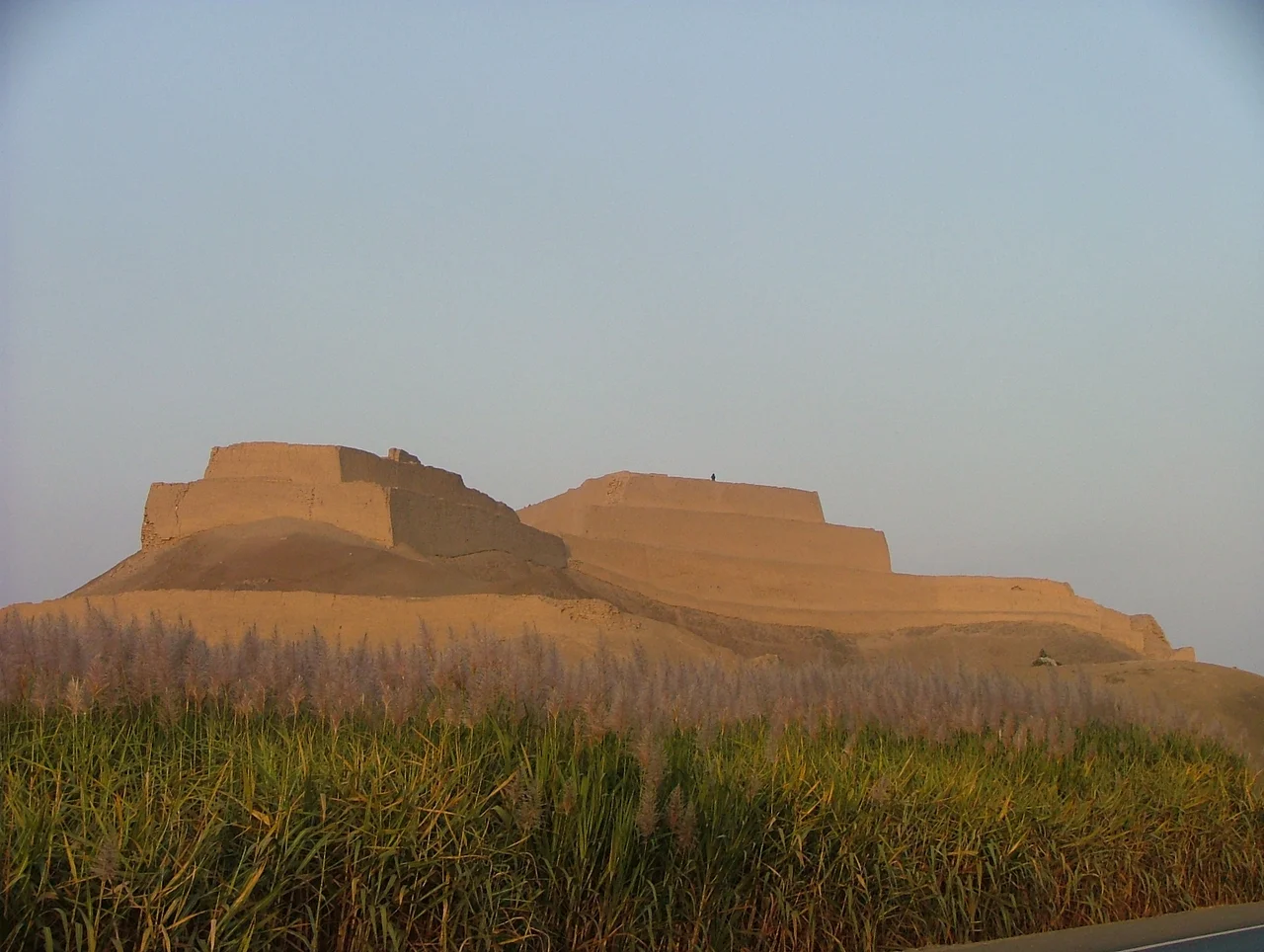

Paramonga
"Walls carved the way it is done in Spain, with two tigers at the main entrance." That is what Miguel de Estete wrote in 1533, after he had spent a night inside the place the Spaniards called Parmunga. Estete was a chronicler-soldier riding with Hernando Pizarro and twenty horsemen down from Cajamarca, where Atahualpa waited in captivity and his ransom was running short. The Inca had suggested, desperate, that the Spanish loot a coastal oracle called Pachacamac. On the way there they stopped at a fortress so large and so painted that a veteran of European sieges could only compare its carved walls to his home country and reach for a word - tigres - that did not even exist for the pumas he was actually describing.
The Edge of Chimor
Paramonga sits on a hill above the Fortaleza River, close to the town of Pativilca, several hours north of Lima on the Peruvian coast. It was built by the Chimú during the late Intermediate Period - roughly AD 1200 to 1400 - at the southern frontier of the Kingdom of Chimor, whose capital was the sprawling adobe metropolis of Chan Chan a few hundred kilometers farther north. Chimor controlled the northern coast of Peru for centuries, a loose confederation of walled cities and irrigated valleys that rivaled the Incas in engineering and succumbed to them only late, in the 1470s. Paramonga stood at the frontier - the last serious Chimú outpost before you hit the territory of Lima's central-coast cultures, including the oracle at Pachacamac whose priests held allegiances the Incas would later exploit.
A Pyramid That Looked Like a Castle
The structure is often called a fortress. The word is imperfect. Paramonga is a staggered pyramid of four enormous levels rising on a natural hill, and what made it look like a medieval European castle to the Spaniards was an accident of converging building traditions - massive adobe walls, commanding elevation, defensible terraces - rather than any shared military theory. The Chimú almost certainly built it as something more than a fort. Its elaborate painted interior, the scale of its ceremonial platforms, and its proximity to the coast all suggest a religious complex on the order of Pachacamac itself. The original name is lost. The modern town of Paramonga gave the ruin its current label, and everything earlier is guesswork. What is clear is that the Chimú did not stack adobe like this for anyone less than their gods or their rulers, and that whoever commanded this place had access to skilled painters, master masons, and the labor to move thousands of cubic meters of earth by hand.
Estete's Night
The conquistadors walked into this world in 1533. Francisco Pizarro had taken Atahualpa at Cajamarca the previous November, and the promised ransom of gold and silver was slowing to a trickle. The soldiers grew impatient. Atahualpa - captive but not yet desperate - offered Pachacamac, a coastal oracle held by priests who had backed his brother Huáscar in the civil war. Hernando Pizarro, Francisco's brother, took twenty horsemen and some arquebusiers, along with a handful of Atahualpa's own retainers as guides, and rode out along the Able Ñan - the imperial coastal road. Estete went with him. They became the first Europeans to sleep inside Paramonga. "A large town that is called Parmunga, which is next to the sea," Estete recorded, "has a Strong House, with five blind fences, painted elaborately on the inside and outside, with its walls carved the way it is done in Spain, with two tigers at the main entrance." The "tigers" were almost certainly pumas, painted guardians at the gateway of a complex the Spaniards had no conceptual vocabulary to describe.
A Witness to What Was
Eight years later, in 1541, the chronicler Pedro Cieza de León passed Paramonga on his way from Lima to Trujillo. The paintings were still there. So were the ruins. "It is certainly very curious to see how they raised water in channels to irrigate higher levels," he wrote. "The buildings were very handsome, and many wild beasts and birds were painted on the walls, which are now all in ruins and undermined in many places by those who have searched for buried gold and silver. In these days the fortress only serves as a witness to that which has been." What had been was a Chimú civilization in the middle of being erased, with its painted walls gutted by treasure hunters within a decade of the conquest. The pumas are gone now. Most of the paint is gone. But the four stepped levels still rise above the Fortaleza River, visible from the Pan-American Highway, and on a clear day they still command the approach to a coast the Chimú once owned.
From the Air
Located at 10.65 degrees S, 77.84 degrees W, on the Peruvian Pacific coast just north of the town of Pativilca, above the Fortaleza River. About 200 km north of Lima by the Pan-American Highway. Aerial access via Lima's Jorge Chávez International (SPJC) to the south, with closer approach possible through small strips near Huacho. Cruise 3,000-5,000 feet for a view of the stepped pyramid against the coastal desert. Marine layer fog common in the mornings May through November; afternoons typically clear.
Nearby Stories
- Huacho 37 km away
- Raura Mountain Range 62 km away
- Pampas Grande 80 km away
- La Unión, Huánuco 86 km away
- Ancon (archaeological site) 99 km away
- Department of La Libertad 264 km away
- Paiján Culture 293 km away
- Easter Island: The Mystery of Rise and Collapse 3703 km away