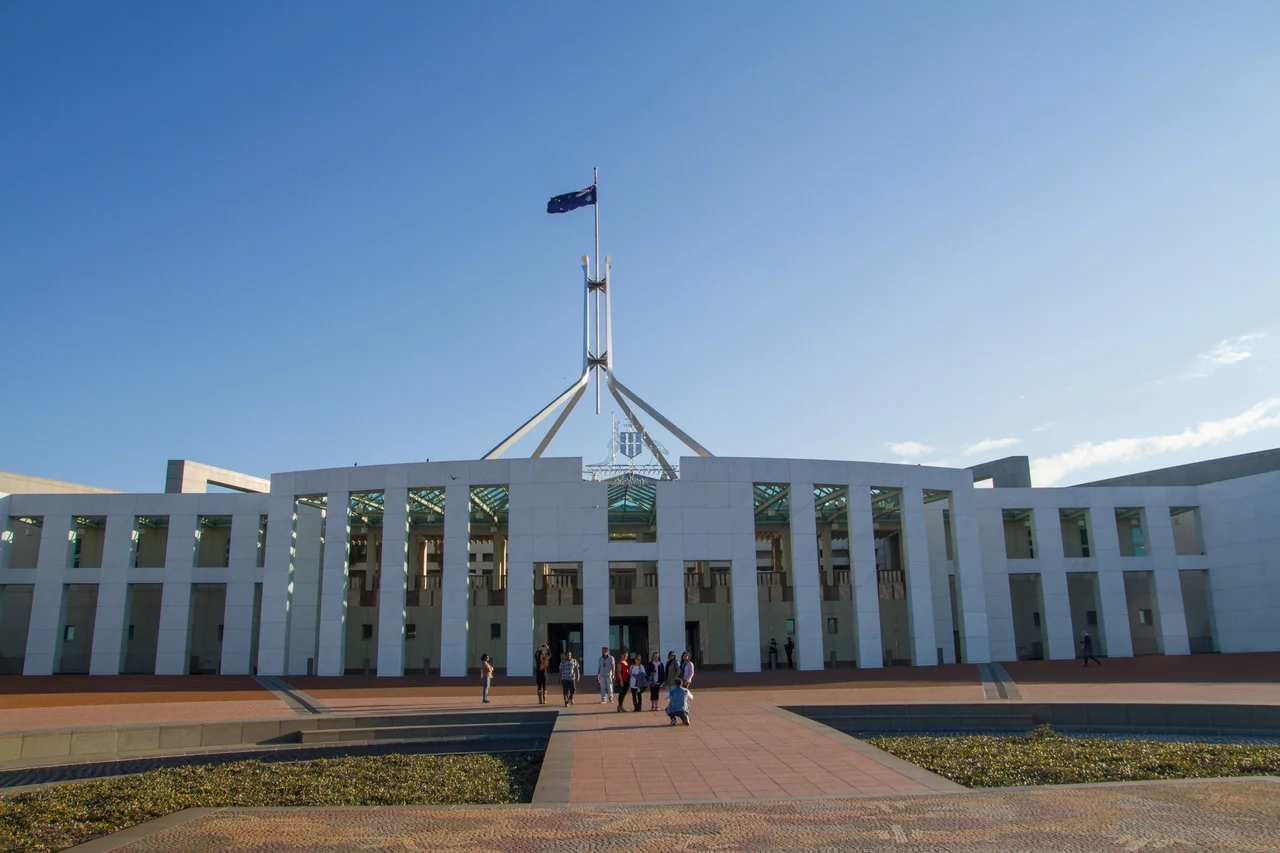

Parliament House, Canberra
You can walk on the roof. That single fact tells you almost everything about the building Australians chose for the seat of their democracy. When the Italian-born architect Romaldo Giurgola won the competition to design a new Parliament House in 1980, his radical idea was not to build upward but to disappear. He sliced the top off Capital Hill, set the parliament inside the cavity, and replaced the soil so that grassy lawns sloped back over the structure. The land the people own runs straight across the heads of the people they elect. Above it all rises a stainless-steel flagpole 81 metres tall, the one element Giurgola allowed himself to make unmistakable from the air.
The Compromise on the Hill
Australia became a nation in 1901, and almost immediately its two biggest cities began sulking. Melbourne and Sydney each wanted to be the capital, and neither would concede to the other. The solution written into Section 125 of the Constitution was almost comic in its diplomacy: build a brand-new capital, place it in New South Wales, but keep it at least 100 miles from Sydney so the older rival could not claim it. Parliament would sit in Melbourne until the new city was ready. That readiness took a quarter-century. The Commonwealth chose the Canberra site in 1909, acquired the land in 1911, then watched World War I swallow its plans. Federal Parliament did not finally leave Melbourne until 1927, moving into a building everyone understood was temporary.
Sixty-One Years of "Temporary"
The provisional parliament was supposed to last fifty years at most. It lasted sixty-one. By its final decade, Old Parliament House was so cramped that members worked elbow to elbow, and the cry to build something permanent grew impossible to ignore. In 1978 the Fraser government committed to a new home on Capital Hill. The winning design came from a Philadelphia firm, Mitchell/Giurgola, and the cost climbed past 1.1 billion dollars, making it one of the most expensive buildings in the southern hemisphere. Construction began in 1981 and aimed at a deadline charged with meaning: Australia Day 1988, the 200th anniversary of European settlement. Queen Elizabeth II opened the finished parliament on 9 May 1988, the same calendar date that had opened the first federal parliament in 1901 and the provisional house in 1927.
A Flag the Size of a Bus
The flagpole is not decoration. Giurgola designed its four splayed legs to trace the outline of the grand domed capitol that the city's original planner, Walter Burley Griffin, had once imagined for this exact spot. The pole weighs roughly 250 tonnes of polished stainless steel and stands as one of the largest stainless-steel structures on Earth. The flag it flies is enormous, measuring 12.8 by 6.4 metres, about the footprint of a double-decker bus, and weighing some 15 kilograms in still air. Floodlit after dark, it becomes a fixed point in the Canberra night. Below it, between the green House of Representatives and the red Senate, sits the Members' Hall with its central pool of water beneath a glass roof, light pouring down onto the symbolic heart of the building.
Tracks Toward the Centre
Before a visitor reaches the chambers, the forecourt makes a quieter argument. Its surface holds a mosaic of 90,000 hand-cut granite stones called Possum and Wallaby Dreaming, designed by the Warlpiri artist Michael Nelson Jagamara from country near Papunya. Three stonemasons spent the better part of two years setting it. White animal tracks converge from every direction on a central circle, a meeting place, the image insisting that this hill was a gathering ground for tens of thousands of years before any parliament was conceived. Inside, the colours soften their British origins on purpose. The Commons green becomes the muted grey-green of eucalyptus leaves; the Lords red shifts toward the ochre of the outback. The architecture quotes Westminster, then translates it into the palette of the Australian bush.
The Building That Argues With Itself
Not everyone has loved the result, and the criticism is revealing. The design was conceived in the late 1970s, in the anxious aftermath of the 1975 dismissal of the Whitlam government and a hotel bombing in Sydney, so security shaped the brief. The answer was to wall the executive into its own ministerial wing, which meant backbenchers no longer bumped into ministers in the corridors. Former prime minister Paul Keating later described walking those halls and "not feeling like you were part of anything." Malcolm Turnbull blamed the lack of "collision space" for thinner friendships across party lines. A building meant to nurture democracy, its detractors argue, was so worried about protecting power that it isolated it. Whether triumph or cautionary tale, it remains one of the most-visited buildings in the country, its grass roof open to anyone who wants to stand on top of their own government.
From the Air
Parliament House sits at 35.31 degrees south, 149.12 degrees east, atop Capital Hill at the southern apex of Canberra's Parliamentary Triangle. From the air the 81-metre flagpole is the standout marker, with the building's symmetrical wings buried under sloping green lawns and the State Circle ring road encircling it. Recommended viewing altitude is 2,000 to 4,000 feet for the geometry of the triangle to read clearly. Canberra Airport (ICAO YSCB) lies about 7 km to the east-northeast; the city is surrounded by Class C and D airspace, so check NOTAMs and restrictions before any low overflight of the capital. Best visibility comes on the clear, cold mornings typical of Canberra's high-plains winters.
Nearby Stories
- Mount Kosciuszko summit trails 69 km away
- Hive shipwreck 79 km away
- Snowy Mountains Scheme 89 km away
- Wollongong 119 km away
- Murray River 179 km away
- Royal National Park 191 km away
- Warangesda Aboriginal Mission 250 km away
- 2003 Fiordland Earthquake 1800 km away