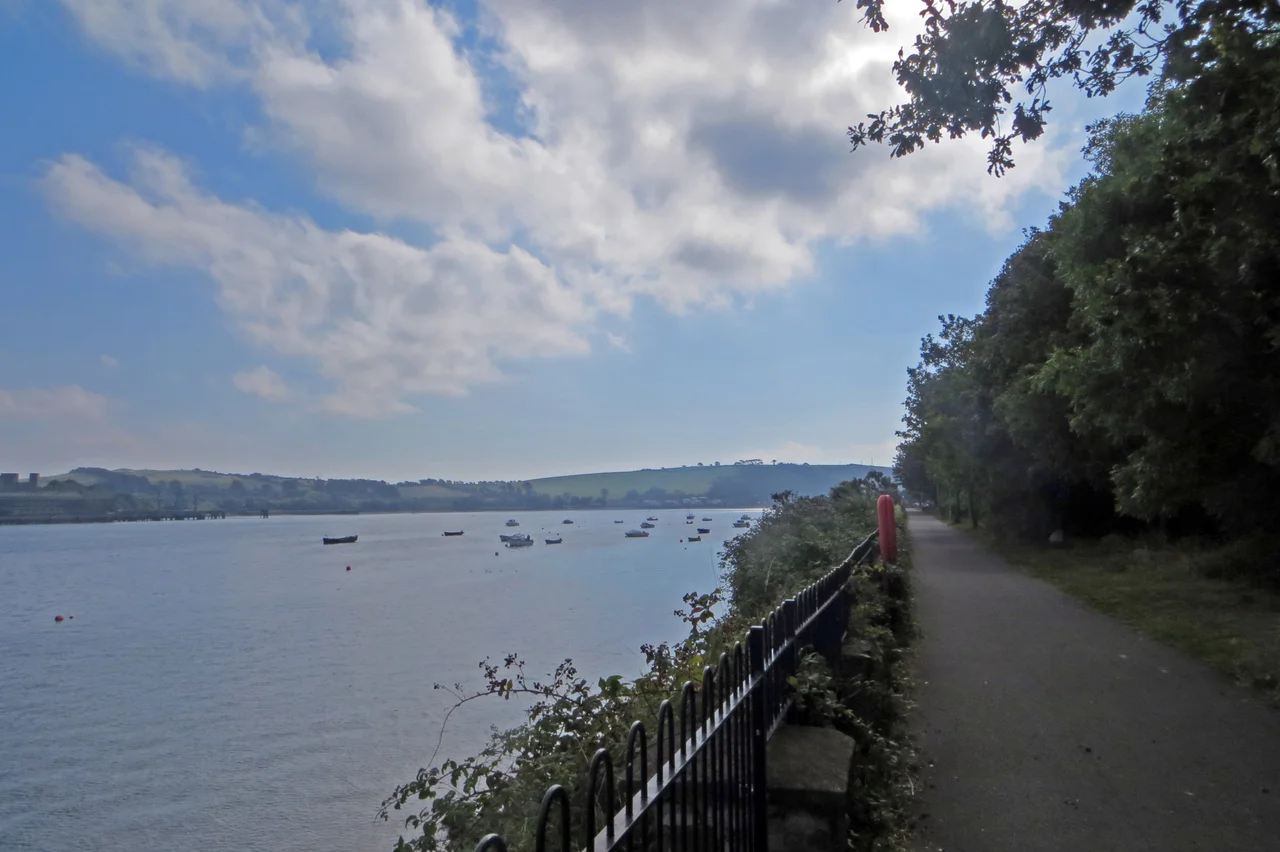

Passage West
John Wesley came to Passage West in 1752 and was not impressed. The founder of Methodism rode down from Cork city to preach to the congregation gathered in the Market House and reported afterwards that they were 'as dull a congregation as I have seen.' What he could not have known was that the town he found dull would, in less than a century, become one of the most consequential industrial sites in nineteenth-century Ireland - the place where the first steamship built in Ireland was launched in 1815, where the SS Sirius set out in 1838 on the first steam crossing of the Atlantic from Europe, and where, in 1922, the Irish Civil War turned in the south on a beach landing of 1,500 National Army troops. Dull is not the word.
Two Dockyards
The two dockyards made the town. Hennessy's yard, on the site of what is now Fr O'Flynn Park, launched the City of Cork in 1815 - the first steamship built in Ireland, a small wooden paddle vessel that began a tradition that would not finally die for over a century. The bigger of the two was the Royal Victoria Dockyard, laid down in 1832 at a cost of 150,000 pounds and named after Queen Victoria when she visited Cork in 1849. The yard worked steadily through the nineteenth century. During the First World War it employed over a thousand people, hammering plates onto Admiralty hulls for the convoys. Then came the post-war shipbuilding slump. By 1925 most of the workforce had been paid off; in 1931 the yard closed entirely. The hammered plates and the riveted hulls and the men who knew the trade dispersed, and the town that had grown around them shrank into a quieter life. The Passage West Town Hall was built directly on the spot from which the City of Cork had been launched. Since 2018, it has also housed the Passage West Maritime Museum.
The SS Sirius
On a April morning in 1838, the small paddle steamer Sirius cast off from Passage West under Captain Richard Roberts, headed for New York. Built originally for the Cork-London route, Sirius had been chartered at the last minute by the British and American Steam Navigation Company to beat Brunel's much larger Great Western to the prize of the first transatlantic steamship crossing. Sirius reached New York on 22 April 1838 after eighteen days at sea, having run her bunkers so low she was burning cabin furniture in the final hours. Great Western arrived a few hours later. Sirius technically won. The transatlantic age of steam began that day. Roberts, the Passage West captain, became a brief celebrity. He drowned five years later commanding another steamship that disappeared in the Atlantic. The paddle shaft of Sirius - the heavy iron bar at the heart of her engine - was recovered and now forms a memorial to Roberts in Passage West, mounted on a plinth near where the Cross River Ferry crosses the harbour.
Civil War Landing
On 2 August 1922, the Irish Civil War came to Passage West. Cork city, the second-largest urban area in the new Free State, was being held by Anti-Treaty IRA forces who had refused the Anglo-Irish Treaty of December 1921. The Free State government under Michael Collins decided to retake Cork not from the landward side - where ambushes in the mountain passes would have made the advance bloody - but from the sea. Fifteen hundred National Army troops sailed from Dublin in commandeered ships, with artillery and armoured vehicles, and landed at Passage West and Youghal on the morning of 2 August. The Anti-Treaty forces, badly armed and surprised, fell back. The Free State troops marched up the harbour road and into Cork city within forty-eight hours. Many Passage West families took the soldiers in, fed them, and dried their clothes. Captain Jeremiah Collins, a local Free State sympathiser, raised the new tricolour flag in front of his house Carrigmahon, overlooking the water, to mark the landing. Ten days later Michael Collins himself was dead, ambushed at Beal na Bláth twenty miles west. The Civil War would grind on for ten more months.
Trains, Resorts, Ferries
For roughly half a century Passage West was a tourist town. The Cork, Blackrock and Passage Railway, a narrow-gauge line that ran out from the city along the western shore of the harbour, opened its Passage station on 8 June 1850. The town became a popular Victorian sea-bathing destination - the Victoria Baths and other 'hydropathic' establishments opened along the shoreline. Then in 1902 the railway extended south to Monkstown, and two years later to Crosshaven, which had a sand beach Passage West could not match. The tourists moved on. The line carried commuters and excursionists for another thirty years before closing entirely on 12 September 1932. Today there is no railway in Passage West. But a different kind of crossing exists: since 1993 the Cross River Ferry has carried cars across the half-kilometre channel of Cork Harbour from Glenbrook, just south of Passage, to Carrigaloe on Great Island - cutting a forty-minute drive around the harbour down to a five-minute boat ride.
The Suburb That Doubled
Passage West today is more bedroom community than port. Between the 1991 and 2011 censuses the town's population grew sixty percent, from 3,606 to 5,790. About half of all the private housing in the town was built in those twenty years. The N28 road south to Ringaskiddy, where the Port of Cork has its container facilities and where the Brittany Ferries service runs to France, takes commuters along the western harbour shore. The Jack Lynch Tunnel, ten kilometres north, has made the city centre an easy commute. The old shipyard site, vacant since 1931, was earmarked for a major mixed-use redevelopment in 2007 by a property company that collapsed in the financial crisis; in 2019 the developers quietly withdrew, and the site remains empty, a long stretch of derelict quay waiting for someone with capital and a plan. The town's most enduring fact is its position: ten kilometres south-east of Cork city, on the west bank of one of the largest natural harbours in the world, with deep water that ships have been using for two millennia.
From the Air
Located at 51.87 degrees N, 8.34 degrees W, on the west bank of Cork Harbour, ten kilometers south-east of Cork city. Cork Airport (EICK) lies twelve kilometers west. Best viewing altitude 2,000 to 4,000 feet to see the town strung along the harbour shore, the narrow channel of the Cross River Ferry between Glenbrook and Carrigaloe on Great Island, the cluster of Cobh and its cathedral spire visible on the island opposite. The N28 dual carriageway runs south to Ringaskiddy and the container port.
Nearby Stories
- St. Declan's Monastery 0.8 km away
- Aghavrin House 2.4 km away
- Mitchelstown Castle 7.4 km away
- Clonakilty 9.5 km away
- Inislounaght Abbey 16 km away
- Walter Siepmann 23 km away
- Newcastle West 33 km away
- SM U-27 110 km away