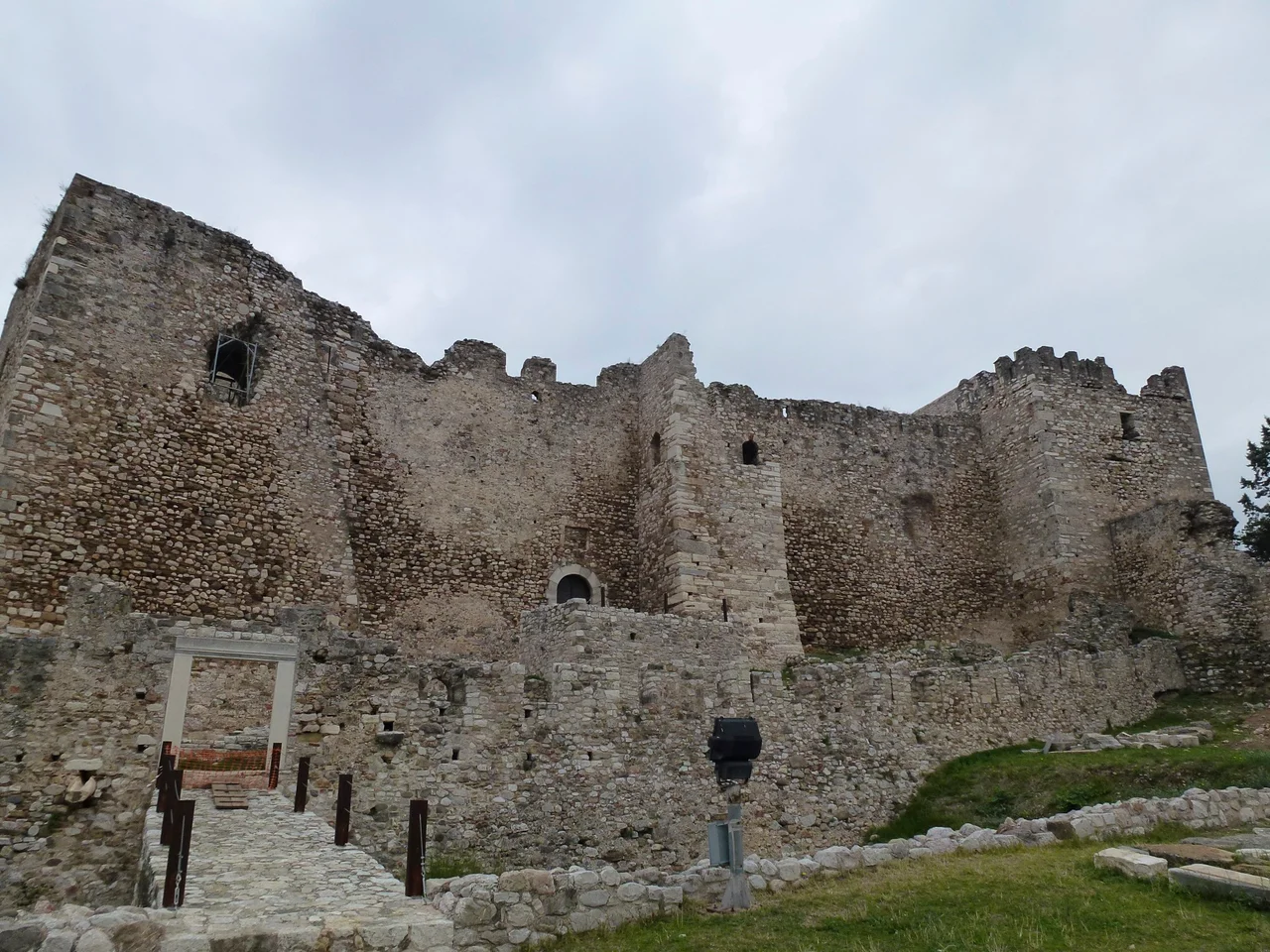

Patras Castle
Embedded in the wall of Patras Castle is the torso of a marble Roman statue — repurposed building material from a pre-Christian structure, used by the builders of Justinian I to fill the gaps in their new fortress after the earthquake of 551 AD. Over the centuries, that fragment of stone acquired a name and a legend. The locals called her the Patrinella — a maiden, they said, who was transformed into a man during Ottoman times, who guards the city against disease, and who weeps when a prominent citizen of Patras dies. A broken Roman statue became a protective spirit. That kind of transformation, the conversion of old things into something that serves the living, is the essential story of this castle.
Justinian's Foundation
The castle was built around the mid-sixth century AD by the Byzantine emperor Justinian I, following a catastrophic earthquake in 551 that destroyed much of the earlier structures on the acropolis hill. Justinian's builders were practical: they reused stone from pre-Christian buildings, filling their triangular outer wall with the fragments of an older city. The resulting fortress covered 22,725 square meters, its outer wall strengthened by towers and gates and originally protected by a moat; an inner compound on the northeastern corner added a second layer of defense.
The location was well chosen. The castle sits on a low outlying spur of Mount Panachaiko, about 800 meters from the sea, overlooking the entire lower city and the Gulf of Patras beyond it. Whoever held the castle held Patras. For the next fourteen centuries, an extraordinary number of powers would try.
The Siege That Shaped a Legend
The Byzantine period tested the castle repeatedly. Slavs besieged it; Saracens tried; Normans attempted it. None succeeded. The most celebrated of these failures was the siege of 805 AD, when Arab and Slavic forces attacked and were repelled. The city credited its patron saint Andrew with the defense — a story that reinforced both the castle's importance and the apostle's place at the center of Patras's identity.
In 1205, the Fourth Crusade's aftermath brought new masters. William of Champlitte and the Villehardouins took the city, and Frankish lords strengthened the castle, opening a moat on all three sides. In 1278, the Principality of Achaea pawned it to the Latin Archbishop of Patras — one of the more unusual transfers of a military fortress in medieval history. The Pope then leased it to the Venetians for five years in 1408. The Latin Archbishop kept possession until 1430, when Constantine Palaiologos — the man who would become the last Byzantine emperor — seized it and made extensive repairs.
From Constantinople's Last Emperor to Ottoman Garrison
Constantine Palaiologos held the castle briefly. In 1458, nine years after becoming emperor and five years after the fall of Constantinople, the Ottomans took Patras. Under Ottoman rule the castle was called Balya Badra — from the Greek Παλιά Πάτρα, 'Old Patras' — and it became one of their main seats of power in the Peloponnese for the long period known as the Tourkokratia.
The Venetians interrupted Ottoman control in 1687, during the Morean War, and held the castle until 1715, when the Ottomans retook the Morea. The castle's current outline dates largely from that second Venetian period. After Greek independence, the Greek Army continued using it until after World War II — an unbroken record of military occupation stretching from the sixth century to the twentieth.
Open to the City Now
In 1973, the castle passed from military to archaeological administration, transferred to the 6th Ephorate of Byzantine Antiquities. The moats that once kept attackers out now mark a public park; the walls that absorbed siege machinery serve as backdrop for summer cultural events. A theatre inside the compound seats 640 people for performances under the stars.
The view from the walls remains what it always was: the city spreading downhill toward the water, the cathedral dome visible among the rooftops, the gulf beyond it wide and blue, and on clear days the mountains of the opposite shore. The Patrinella, wherever she is embedded in the stonework, keeps her vigil. The castle that survived every medieval attacker has outlasted them all, and now hosts concerts.
From the Air
Patras Castle sits at approximately 38.2450°N, 21.7418°E on the acropolis hill above the city, at a clearly elevated position relative to the urban grid below. At 3,000–5,000 feet the triangular fortress outline is visible against the hillside, with the city and its port spreading north and west toward the Gulf of Patras. The Cathedral of Saint Andrew's dome is identifiable to the southwest at water level. The nearest major airport is LGRX (Araxos), approximately 40 km to the west along the coast. Approach from the gulf for a panoramic view of both the castle and the city it has guarded for fifteen centuries.
Nearby Stories
- Thermos (Aetolia) 8.2 km away
- 1861 Eliki Earthquake 9.6 km away
- Pheneus 14 km away
- Battle of the Echinades (1427) 15 km away
- HMS Perseus (N36) 19 km away
- Amfissa 20 km away
- Astras 21 km away
- Acarnania 28 km away