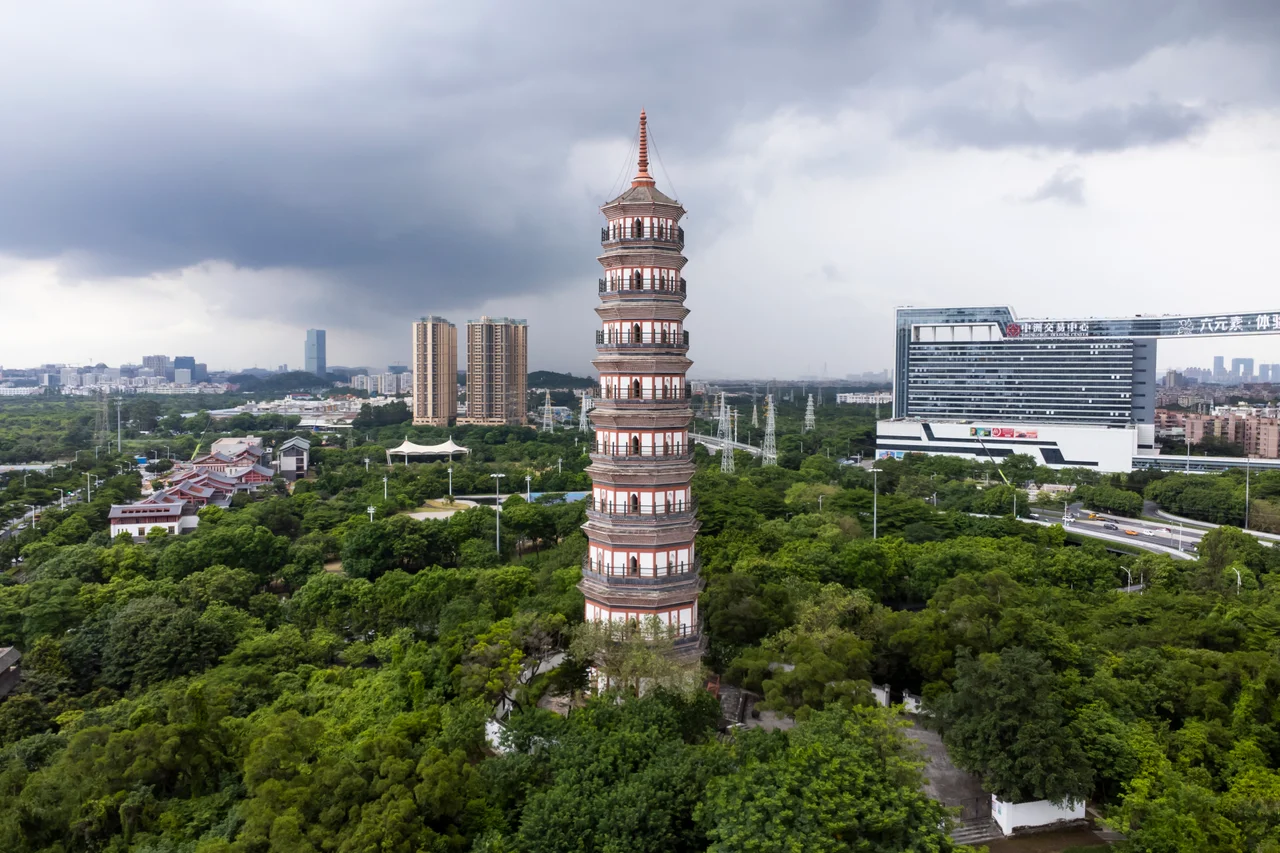

Pazhou Pagoda
Merchant captains navigating the Pearl River toward Guangzhou in the late 16th century had more than tides and sandbars to contend with — they had to reckon with fengshui. The city's geomancers had identified a spiritual vulnerability where the river bent around Pazhou Island, and in 1597 they began erecting a remedy. Three years later, the Pazhou Pagoda stood complete: an octagonal stone tower nine stories tall, rising 59 meters above the island's southern bank to correct the city's cosmic alignment and mark the river channel for ships pressing upstream.
Stone Needle on a Bending River
The Pearl River splits and rejoins around Pazhou Island in Guangzhou's Haizhu District, creating one of the busiest passages in imperial China's maritime trade. The Pazhou Pagoda — also called the Whampoa Pagoda after the old Western name for this stretch of water — was built on the island's edge precisely because that bend mattered. In fengshui cosmology, a pagoda placed at the right point could anchor beneficial energy, deflect harmful forces, and harmonize the landscape. Practical sailors knew a second truth: a tall tower on a flat riverbank is an excellent landmark. The pagoda served both purposes without contradiction. Its base measures 12.7 meters across and covers 111 square meters of ground. That is not a large footprint for a tower of such height, but the proportions are deliberate — slender enough to read as a spire against the sky, solid enough to survive centuries of Pearl River floods and typhoons.
Architecture of the Ming Shore
Construction began in 1597 and was finished by 1600, placing the pagoda firmly in the late Ming dynasty. The structure follows a classic octagonal plan, with nine principal levels divided by seventeen sub-sections of bracketing and eave. Each face of the octagon is articulated with projecting cornices that cast deep shadows in the subtropical sun, giving the tower a layered, almost feathered silhouette when seen from the water. The design aligns closely with the Chigang Pagoda, built slightly later in 1619 a few kilometers upriver — both towers were conceived as a pair of markers to bracket the navigational approach to Guangzhou's wharves. Together they formed a kind of gateway, visible from decks far downstream, announcing the proximity of one of the wealthiest port cities in the world. German artist Wilhelm Heine sketched the pagoda in 1853 during a visit to Whampoa, capturing the tower as foreign ships still anchored offshore — Guangzhou's colonial-era trade restrictions kept most Western merchants from proceeding further upriver.
From Fengshui Anchor to Island Landmark
The Whampoa anchorage where the pagoda stands was, for centuries, the furthest point foreign vessels could reach. Chinese junks and later steamers continued past it; Western merchantmen unloaded their cargoes here onto smaller boats for the final leg to the city. The pagoda watched over this exchange — tea, silk, and porcelain going out, silver coming in — for more than two hundred years of trade that shaped the global economy. Today Pazhou Island is better known for the Canton Fair, the vast biannual trade exhibition that draws hundreds of thousands of buyers from around the world. The pagoda sits among modern exhibition halls and apartment towers, a stone accent in a landscape of glass and steel. It remains a listed heritage site, its nine stories still legible from the Pearl River ferries that carry commuters past the island's shores.
A View from the Water
Standing on the pagoda's upper levels on a clear morning, the view takes in the full width of the Pearl River and the Guangzhou skyline beyond it — Canton Tower's distinctive lattice silhouette visible to the northwest, container ships queuing in the shipping lanes to the south. The island itself has been transformed by development, but the river still bends as it always did, and the fengshui logic that placed this tower here is still legible in the landscape. From the water, looking up, the pagoda appears exactly as it was intended: a fixed point on a moving river, a marker that says you are arriving somewhere that matters.
From the Air
The Pazhou Pagoda sits at 23.1018°N, 113.3703°E on Pazhou Island in Haizhu District, roughly 6 km southeast of central Guangzhou. At 500 feet AGL heading northwest on approach to ZGGG (Guangzhou Baiyun International Airport, approximately 20 km to the north), the Pearl River is clearly visible below. The pagoda is hard to distinguish individually amid the dense urban fabric at typical approach altitudes, but the island's distinctive shape in the river bend provides a useful geographic reference. The Canton Tower (600 m) is the dominant vertical landmark of this skyline. Pearl River Tower and the high-rise cluster of Tianhe District mark the city center to the northwest.
Nearby Stories
- Shunde 12 km away
- 2015 Shenzhen Landslide 15 km away
- Mount Luofu 23 km away
- Qingyuan Maglev Tourist Line 32 km away
- Kaiping 56 km away
- Heyuan 90 km away
- Chikan, Kaiping 92 km away
- Erlitou Site Museum of the Xia Capital 1257 km away