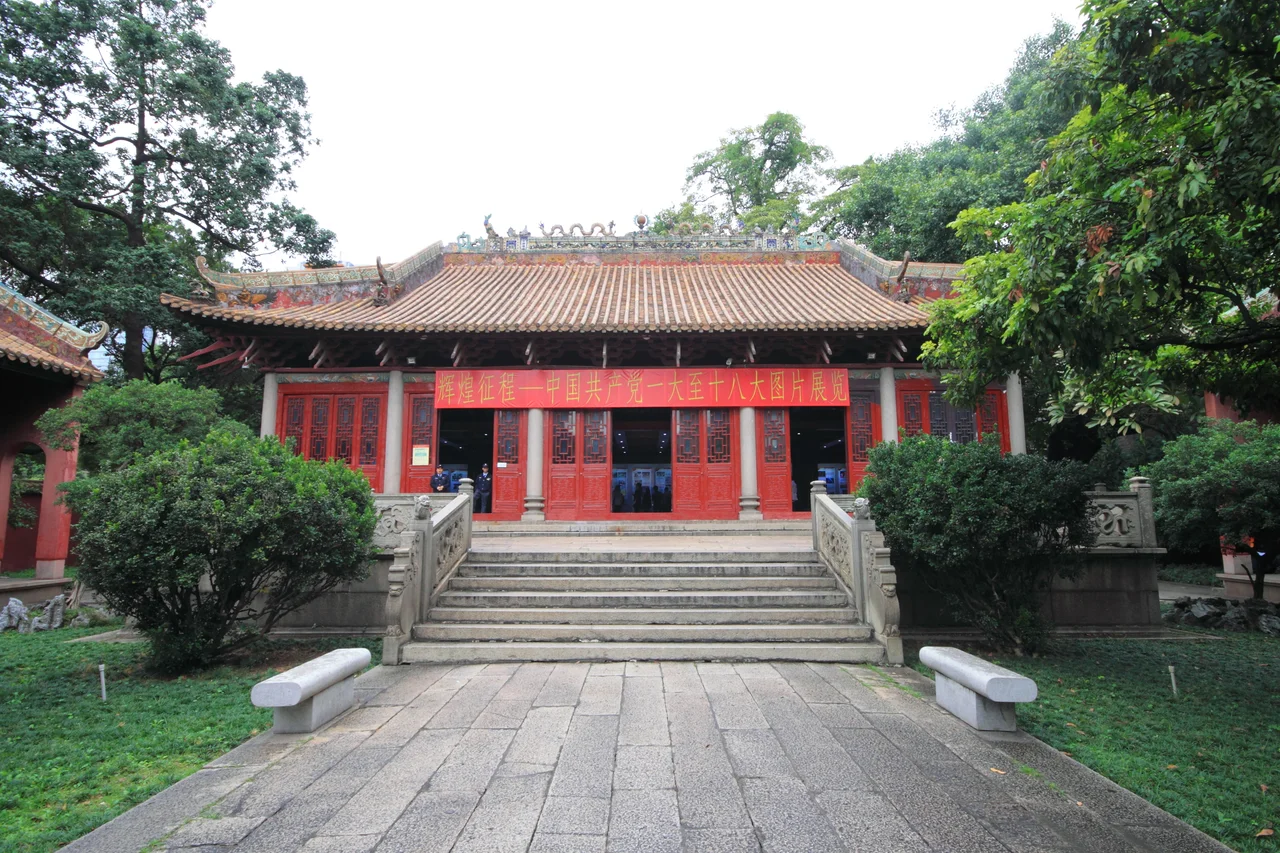

Peasant Movement Training Institute
The building has been a Confucian temple, a training school for revolutionary organizers, and now a museum. What it has always been, across those transformations, is a place where ideas about China's future were seriously argued. The Peasant Movement Training Institute operated here from 1924 to 1926, and in those two years it sent graduates into the countryside to do something no government had formally attempted before: organize China's rural poor as a political force.
A Confucian Temple Repurposed
The building that houses the institute dates to the 14th century, when it was constructed as a Confucian temple on what is now 42 Zhongshan 4th Road in Yuexiu District. Classical Chinese architecture, with its courtyard layout and heavy tiled roofs, proved well-suited to the institute's needs — lecture halls, dormitories, and common spaces were already built into the structure. The temple's original purpose, the cultivation of classical learning for the imperial examination system, was not entirely alien to the new purpose: both required teaching, both assumed that trained individuals could go out and change society. The institute officially opened on July 3, 1924, initially at the Huizhou Association headquarters at 53 South Yuexiu Road before settling at this site. The first director was Peng Pai, one of the early leaders of the Chinese Communist Party and a pioneering organizer of peasant associations in Guangdong province.
The Alliance That Made It Possible
The Peasant Movement Training Institute existed because of an unlikely partnership. In 1923, the Kuomintang (KMT) under Sun Yat-sen and the Chinese Communist Party formed the First United Front, a tactical alliance against the warlords who controlled northern China. The KMT adopted three guiding principles: alliance with Soviet Russia, cooperation with the Communists, and support for peasant and worker movements. The institute was a direct product of the third principle. The KMT Central Committee established it as the first formal government-sponsored training school for rural political organizing in Chinese history — an acknowledgment that whoever could mobilize China's vast rural population would hold decisive political power. Between July 1924 and September 1926, the institute ran six classes. Peng Pai directed the first and fifth terms. Other directors led the second, third, and fourth. Mao Zedong directed the sixth and final term, which was also the largest. Faculty included Zhou Enlai and Yun Daiying, both significant figures in the Communist Party's early years.
What Was Taught Here
The students who came to the institute were young idealists recruited from across China. They arrived at a moment when the country's peasantry — the great majority of the population — lived under conditions of near-feudal dependence on landlords and local strongmen. The curriculum trained them to go back to their home villages and provinces and build peasant associations: organizations that could negotiate rents, resist exploitation, and eventually participate in the broader revolutionary movement. The teaching was practical and political simultaneously. Graduates fanned out into Hunan, Guangdong, Jiangxi, and other provinces during the mid-1920s, establishing associations that, at their peak, organized millions of rural people. Mao Zedong's famous 1927 report on the peasant movement in Hunan drew on what he had observed from these graduates. The institute closed in 1926 as the First United Front collapsed and the KMT-CCP relationship shattered. Many of the institute's students and graduates died in the violent suppression that followed, particularly in the failed 1927 Guangzhou Uprising. Their names are among those commemorated at the nearby Martyrs Memorial Park.
The Site Today
After 1949, the Peasant Movement Training Institute was restored as a commemorative site under the new government. The lecture rooms and dormitories were recreated to approximate their 1920s condition. Today it operates as a museum in Yuexiu District, a short walk from the Peasant Movement Institute metro station on Guangzhou Metro Line 1. The Confucian temple architecture — the tiled roofs, the courtyard, the carved stone details — survives substantially intact, and the setting gives visitors a tangible sense of the building's layered past. The institute is classified as a Major National Historical and Cultural Site, reflecting its significance in the official narrative of Chinese Communist Party history. Visiting it requires holding that history clearly: the institute was founded by a partnership that ended in bloodshed, trained men and women many of whom did not survive the decade, and produced consequences that shaped the 20th century in ways still felt today.
From the Air
The Peasant Movement Training Institute is located at 23.1303°N, 113.2713°E in Yuexiu District, near the center of historic Guangzhou. The surrounding district is densely built with mid-rise buildings; the temple complex is not individually visible from cruising altitude. Guangzhou Baiyun International Airport (ZGGG) is approximately 18 km to the north. The Pearl River is visible approximately 1 km to the south. At 1,500 feet AGL on a southbound heading, the Yuexiu Park hill (with the Five-Ram Statue) is a useful visual reference approximately 500 meters to the northwest.
Nearby Stories
- Shunde 12 km away
- 2015 Shenzhen Landslide 15 km away
- Mount Luofu 23 km away
- Qingyuan Maglev Tourist Line 32 km away
- Kaiping 56 km away
- Heyuan 90 km away
- Chikan, Kaiping 92 km away
- Erlitou Site Museum of the Xia Capital 1257 km away