
Peinan Site Park
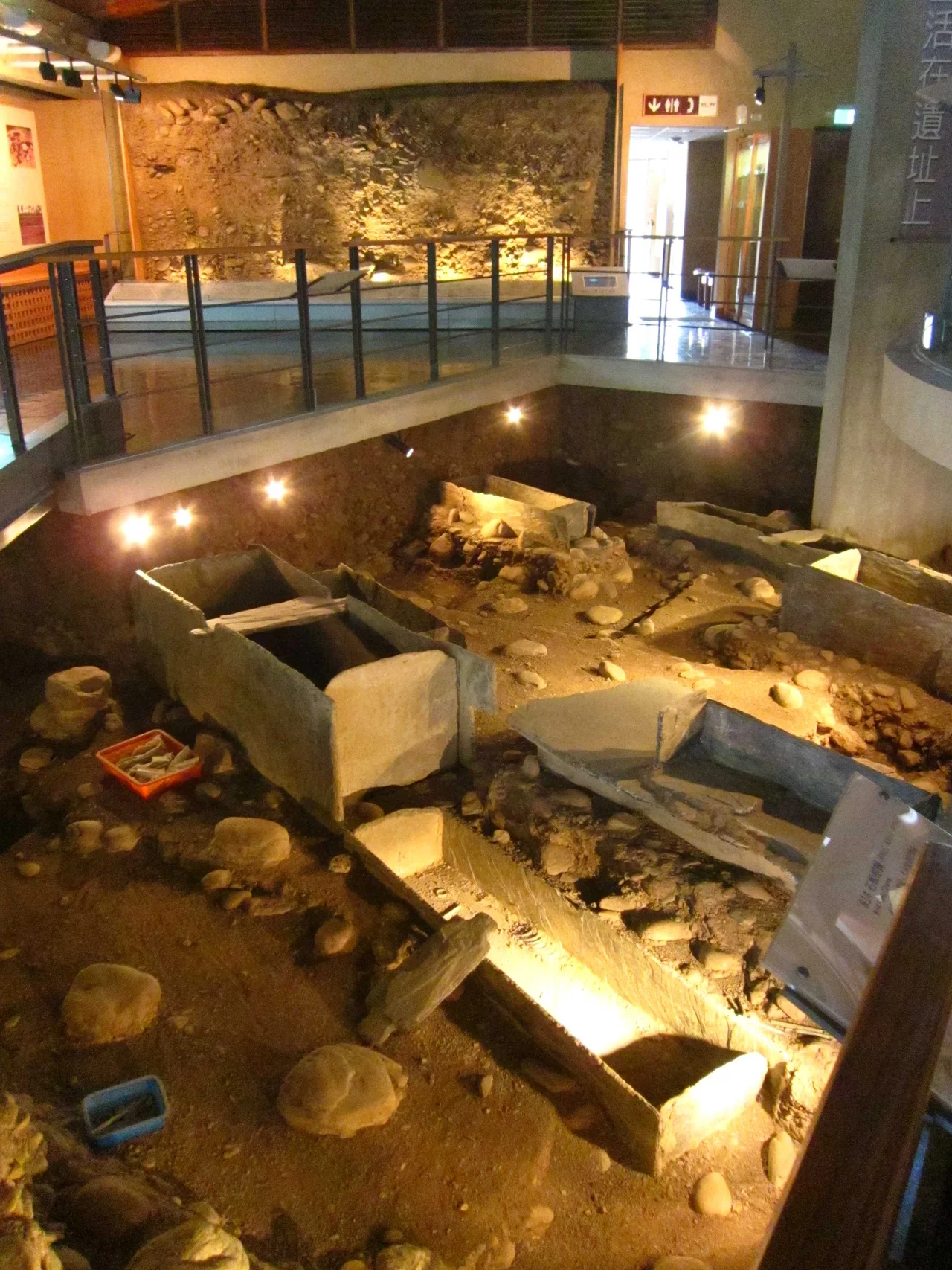
They were building a railway station when they found the dead. In 1980, construction workers digging behind Taitung station in southeastern Taiwan broke through soil that had not been disturbed for millennia. Beneath the surface lay a graveyard of several thousand slate coffins, some still cradling human remains. Around them, scattered like offerings, were more than 20,000 pieces of jade, pottery, and stone tools - the material record of a sophisticated prehistoric civilization that had flourished on this coastal plain roughly three thousand years ago. It was the largest and most complete prehistoric settlement ever discovered in Taiwan, and it had been sleeping beneath a railway platform.
The First Witness
The earliest outsider to record the site was Torii Ryuzo, a Japanese anthropologist who visited Taiwan four times during the early period of Japanese colonial rule. Torii photographed the monolithic stone pillars that stood above ground at Peinan - massive carved columns whose purpose remained mysterious. The pillars had been there long before the indigenous Puyuma people who inhabited the area, long before the Dutch traders and Qing dynasty administrators who followed. They were remnants of a culture that left no written language, only stone, jade, and the careful arrangement of their dead.
Jade and Slate
The 1980 discovery transformed Peinan from an archaeological curiosity into a national priority. The burial sites covered an area of more than 10,000 square meters and contained over 1,600 individual graves. The dead had been interred in coffins made from carefully shaped slate slabs, laid out in orderly rows that suggested a society with clear organizational structure and burial customs. The jade artifacts were extraordinary - finely worked tubes, pendants, and ornaments that demonstrated both artistic skill and access to trade networks stretching across prehistoric Taiwan. Pottery and stone tools rounded out the picture of a community that hunted, farmed, and crafted with considerable sophistication.
From Dig Site to Park
The sheer scale of the find forced Taiwan's government to act. Archaeological excavation began in earnest, and the decision was made to preserve the site in place rather than scatter its contents across distant museums. Peinan Site Park opened in 1997, built around the original excavation area so that visitors could see the archaeological layers exposed during the dig. Five years later, in 2002, the National Museum of Prehistory opened nearby - an indoor and outdoor facility designed to display the artifacts and explain the culture that produced them. Together, the park and museum form one of Taiwan's most important cultural heritage sites, part of a potential World Heritage nomination alongside nearby Mount Dulan.
A Civilization Without a Name
Archaeologists call them the Peinan culture, but the people themselves left no name for us to use. They lived on Taiwan's southeastern coast during the late Neolithic period, roughly contemporary with the early Bronze Age civilizations of mainland Asia. Their jade-working skills were exceptional, suggesting either local sources of the stone or robust maritime trade routes. The monolithic pillars that first caught Torii Ryuzo's eye in the early 1900s appear to have been structural elements of large buildings - possibly ceremonial, possibly residential. Without writing, the Peinan culture speaks only through its material remains: the precision of its slate coffins, the beauty of its jade, and the sheer number of its dead, buried with care in a place that three thousand years later would become a railway station.
From the Air
Located at 22.79N, 121.12E in Taitung City, southeastern Taiwan. The park sits on the coastal plain just west of Taitung Railway Station. The Coastal Range rises sharply to the east, with the Pacific Ocean visible beyond. Mount Dulan (1,340m) is a prominent landmark to the north-northeast. Nearest airport: Taitung Airport (RCFN), approximately 5km north. The area is characterized by flat agricultural land transitioning to forested mountains. Recommended viewing altitude 3,000-5,000 feet for site context against the dramatic backdrop of the Coastal Range.
Nearby Stories
- Jiadong 8.7 km away
- Bunun Cultural Museum 10 km away
- Liudui Hakka Cultural Park 12 km away
- Yujing District 16 km away
- Shouka Mountain Pass 40 km away
- 1951 East Rift Valley Earthquakes 97 km away
- Mavulis Island 157 km away
- 2021 Hualien Train Derailment 162 km away