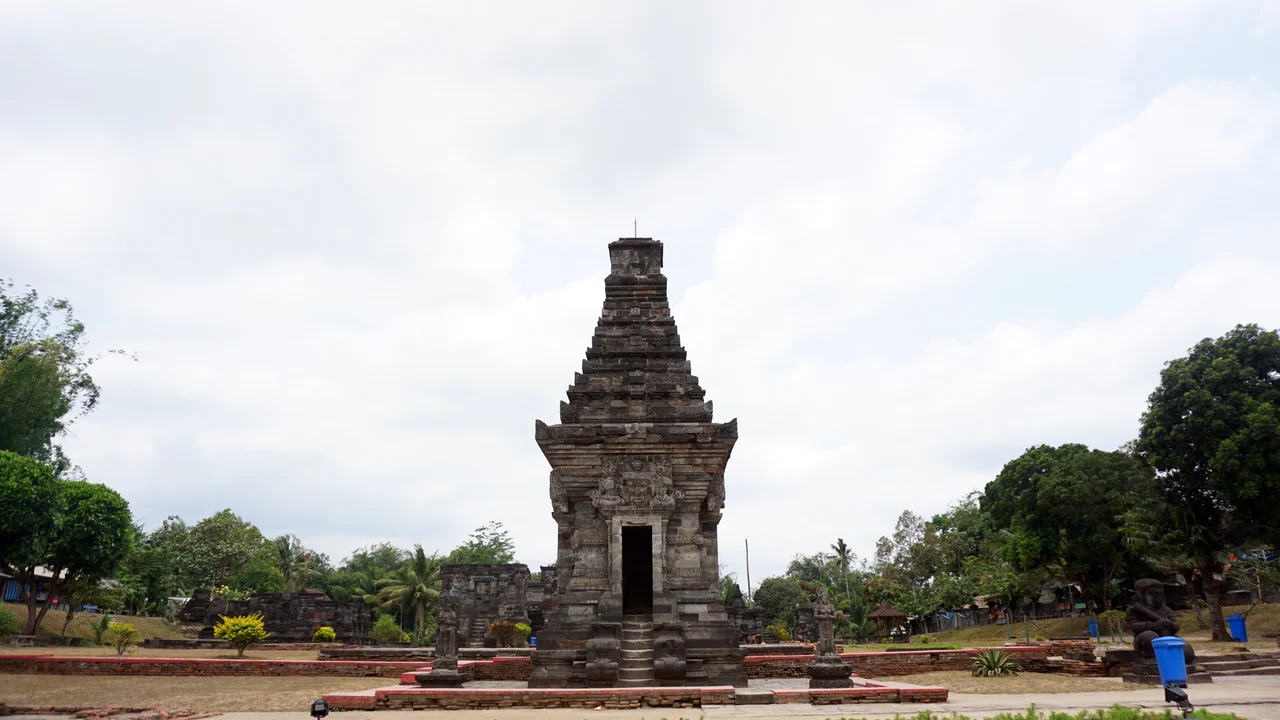

Penataran: Where Rama Walks in Stone
The main temple at Penataran has no roof -- and scholars believe it never had a stone one. When construction began in 1197 under the Kediri kingdom, the builders chose thatch and timber for the upper structure, a design decision that reveals something essential about Javanese temple architecture. Stone was for the gods: the reliefs, the platforms, the narrative panels that told the stories of Rama and Krishna in carved detail that still reads clearly after eight centuries. The roof was practical -- light enough to survive the earthquakes that shake East Java with regularity, easy to repair when the nearby volcano Kelud reminded everyone who truly commanded this landscape. The result is a temple complex that survives as a magnificent ruin of its permanent parts, while its perishable elements vanished centuries ago.
Three Courtyards, Three Centuries
Penataran was not built in a single campaign. The complex grew over roughly three hundred years, from its founding in 1197 through its peak under the Majapahit Empire in the 14th century. The layout follows a pattern still recognizable in Balinese puras today: three courtyards arranged in sequence, each more sacred than the last as you move toward the mountain. The first courtyard holds two rectangular platforms that once supported wooden pavilions for ceremonies. The smaller platform is covered in carved nagas -- mythical serpents that coil across the stonework. To the left of the passage into the second courtyard stands the Dated Temple, a small stone shrine named for a lintel inscribed with the equivalent of 1323 CE. The second courtyard centers on the Naga Temple. And in the rear courtyard, closest to Kelud's slopes, stands the main temple -- dedicated to Shiva, decorated with the Ramayana, and conspicuously missing any stones that could have formed a permanent roof.
Epic in Relief
The main temple carries one of the largest collections of Hindu narrative reliefs in Indonesia. The Ramayana unfolds across the stone base in the Javanese version of the epic, following Rama through exile, battle, and reunion. Alongside it runs the Krishnayana, drawn from the epic poem by Triguna, depicting scenes from the life of Krishna. The tradition echoes the great Shiva temple at Prambanan in Central Java, which also tells the Ramayana in carved panels -- but Penataran's reliefs belong to the East Javanese style, flatter and more decorative than their Central Javanese predecessors, with figures that seem to emerge from dense foliage and ornamental borders. To walk the base of the main temple is to read a stone library. Each panel advances the narrative, and the carvers achieved a level of detail that includes facial expressions, elaborate costumes, and lush vegetation filling every available surface.
A King's Favorite Sanctuary
The Nagarakretagama, composed by the court poet Mpu Prapanca in 1365, identifies Penataran by its older name -- Palah -- and records that King Hayam Wuruk visited the temple during his royal progress across East Java. Hayam Wuruk considered it his favorite sanctuary, and the Majapahit court lavished resources on the complex during his reign. The temple's significance was political as much as religious. By associating himself with the Ramayana reliefs and the Shiva worship at Penataran, the king linked his authority to divine narrative -- a strategy common across Southeast Asian kingdoms but executed at Penataran with particular ambition. The complex sits roughly 12 kilometers northeast of Blitar, on the lower southwestern slopes of Kelud, placing it in a landscape that oscillated between sacred geography and volcanic destruction. That the Majapahit court continued to invest in a temple beneath an active volcano speaks to the depth of its religious significance.
The Balinese Connection
One of the most revealing details about Penataran comes from across the Java Sea. On Bali, the Pura Yeh Gangga near the village of Perean dates from 1334 -- the same period as Penataran's main temple -- and shares a comparable substructure topped by a tiered thatched roof. Dozens of Balinese puras follow this pattern today, providing a living model of what Penataran likely looked like when its wooden superstructure was intact. The Indonesian scholar R. Soekmono noted that the central shrine at Penataran was empty -- it contained no divine image. This absence marks a transitional moment in Indonesian temple architecture: the shift from classical Hindu temples with stone roofs enclosing a deity statue to the open, roofed-in-thatch style that became standard in Bali. When the Majapahit Empire declined and Hindu-Buddhist culture retreated to Bali in the 15th and 16th centuries, it carried this architectural tradition with it. Penataran may be a ruin in East Java, but its design philosophy lives on in every Balinese temple compound.
Between Recognition and Neglect
Penataran was added to the UNESCO World Heritage Tentative List in 1995, recognized for its outstanding universal value as a cultural site. For two decades it waited for full inscription -- a process that would have brought international funding, conservation standards, and global attention. Then in 2015, the Indonesian government withdrew it from the tentative list along with 11 other sites, a decision that left the complex in a kind of administrative limbo. The temple remains a protected Cultural Property of Indonesia and draws visitors, but it lacks the international profile that World Heritage status would have conferred. The ruins sit quietly in the Blitar countryside, the carved nagas and Ramayana panels exposed to the equatorial weather, the empty shrine at the center still waiting for something -- recognition, restoration, or perhaps just the patience that stone has always had in abundance.
From the Air
Located at 8.02S, 112.21E on the lower southwestern slopes of the Kelud volcano in Blitar Regency, East Java. The temple complex is roughly 12 km northeast of the town of Blitar. From the air, look for the cleared compound among surrounding vegetation on the volcanic slope. Nearest airports are Abdul Rachman Saleh (ICAO: WARA) near Malang, approximately 60 km east, and Juanda International (ICAO: WARR) near Surabaya, approximately 110 km northeast. Best viewed at 3,000-5,000 feet AGL. The proximity to Kelud volcano means checking NOTAM and volcanic activity advisories before overflying.
Nearby Stories
- Ranu Kumbolo: The Lake That Rewards the Climb 9.2 km away
- Where an Empire's Memory Lives in Clay and Stone 20 km away
- The Train Builders of Madiun 33 km away
- The School That Gave Itself Away 34 km away
- Shaken Foundations: The 2021 East Java Earthquake 40 km away
- Madura: Salt, Bulls, and the Island That Emptied Itself 91 km away
- Meru Betiri: The Last Forest on Java's Southern Edge 108 km away
- The Ghost Boat That Built an Empire 322 km away