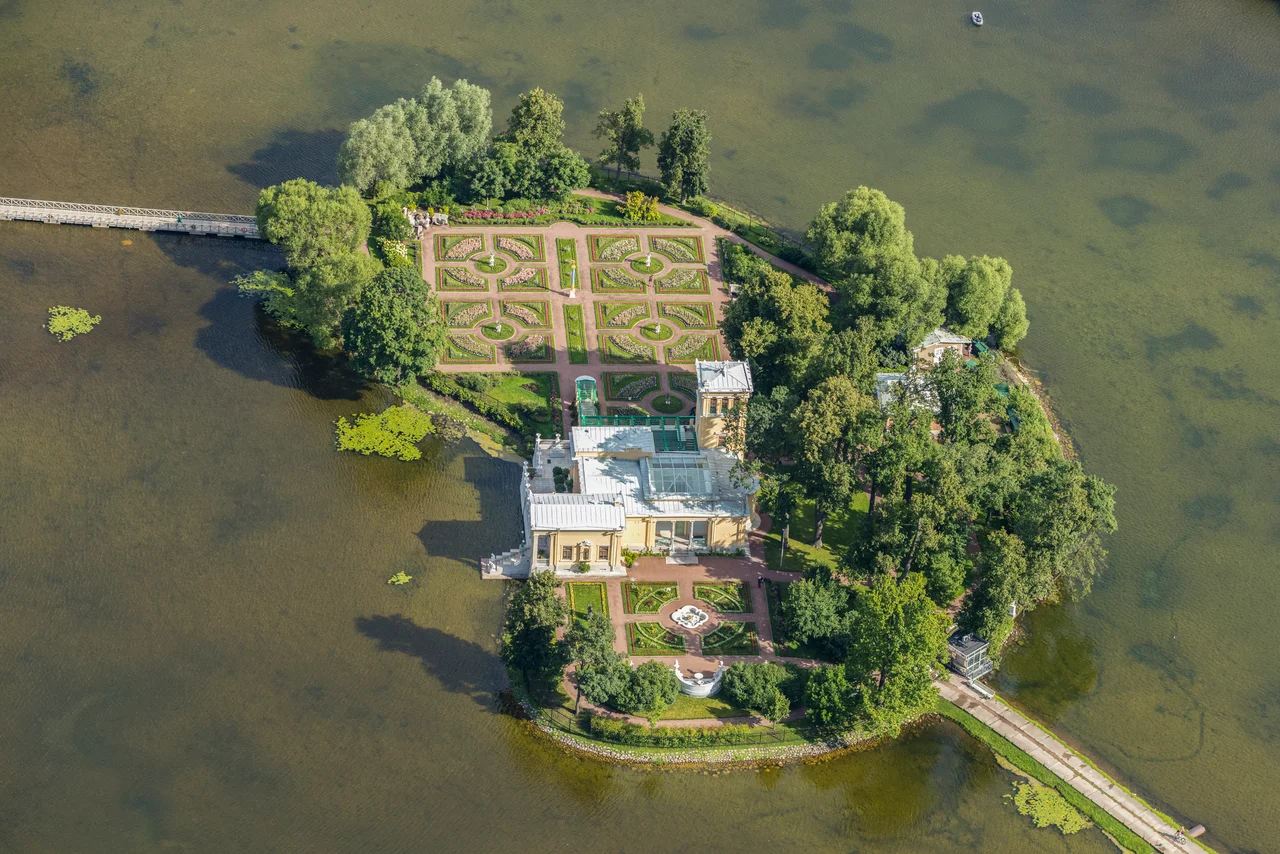

Peterhof Palace
Peter the Great visited Louis XIV's court in 1717 and came home determined to outdo it. He had already begun a country residence west of his new capital, Saint Petersburg, but Versailles changed his ambitions. The Peterhof he commissioned would not be a hunting lodge with gardens. It would be a statement: Russia had arrived in Europe, with the wealth and the engineering and the artistic confidence to match any French king. Two and a half centuries later, the Wehrmacht spent three years trying to obliterate it. The Russians put it back, fountain by fountain, statue by statue.
Peter's Sketches
Construction began in 1714 with a small palace called Monplaisir — Peter's own private retreat, designed largely by the Tsar himself. He chalked out the site, sketched the interiors, fussed over decorative details. By 1717, after seeing what Louis XIV had built at Versailles, Peter expanded his vision dramatically. The architect Domenico Trezzini supplied the Petrine Baroque style that would define Saint Petersburg. The French landscape designer Jean-Baptiste Le Blond — who had collaborated with Versailles' own André Le Nôtre — laid out the gardens. The Italian architect Bartolomeo Rastrelli later expanded the Grand Palace for Empress Elizabeth between 1747 and 1756, adding the wings that give it its present silhouette. The whole complex grew over decades, but Peter's stamp remained on it: the bluff above the Gulf of Finland, the cascade pouring down toward the sea, the channel cut to admit imperial barges.
The Grand Cascade
The masterpiece is the Grand Cascade. Sixty-four fountains tumble down a tiered staircase below the palace, ranged around a central grotto and feeding a semicircular pool that begins the Sea Channel — a long water boulevard cutting straight to the gulf. At the foot of the cascade stands the Samson Fountain: the biblical hero ripping open a lion's jaws, and from the lion's mouth a single jet of water shoots twenty meters into the air. The symbolism was specific. Peter's victory over Sweden in the Great Northern War had been sealed at the Battle of Poltava, fought on St Sampson's Day. The lion was the Swedish coat of arms. Russia had bested Sweden, the lion had been torn open, and water from a fountain commemorated it forever. The technological feat is just as impressive as the iconography: every fountain at Peterhof runs without pumps. Water flows from natural springs into reservoirs in the upper gardens, and the elevation difference alone drives the entire system.
1941
On 23 September 1941 German troops captured Peterhof. The Soviet evacuation had managed to save only a fraction of the treasures. Workers had tried to dismantle and bury the largest fountain sculptures, but three quarters remained in place, including the Samson group, when the Wehrmacht arrived. Two weeks later the Soviets attempted to take it back. 510 marines of the Baltic Fleet landed on the beach of Alexandria Park on 5 October. The operation collapsed almost immediately. The commander was killed. One landing craft was sunk, another missed the beach entirely. Coastal artillery from Kronstadt could not coordinate with troops who had no working radios. By 7 October the last pockets of resistance had been destroyed. German forces released dogs into the gardens to find the marines hiding among the fountains, and many of the wounded were mauled. Then the occupiers settled in for nearly three years. They looted what they could. They blew up parts of the palace and burned what would not move. By the time Soviet forces drove them out in 1944, the Grand Palace was a roofless ruin and Samson was gone.
Putting It Back
Restoration began almost immediately. The Lower Park reopened to the public in 1945 — sooner, in some ways, than it had any right to. Russian craftsmen had been documenting Peterhof for decades, and pre-war photographs and measured drawings made reconstruction possible. A replica of the Samson statue was installed in 1947, recreated from photographs because the original had vanished forever, presumably melted down by the occupiers for its bronze. The Soviet government renamed the complex Petrodvorets — Peter's Palace — in 1944, scrubbing the German-derived name during a wave of wartime patriotism. The original name was restored only in 1997, after the USSR itself was gone. The work continues today. Nearly every visitor to the Grand Cascade is looking at recreation rather than original — but the gardens, the cascade, the fountains driven by gravity from springs in the hills above, are exactly what Peter and Le Blond designed three centuries ago. UNESCO listed Peterhof and the historic centre of Saint Petersburg as a World Heritage Site in 1990.
From the Air
Peterhof sits at 59.89°N, 29.91°E, on the southern shore of the Gulf of Finland about 30 km west of central Saint Petersburg. ULLI (Pulkovo Airport) is 35 km east. From the air, the complex is unmistakable: the bluff drops to a long straight Sea Channel pointing toward Kronstadt Island and the gulf beyond. The Grand Cascade and golden Samson Fountain catch the sun directly opposite the palace. In summer the formal gardens trace clean geometric patterns; in winter the fountains are dry and shrouded. EFHK (Helsinki Vantaa) lies 280 km west across the gulf. EETN (Tallinn) is 320 km southwest. Peterhof is best appreciated below 5,000 ft on approach to or departure from Pulkovo.
Nearby Stories
- Battle of Krasny Bor 20 km away
- Ingrian War 28 km away
- Yam Fortress 58 km away
- Ivangorod Fortress 107 km away
- Khutyn Monastery 121 km away
- Battle of Fredrikshamn 137 km away
- Battle of Svensksund (1789) 173 km away
- Battle of Kollaa 231 km away