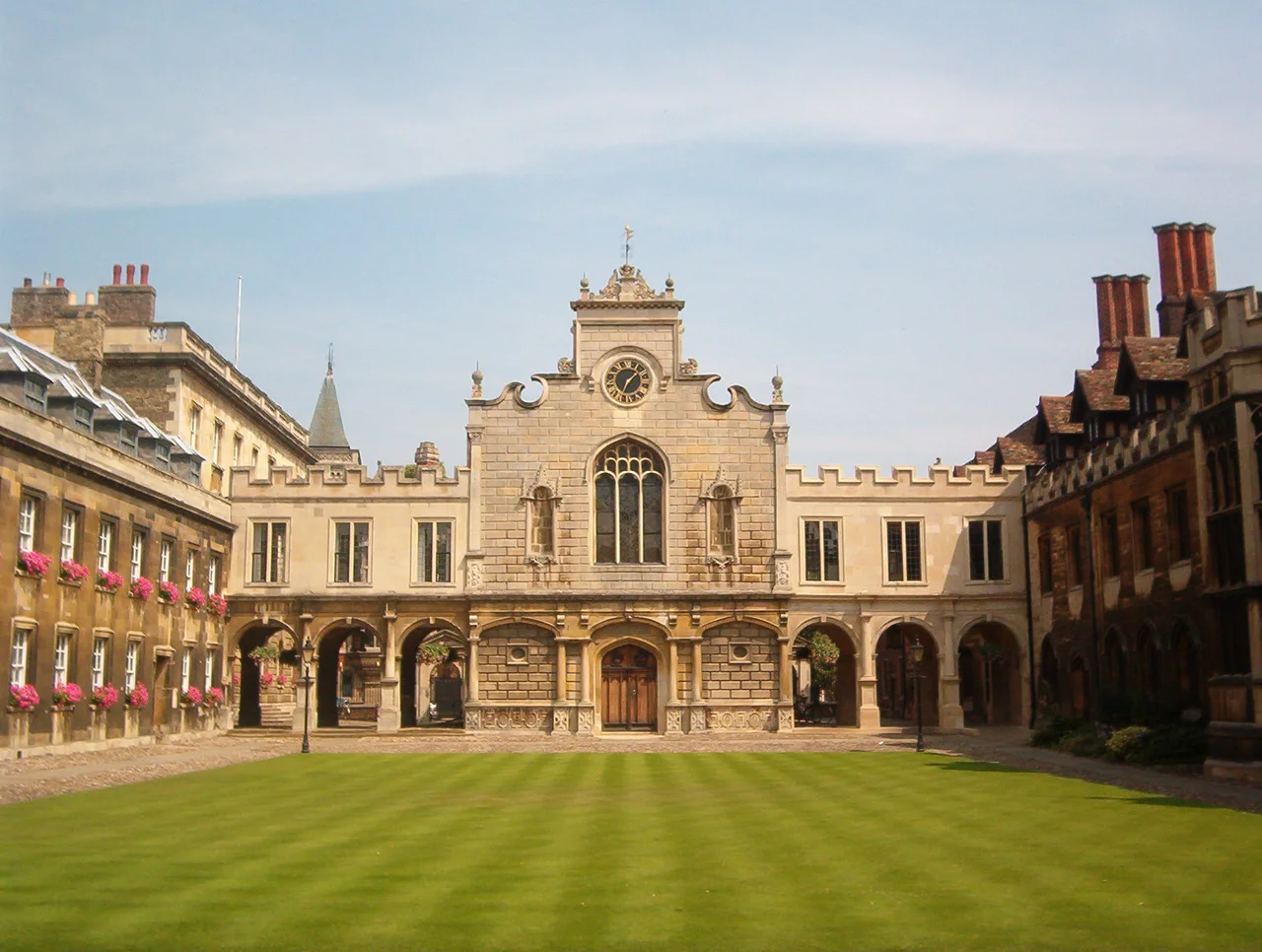

Peterhouse, Cambridge
In 1883–84, Lord Kelvin provided electric lighting for the Hall and Combination Room at Peterhouse, celebrating the college's six-hundredth anniversary. It was the second building in the country to receive electric lighting, after the Palace of Westminster. Kelvin had studied here. So had Henry Cavendish, who discovered hydrogen. So had Charles Babbage, the father of computing, and James Clerk Maxwell, who formulated classical electromagnetic theory, and Frank Whittle, who invented the jet engine. Peterhouse is the oldest college in Cambridge, founded in 1284, and its record of producing scientists who changed the world is essentially unmatched.
The Oldest College in Cambridge
Peterhouse dates to 1280, when letters patent from Edward I allowed Hugh de Balsham, Bishop of Ely, to house scholars in the Hospital of St John. After a dispute between the scholars and the hospital's brethren, Balsham transferred the scholars in 1284 to two houses just outside Trumpington Gate. That transfer is considered the founding of Peterhouse. The dining hall — the building that still stands on the south side of Old Court — is the oldest collegiate building in all of Cambridge, the only Peterhouse building to survive from the 13th century. Its stained glass windows were destroyed by Parliamentary forces in 1643; only the east window's crucifixion scene survived. The replacements installed in 1855, by the Bavarian artist Max Ainmiller, are still there. William Morris, Ford Madox Brown, and Edward Burne-Jones contributed Pre-Raphaelite stained glass panels during a restoration between 1866 and 1870.
Scientists Who Changed Everything
The list of Petreans — as Peterhouse alumni are known — who made fundamental contributions to science is extraordinary. Henry Cavendish, studying at Peterhouse in the 18th century, identified hydrogen as a distinct element and measured the density of the Earth. Charles Babbage designed the Difference Engine, widely considered the first mechanical computer. James Clerk Maxwell formulated the equations that describe electromagnetism, unifying electricity, magnetism, and light into a single framework and establishing the foundation of modern physics. Frank Whittle invented the turbojet engine; Sam Mendes, the Oscar-winning film director, and David Mitchell, the comedian and writer, offer a different order of distinction. Peterhouse has five Nobel laureates in chemistry: John Kendrew, Aaron Klug, Archer Martin, Max Perutz, and Michael Levitt.
Puritans, Arminians, and Decorations Torn Down
Peterhouse has not always been a quiet academic retreat. Between 1626 and 1634, the Master was Matthew Wren (uncle of the architect Christopher Wren), a firm supporter of Archbishop Laud. Under Wren and his successor John Cosin, the college chapel was redecorated to reflect Laud's vision of the 'beauty of holiness.' On 21 December 1643, the Puritan zealot William Dowsing led a committee that pulled down the statues and decorations in the chapel. A single crucifixion scene survived, partially because it was based on a painting by Rubens and was harder to destroy. The Peterhouse Partbooks — music manuscripts from the chapel's early years — are one of the most important collections of Tudor and Jacobean church music in existence. Some of the material has not been heard since the 16th century.
The Peterhouse Right and Seven Wasted Years
In the 1980s, the mastership of Hugh Trevor-Roper coincided with a period of intense ideological conflict among the fellowship. Maurice Cowling and Roger Scruton were influential fellows associated with what became known as the 'Peterhouse right,' a philosophical conservative movement linked to Thatcherite politics — though its relationship to Thatcher's economic liberalism was complicated. Trevor-Roper fought repeatedly with Cowling's faction, pushed through administrative reforms, and urged the admission of women (achieved in 1983). The conflict became, in the words of journalist Neal Ascherson summarising Adam Sisman's biography, a campaign to drive Trevor-Roper out 'by grotesque rudeness and insubordination.' In 1987, Trevor-Roper retired, complaining of 'seven wasted years.' The college is widely believed to have partly inspired Tom Sharpe's satirical novel Porterhouse Blue. Today Peterhouse consistently ranks in the top ten of Cambridge colleges academically.
From the Air
Peterhouse is located at 52.201°N, 0.118°E on Trumpington Street, immediately north of the Fitzwilliam Museum in central Cambridge. Cambridge City Airport (EGSC) is approximately 2 nautical miles to the northeast. From the air, Peterhouse's compact site and small deer park — now without deer — are visible south of the main college area. The approach from the east over flat Cambridgeshire farmland provides excellent forward visibility. Best viewed at 1,000–2,000 feet in clear conditions.
Nearby Stories
- Kentwell Hall 2.5 km away
- Thetford Hoard 2.8 km away
- King's Ely 6 km away
- Bedford 7.8 km away
- White House Farm murders 13 km away
- Oundle 14 km away
- Hemel Hempstead 14 km away
- North Weald Airfield 15 km away