
Philae temple complex
For sixty years, tourists visited Philae by rowboat and looked down through clear green water at a temple they could not walk into. The Aswan Low Dam, completed in 1902 and raised twice more, kept the sacred island of Isis flooded for most of every year; only when the dam's sluices opened from July to October did the colonnades and pylons briefly surface, streaked with silt. The temple was drowning by degrees. What the British engineers had built to modernize Egypt was slowly dissolving one of its most beautiful monuments, an island shrine that had drawn pilgrims for well over a thousand years. Saving it would take an even bolder idea than the dam that doomed it.
The Last Light of the Old Gods
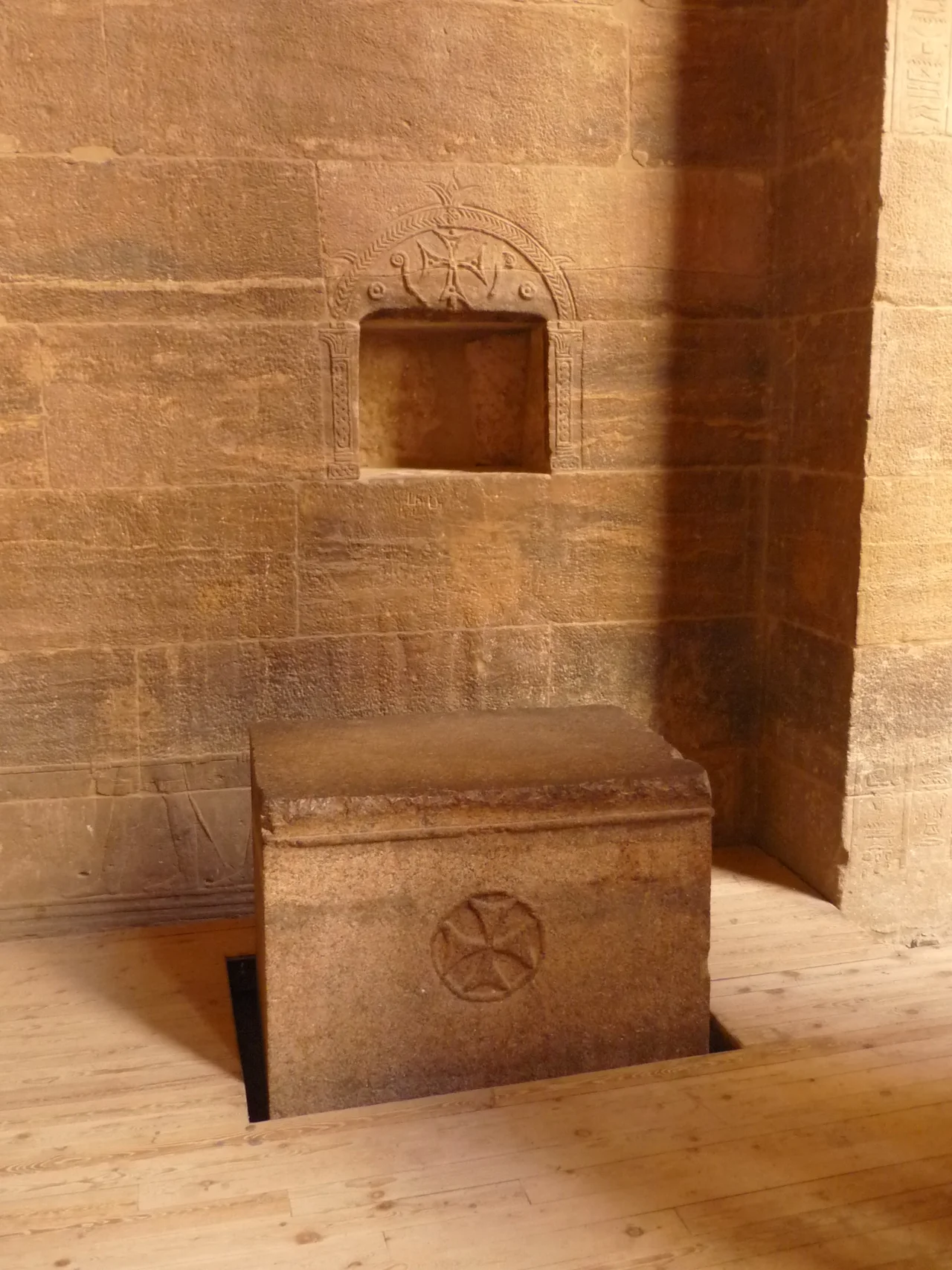
Philae held on to ancient Egyptian religion longer than almost anywhere else. As the Roman world turned away from the old faith, this island near the First Cataract remained a working sanctuary of Isis, where worship and inscription continued for centuries after such things had ended elsewhere. The Kushite king Yesebokheamani made a pilgrimage here. The last evidence of an active pagan priesthood dates to the 450s, and the temple is often cited as the place where the old religion finally fell silent. Christianity then took root in its halls, leaving altars among the hieroglyphs, so that even Philae's conversion was layered onto what came before rather than scrubbing it away.
Half a Century Underwater
The slow flooding after 1902 did not topple the temple, but it bled the life out of it. Engineers chose to reinforce the foundations rather than move the buildings, and the structures held. The losses were of another kind. The island's lush vegetation died, the painted color on the reliefs washed away, and the carved walls grew encrusted with silt and debris carried in by the Nile. By the 1960s, with the new High Dam about to raise the water permanently, the situation turned dire: the island sat submerged up to a third of the buildings all year round. Reinforcement had bought time. It had not bought a future.
Moving an Island
In 1960, UNESCO launched a rescue that reads more like engineering science fiction than archaeology. First, workers ringed Philae with a vast coffer dam, two rows of steel plates packed with a million cubic meters of sand, and pumped the enclosure dry. Then specialists measured every surface using photogrammetry, a technique that let them reconstruct each block's exact dimensions. Stone by stone, they took the entire complex apart into roughly 40,000 pieces weighing two to twenty-five tons each. The destination was Agilkia, a nearby island on higher ground some 500 meters away, which engineers reshaped, shaving off its top, to match the old contours of Philae as closely as they could. The transfer ran from 1977 to 1980.
Philae Reborn
Today the Temple of Isis stands on Agilkia, rebuilt so faithfully that most visitors never realize they are not on the original island, much as travelers at Abu Simbel rarely notice its cliff is artificial. Boats now cross open water to reach it, gliding over the place where the old island lies submerged. The pylons rise again, the colonnades run unbroken, and the elegant kiosk of the emperor Trajan still frames the river view it was built for. Just to the west, the holy island of Bigeh remains beneath the surface, its ruins lost to the reservoir; from its highest point travelers once looked out over the cataract where the Nile plunged over shelves of rock. Philae was luckier. The same campaign that lifted Abu Simbel out of the water's reach also gave this island of Isis a second island to stand on. It is one of the great triumphs of the effort to save Nubia, a temple that was taken apart in order to keep it whole.
From the Air
Located at roughly 24.03 N, 32.88 E on Agilkia Island in the reservoir between the Aswan Low Dam and the Aswan High Dam, just south of Aswan, Egypt. Nearest airport: Aswan International (ICAO HESN), about 15 km north. From the air the relocated complex reads as a compact temple island, its pylons and colonnades set amid open water near the First Cataract; the submerged original Philae island and the drowned island of Bigeh lie nearby. High-visibility desert conditions prevail year-round, with the temple best seen at low approach when the colonnades and Trajan's Kiosk cast long shadows.
Nearby Stories
- Temple of Dendur 40 km away
- Edfu 80 km away
- Qasr Ibrim 125 km away
- Wadi Allaqi 150 km away
- Wadi El Gemal National Park 168 km away
- Lake Nasser 173 km away
- Kharga Oasis 212 km away
- Berenice Troglodytica 213 km away