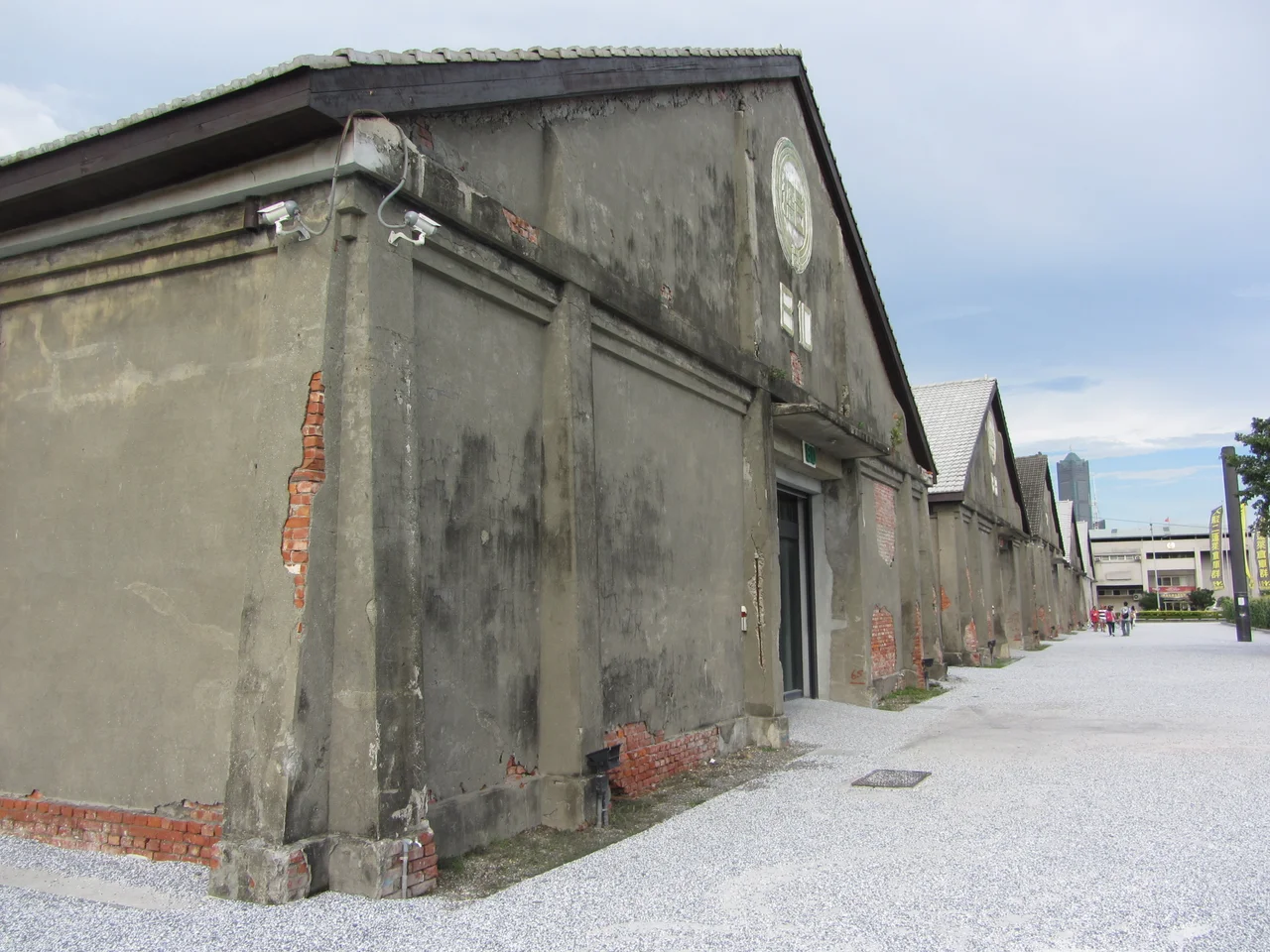

Pier-2 Art Center
In the 1990s, the warehouses along Kaohsiung's inner harbor sat empty and decaying, artifacts of a port economy that had shifted away from the old docks. They were built in 1973 to hold cargo, and for years after the cargo stopped coming, the only question was when the bulldozers would arrive. A group of local artists had a different idea. Through sustained pressure and persistence, they convinced the city to hand the warehouses over to the creative community rather than tear them down. What emerged from that fight is the Pier-2 Art Center — a complex of converted industrial buildings in Yancheng District that now hosts exhibitions, film screenings, markets, cycling paths, and one of Taiwan's most unusual railway museums, all within walking distance of the harbor's edge.
From Cargo Hold to Canvas
The warehouses that became Pier-2 were built in 1973 as functional port infrastructure, part of Kaohsiung's identity as one of Asia's major container shipping hubs. When the city's economy pivoted toward services and manufacturing moved elsewhere, the old dockside facilities lost their purpose. The shift left buildings — solid concrete and steel structures, built to last — standing idle on prime waterfront land. Developers saw redevelopment potential. The artists who campaigned for the buildings saw something else: volume, industrial texture, proximity to the water, and a history that had value precisely because it was disappearing. Their campaign succeeded. In 2006, the Bureau of Cultural Affairs of Kaohsiung City Government formalized the arrangement, bringing the Kaohsiung Pier-2 Art Development Association and Shu-Te University's art development workshop in to manage the growing complex. A new kind of institution was taking shape on the old docks.
A District Built from Warehouses
Pier-2 is not a single building but a district — a cluster of named warehouses spread across a stretch of the old harbor, each with its own character and programming. The Dayi Warehouse and P2 Warehouse anchor the complex, while the Penglai Warehouse and C1, C2, C3, and C5 Warehouses host different uses, from contemporary art exhibitions to the In89 Cinemax, a cinema operating inside one of the converted cargo spaces. The Moonlight Theater brings live performance to the waterfront. The Bicycle Warehouse is exactly what it sounds like: a facility connecting Pier-2 to the West Coast Bike Path that follows the harbor edge, making the art center a natural waypoint for cyclists exploring the coastline. The Art Plaza opens the complex toward the water, giving the whole district an outdoor gathering space where the harbor light falls across murals and sculpture.
Trains, Tracks, and the Hamasen Museum
Among the more unusual inhabitants of Pier-2 is the Hamasen Museum of Taiwan Railway, housed in Warehouses 7 and 8. Hamasen — the old Japanese-era name for the waterfront district — was once the terminus of Taiwan's western railway corridor, and the connection between the port and the rail network was central to Kaohsiung's industrial history. The museum preserves that connection, displaying rolling stock, station equipment, and archival material from the railway's long history in southern Taiwan. It is a reminder that the culture being preserved at Pier-2 is not only that of contemporary artists but also that of the workers and engineers who built the infrastructure the artists now inhabit. The presence of a railway museum inside an art center feels unlikely, but it fits: both are about honoring the human labor embedded in objects.
Fire and Continuity
On the night of 9 March 2021, at 1:04 a.m., fire broke out in one of the warehouse buildings at Pier-2. The blaze was extinguished within two hours, but by the time firefighters finished, the building was reduced to its concrete walls and metal frames — the bones of the structure standing bare against the harbor sky. For a complex that had already survived bureaucratic indifference and the pressures of urban redevelopment, the fire was another test. The concrete shell that remained is both a ruin and a record: evidence of what the building was, and of what fire does to a space. How that particular structure is used going forward is itself an artistic and curatorial question, the kind the people at Pier-2 have always been willing to ask.
By Light Rail, Bike, or Metro
Getting to Pier-2 has become easier as Kaohsiung has built out its transit network. Since 2017, the complex has been served by two stations on the Kaohsiung Circular Light Rail: Dayi Pier-2 Station and Penglai Pier-2 Station, connecting the art center directly to the broader loop of the LRT that encircles the city center. The Kaohsiung MRT's Yanchengpu Station is also within walking distance. And because the West Coast Bike Path runs through the complex, arriving by bicycle is perhaps the most fitting approach — rolling in along the harbor's edge, with the old warehouses materializing ahead and the sounds of the port giving way to the sounds of art.
From the Air
The Pier-2 Art Center sits at 22.6199°N, 120.2820°E on the inner harbor waterfront of Yancheng District, Kaohsiung, approximately 4 kilometers southwest of Kaohsiung International Airport (RCKH). From the air the complex is identifiable by the cluster of parallel warehouse rooftops running along the harbor edge, just south of the Love River mouth where it enters the inner harbor. The Kaohsiung port container terminals are visible to the south and west. At 2,000–3,000 feet, the contrast between the old warehouse district and the modern city skyline to the north is clearly apparent. RCKH is the nearest airport, only 4 km northeast — pilots on approach to runway 09 pass almost directly over the Yancheng waterfront.
Nearby Stories
- Taimali 7.2 km away
- Meinong East Gate Tower 15 km away
- Kunci Temple 20 km away
- Checheng Fu'an Temple 42 km away
- Dongji Island 49 km away
- Orchid Island 69 km away
- South Penghu Marine National Park 77 km away
- Hong Kong 12 549 km away