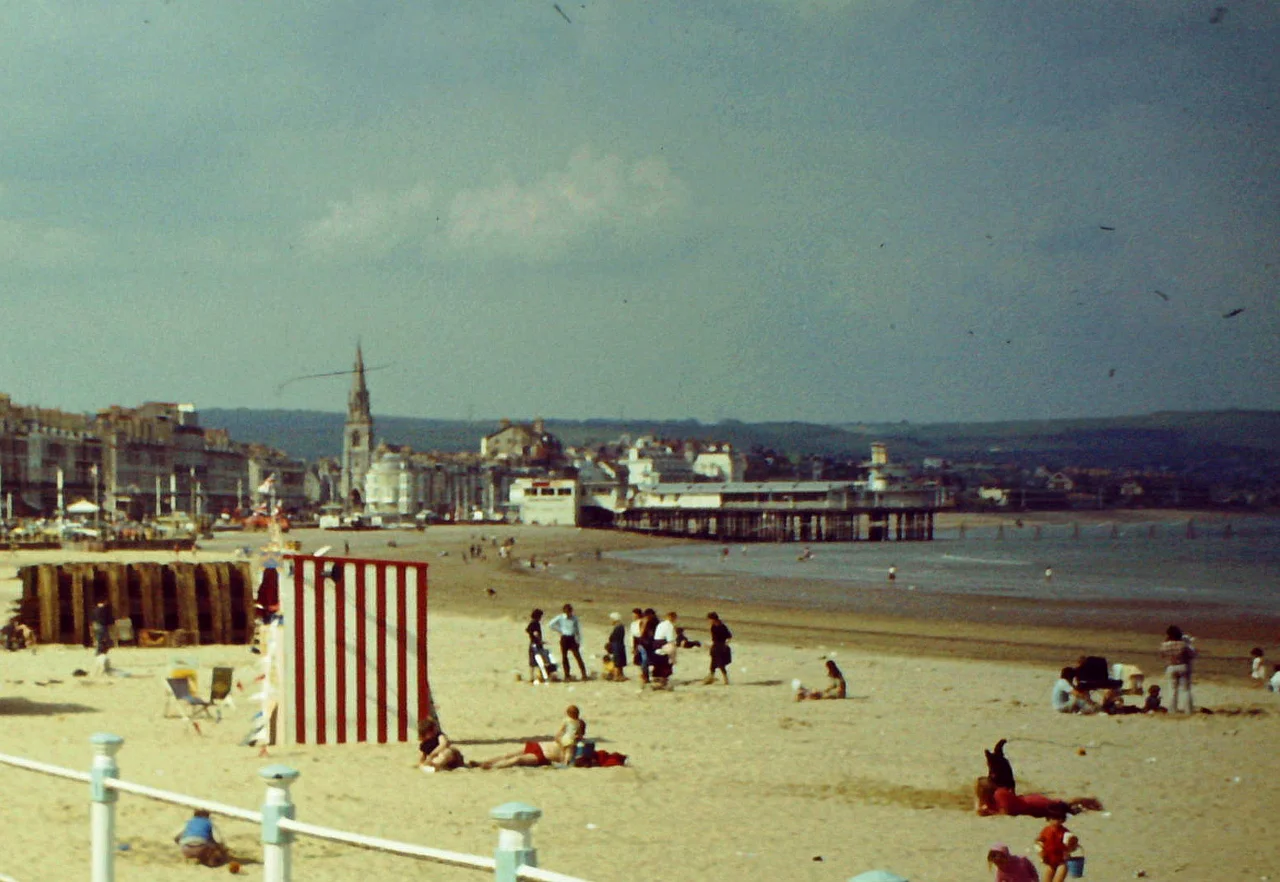

Pier Bandstand, Weymouth
On a spring afternoon in 1986, two Weymouth schoolgirls were chosen to push a button and detonate the underwater explosives that brought down their town's beloved seafront landmark. The Pier Bandstand had survived a world war, a 1960s reinvention as an amusement arcade, and forty-seven years of admission queues - but its reinforced concrete piles had finally rotted past saving. The engineering report was blunt: the structure could not be expected to carry the weight of the platform much longer. So the council chose two children, gave them the plunger, and brought the curtain down on Weymouth's strangest piece of Art Deco architecture in front of a crowd that had grown up dancing on it.
A Competition with Twenty-Six Entries
Weymouth Corporation announced the project in June 1936: a new bandstand and concert enclosure on the seafront, to replace the modest 1907 Burdon Bandstand on the same Esplanade site. An open architectural competition drew twenty-six designs. H. S. Goodhart-Rendel, one of the most influential British architects of the inter-war years, picked the winner in May 1937 - a streamlined Art Deco scheme by V. J. Wenning of London. The first concrete pile was driven on 18 March 1938. Just over a year later, on 25 May 1939, the Mayor of Weymouth, John T. Goddard, opened the completed structure. The bandstand extended two hundred feet seawards on reinforced concrete piles, with an outer promenade running around the edge of the main deck. The £35,000 build was the kind of municipal optimism the late 1930s specialised in producing, just months before that optimism became impossible.
A Quarter of a Million Admissions
In its first summer season, more than 250,000 people paid to come aboard the bandstand. Then the war started. Admissions fell to 55,000 in 1940 and 50,000 in 1941; the bandstand was largely closed for the duration. It fully reopened in July 1944, with light repairs to the piles. Once peace returned, the dance bands came back too, and the bandstand quickly became one of Weymouth's defining venues. Concerts. Roller skating. Wrestling. The Miss Weymouth Bathing Beauty Contests, which drew local young women to compete in front of holiday crowds. From around 1944 the entrance building housed Pullingers Cafe, run by Dennis and Mary Pullinger - it became the social heart of the structure, and outlasted the bandstand by decades.
The Slow Reinvention
By the 1960s, audiences for live bandstand entertainment had been thinned out by television and changing tastes. In 1967 the bandstand was redesigned to house an amusement arcade and rides instead. The concrete piles, already a quarter-century old in salt water, were repaired between 1966 and 1967 as the structure was modified for its new role. The amusement park ethos took hold completely. In 1979 a £50,000 refit added new arcade machines, mini-dodgems, an inflatable castle and radio-controlled boats. In 1981 the Pullingers retired and sold their business to Derek and Susan Abutt, who turned the entrance restaurant into the Seaview. The bandstand had become a thoroughly different building - still busy, still loved, but no longer the venue Wenning had drawn in 1937.
The Big Bang
The 1985 structural report from the engineers Lewis and Duvivier concluded what locals could already see in the cracked concrete: the piles had suffered severe deterioration and the bandstand was in an unsafe condition. The council decided to keep the entrance building, which still held the restaurant and the shops, and remove everything beyond it. The demolition contractor, Dismantling & Engineering Ltd of Halesowen, separated the entrance from the seaward platform first. Then came the explosives. The schoolgirls pushed the plunger, the deck collapsed into Weymouth Bay, and forty-seven years of summer holidays ended in a single spray of grey water. The Dorset Echo ran photos. A landmark was gone, and a small triangle of Art Deco frontage was all that remained.
An Italian on the Esplanade
The entrance building still stands at the northern end of the Esplanade. It very nearly didn't survive - in 1991 the council considered demolishing it for £68,000 before voting to keep it. In 1994 the local businessman Peter Bennett took over the lease and pushed through a refurbishment scheme that aimed to restore the building's 1930s Art Deco look, completed in 2000. The first floor became a Chinese restaurant in 2002, an Italian one called Al Molo in 2015, and a different Italian, Oliveto, in 2023. The ground floor still operates an amusement arcade, a gift shop, and the public toilets that have become quietly essential to the seafront. The ambitious 2007 plan to restore and extend the bandstand for the 2012 Olympics collapsed when the South West Regional Development Agency withdrew its £6.6 million in 2009. The fragment that survives is the last piece of a building that once stretched two hundred feet into the bay - an Art Deco doorway with a memory.
From the Air
50.6172°N, 2.4505°W on the northern end of Weymouth's Esplanade, at the seaward end of the seafront's main promenade. Only the entrance building survives today - look for the Art Deco frontage where the curve of the Esplanade meets the beach. Nearest aviation reference is Bournemouth (EGHH) about 29 nm east. Best viewed at 1,500-2,500 ft AGL on a westerly approach over Weymouth Bay; the long straight Esplanade and Weymouth's Georgian seafront read clearly from the air.
Nearby Stories
- Needles Lighthouse 18 km away
- Lyme Bay Canoeing Disaster 19 km away
- HMS Formidable (1898) 19 km away
- National Motor Museum, Beaulieu 22 km away
- Sherborne Castle 22 km away
- Muchelney Abbey 24 km away
- German Submarine U-672 29 km away
- Battle of Cherbourg (1864) 58 km away