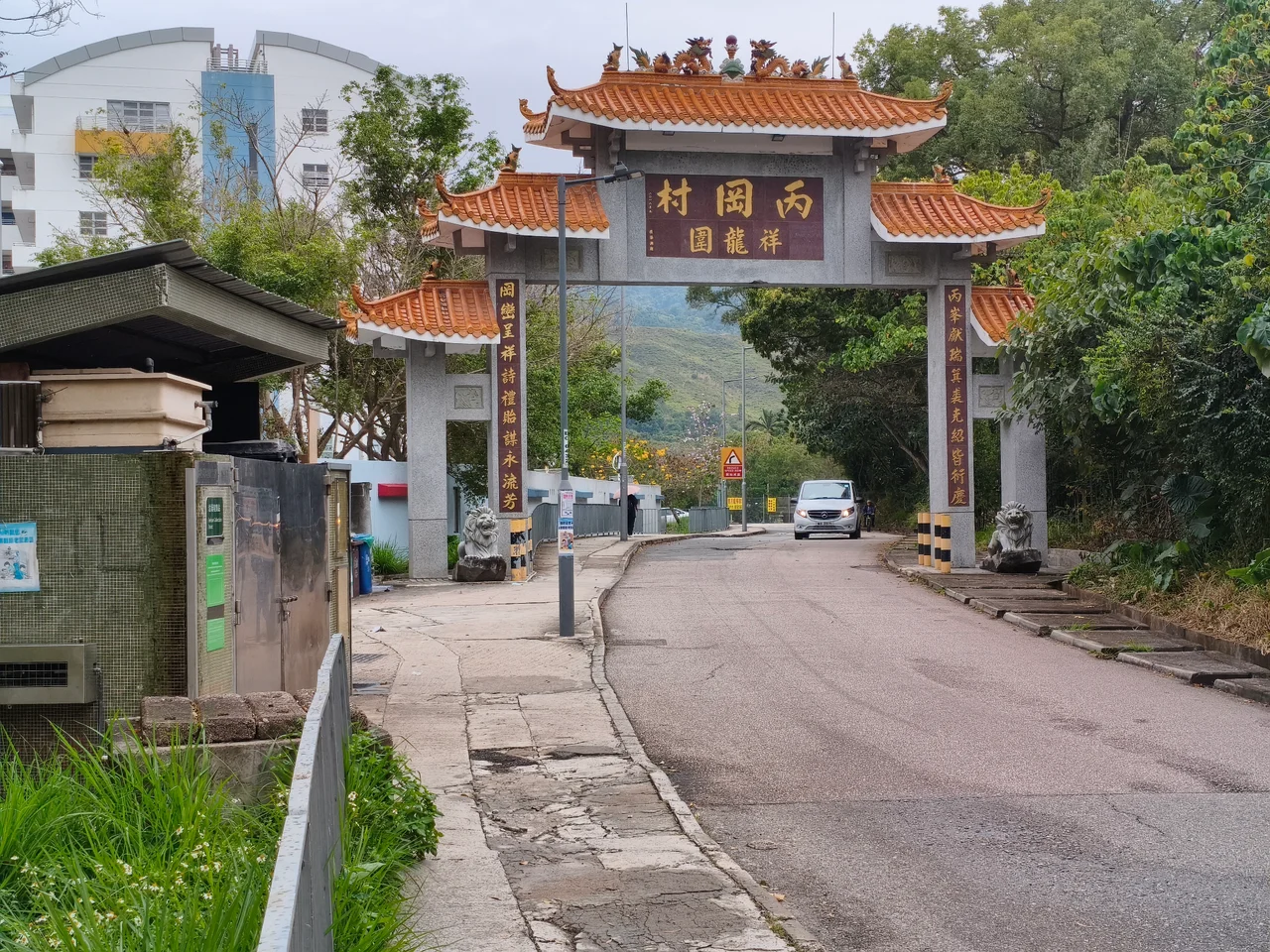

Ping Kong
Ping Kong's Tin Hau Temple has been standing for centuries — long before the village became known to a wider audience through its association with Hong Kong's film industry. The village around it has been standing longer still, its walls enclosing a history that stretches back to the Southern Song dynasty, when the Hau clan first made their way to this corner of what would one day become Hong Kong. The old name for the village was Cheung Lung Wai: the Lucky Dragon Wall.
Eight Hundred Years Behind the Wall
The Hau clan is one of the Five Great Clans of the New Territories, those dominant lineages whose arrival in the region during the Song dynasty shaped its social and agricultural landscape for centuries. They came to what is now Hong Kong toward the end of the twelfth century, first settling at Ho Sheung Heung, then branching outward into three daughter villages: Yin Kong, Kam Tsin, and Ping Kong. The walled village — the 'wai' — that gave Ping Kong its old name, Cheung Lung Wai, was both a practical defense and a statement of permanence. Walls meant you intended to stay. By the early twentieth century, Ping Kong was described in contemporary accounts as 'a very wealthy Punti village,' the Punti being the Cantonese-speaking settled population as distinct from the Hakka newcomers. The village has been recognized under Hong Kong's New Territories Small House Policy, continuing a centuries-old tradition of indigenous village rights in a territory that has otherwise transformed almost beyond recognition.
The Tin Hau Temple and the Ancestral Hall
Tin Hau — the Empress of Heaven, protector of fishermen and seafarers — is worshipped across coastal Hong Kong in dozens of temples large and small. The temple at Ping Kong is modest by comparison with some of the territory's grander shrines, but it carries a particular story. The Hau ancestral hall inside the village tells a different story: the original hall outside the walls was burned down during a conflict with the Man clan, and the clan rebuilt it within the safety of the walled enclosure. Both buildings survive, layered monuments to devotion and to the violence that sometimes surrounded it.
The Once-a-Decade Festival
Every ten years, Ping Kong holds the Taiping Qingjiao festival — a three-day Taoist celebration to thank the heavens for a peaceful decade and to ask for prosperity in the decade to come. It is one of the few villages in Hong Kong that still maintains this tradition. The most recent festival was held in 2018. Representatives are chosen from among the Hau family by tossing ritual cups called Holy Cups; the genealogy book is consulted, and the first five males who toss both cups face-up are designated to lead the ceremonies. Members of the Hau clan who have emigrated to Europe and the Americas — and there are many — return for this event. The rituals over those three days are elaborate: animals are freed as acts of compassion, wandering spirits are symbolically invited into the village and then sent on their way, a 'horse' is ceremonially run around the village to gather the names of all residents for transmission to the heavens, and the ghost king is carried through the streets to capture evil spirits before being burned at the ceremony's end.
Food, Family, and the Lucky Dragon Wall
The festival is also, practically, a reunion. Hau family members gather at the ancestral hall for communal meals during the three days of ceremony, eating traditional vegetarian poon choi — the layered Cantonese feast dish — while the rituals continue. After the formal ceremonies conclude, the poon choi shifts to its classic version: meat, seafood, and vegetables stacked in wooden basins. Each household in the clan receives a portion of roast pork. It is a meal that acknowledges both the sacred and the practical, the obligations to heaven and the pleasures of being together. The village that was once called the Lucky Dragon Wall stands at the edge of Sheung Shui, surrounded by the infrastructure of modern Hong Kong — rail lines, industrial estates, the vast logistics corridors that connect the territory to the mainland. The walls are still there. The ancestral hall is still there. And every decade, the clan comes home.
From the Air
Ping Kong village sits at approximately 22.49°N, 114.12°E in the North District of Hong Kong, near the town of Sheung Shui. It lies roughly 3 km south of the border with mainland China and about 5 km west of the Lo Wu crossing. Hong Kong International Airport (VHHH) is approximately 40 km to the southwest on Lantau Island. At low altitude, the village is distinguishable within the Sheung Shui urban area as a historic walled cluster amid the more modern development. The MTR East Rail Line runs nearby, making this an accessible destination from central Hong Kong.
Nearby Stories
- Chapel of St. Francis Xavier 3.5 km away
- Cuiheng 4.1 km away
- 2015 Shenzhen Landslide 16 km away
- Shunde 31 km away
- Wanshan Archipelago 37 km away
- Nanxiong Formation 96 km away
- Heyuan 149 km away
- Checheng Fu'an Temple 629 km away