.jpg)
Ping Shan Heritage Trail
The Tsui Sing Lau Pagoda stands three storeys tall at the edge of Ping Shan, its grey stone weathered by more than six hundred years of Hong Kong's subtropical summers. It is the only ancient pagoda in the territory — a fact that might seem less remarkable until you consider that Hong Kong, widely understood as a city that reinvents itself every decade, has been continuously inhabited for far longer than most of its residents suspect. The Ping Shan Heritage Trail, inaugurated on 12 December 1993, connects this pagoda and thirteen other historic structures across three Tang clan villages in Yuen Long District. Walking it takes perhaps an hour. Understanding it takes considerably longer.
Seven Hundred Years of the Tang Clan
The Tang Ancestral Hall at the heart of the trail is one of the largest ancestral halls in Hong Kong. It was built by Tang Fung-shun, the fifth-generation ancestor of the Ping Shan Tang clan, roughly seven hundred years ago — which means it was standing before the Ming dynasty, before the Portuguese arrived in Asia, before any European had any reason to know this particular stretch of coastline existed. The hall is a three-hall structure with two internal courtyards, its wooden brackets and beams carved with Chinese decorative motifs. Shiwan dragonfish and pottery unicorns decorate the main ridges and roofs, their glazed surfaces still vivid. The rear hall holds ancestral tablets. The building is not a museum piece: it is used regularly for worship and for the celebration of traditional festivals. Adjacent to it, and declared a monument on the same day in December 2001, is a second compound built in the early sixteenth century by two eleventh-generation brothers of the clan, Tang Sai-yin and Tang Sai-chiu. A primary school occupied this building from 1931 to 1961 — a detail that quietly captures a century of social transformation in a single fact.
The Pagoda of Gathering Stars
Tsui Sing Lau — 聚星樓, or 'Pagoda of Gathering Stars' — was built by Tang Yin-tung, the seventh-generation ancestor, more than six hundred years ago. According to the clan genealogy, he built it to protect the village from flooding. The logic was geomantic: in Chinese feng shui practice, a tower at the right point in the landscape could redirect the flow of energy and deflect disaster. Whether the pagoda succeeded in its hydraulic ambitions is unclear, but it survived when many things did not, and it became a declared monument in December 2001. It stands today north-west of the walled village of Sheung Cheung Wai, compact and slightly asymmetrical in the way of very old structures, its stones darkened with age. Of all the sights on the trail, this one most requires the visitor to stand still for a moment and simply look.
Wells, Walls, and Watchtowers
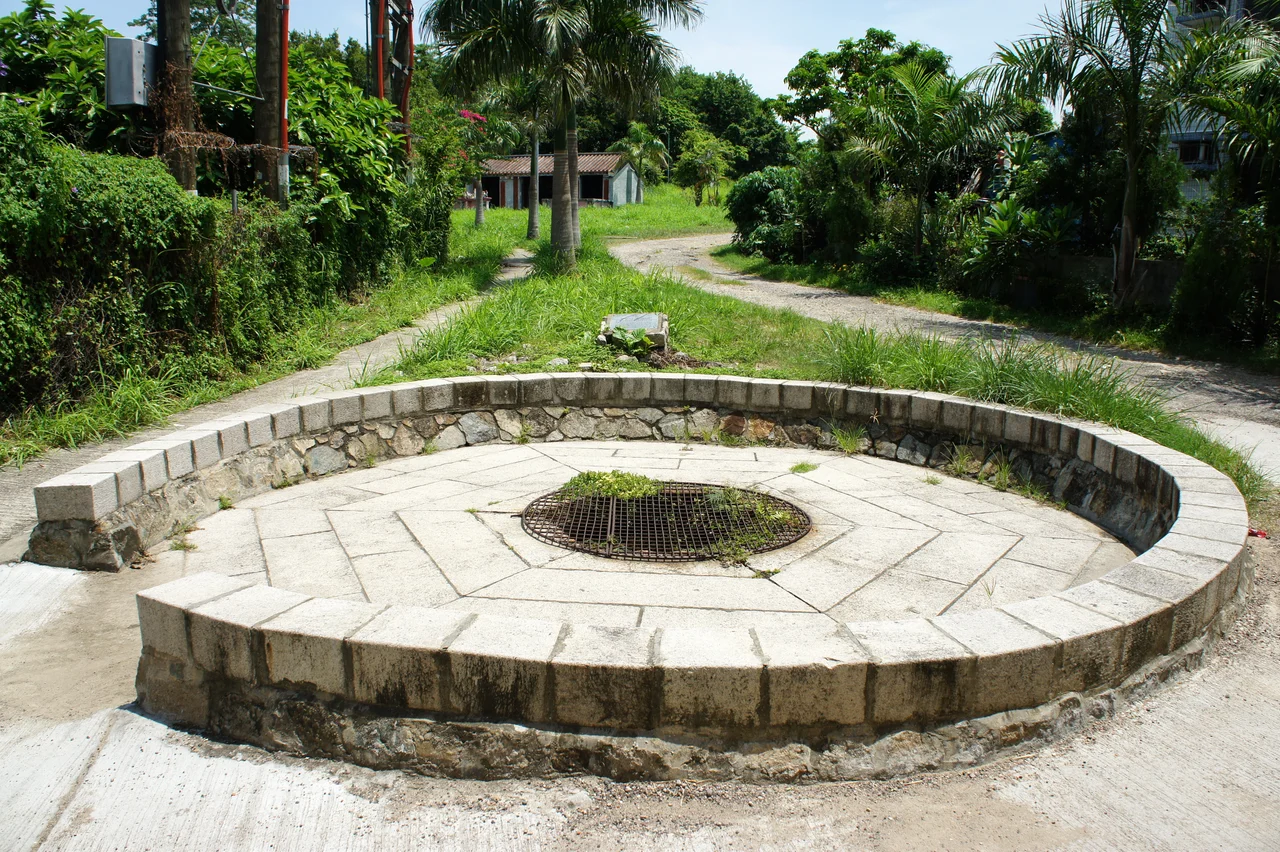
Between the Yeung Hau Temple and Sheung Cheung Wai, the trail passes an old well. Tang villagers say it was built more than two hundred years ago by residents of Hang Tau Tsuen; it was once the main water source for two villages. The exact date of its construction is unknown, and the well itself is unremarkable to look at — a stone collar rising from the ground, the kind of structure that is easy to walk past. But it held the water that kept people alive here for generations, which is not nothing. Sheung Cheung Wai, the walled village at the trail's end, was built around the same time by a Tang clan branch from Hang Tau Tsuen. It is the only walled village on the trail itself. The moat that once surrounded it has been filled in. Three of the original watchtowers have collapsed; only the lower storey of the southwest tower remains, and it has been converted for residential use. The walls still stand.
Temples, Study Halls, and an Earth God
The trail's fourteen historic structures span a range of functions that together describe the infrastructure of traditional Tang clan life: ancestral halls for remembering the dead, study halls for preparing scholars for the imperial civil service examinations, temples for propitiating the gods, and a police station — now the Ping Shan Tang Clan Gallery and Heritage Trail Visitors Centre, opened in 2007 in the old Ping Shan Police Station — for negotiating with more recent authority. The Hung Shing Temple was probably first built in 1767 during the Qianlong reign of the Qing dynasty; the existing structure was rebuilt in 1866. The Yeung Hau Temple, in Hang Tau Tsuen, is one of six temples in Yuen Long dedicated to Hau Wong. Near Sheung Cheung Wai, a small shrine to She Kung, the Earth God, stands in the simple form that such shrines usually take: a few bricks, a piece of stone, the presence of the deity indicated rather than represented. The trail connects these places not just physically but chronologically, running from the Tang clan's medieval consolidation of the New Territories all the way to the colonial police station that watched over it.
From the Air
The Ping Shan Heritage Trail lies at approximately 22.44°N, 114.01°E in the Ping Shan area of Yuen Long District, in Hong Kong's northwestern New Territories. Hong Kong International Airport (VHHH) on Lantau Island is roughly 10 km to the southwest, making this one of the heritage trail's closest approaches to an active airport. At low altitude the Yuen Long lowlands are flat and cultivated, with the old village clusters identifiable against the surrounding development. The West Rail Line (MTR Tuen Ma Line) serves Ping Shan, with Tin Shui Wai station nearby. Deep Bay and the wetlands of Mai Po lie approximately 5 km to the northwest.
Nearby Stories
- Chapel of St. Francis Xavier 3.5 km away
- Cuiheng 4.1 km away
- 2015 Shenzhen Landslide 16 km away
- Shunde 31 km away
- Wanshan Archipelago 37 km away
- Nanxiong Formation 96 km away
- Heyuan 149 km away
- Checheng Fu'an Temple 629 km away