.jpg)
Piratini Palace
In late August 1961, a governor barricaded himself inside this palace and broadcast defiance across an entire country. Brazil's president had resigned, hardliners in the military were refusing to let the elected vice president take office, and Leonel Brizola, governor of Rio Grande do Sul, turned the Piratini Palace into a fortress of resistance. From its rooms he ran the cadeia da legalidade, a chain of radio stations that called citizens into the streets in defense of the constitution. The federal government's answer was an order to bomb the building. The pilot officers at Canoas Air Base were prepared to comply - but that night, sergeants from Rio Grande do Sul sabotaged the aircraft, deflating tires, disarming the planes, and blocking the runway with barrels. The bombing never came. The vice president, Joao Goulart, was sworn in. The palace still stands, still governs, its stone unscarred.
From Clay to Stone
There was a palace here long before this one. The original Palacio de Barro, the Clay Palace, was raised in 1773 on the orders of governor Jose Marcelino de Figueiredo, and by the close of the nineteenth century it had crumbled past saving. State president Julio de Castilhos ordered a replacement, and the first cornerstone was laid in 1896. What followed was a comedy of delay worthy of the city it serves. The architect Affonso Hebert's design was judged too modest. A delegation sailed to Paris in 1908 to hold an international competition; the two entrants who answered were praised and then ignored. Only when the French architect Maurice Gras arrived in 1909 with a grander vision did the work truly restart, and even then it crawled. The palace became habitable in 1921, decades after that first stone, its halls and gardens still unfinished.
A Cabinet of Marvels
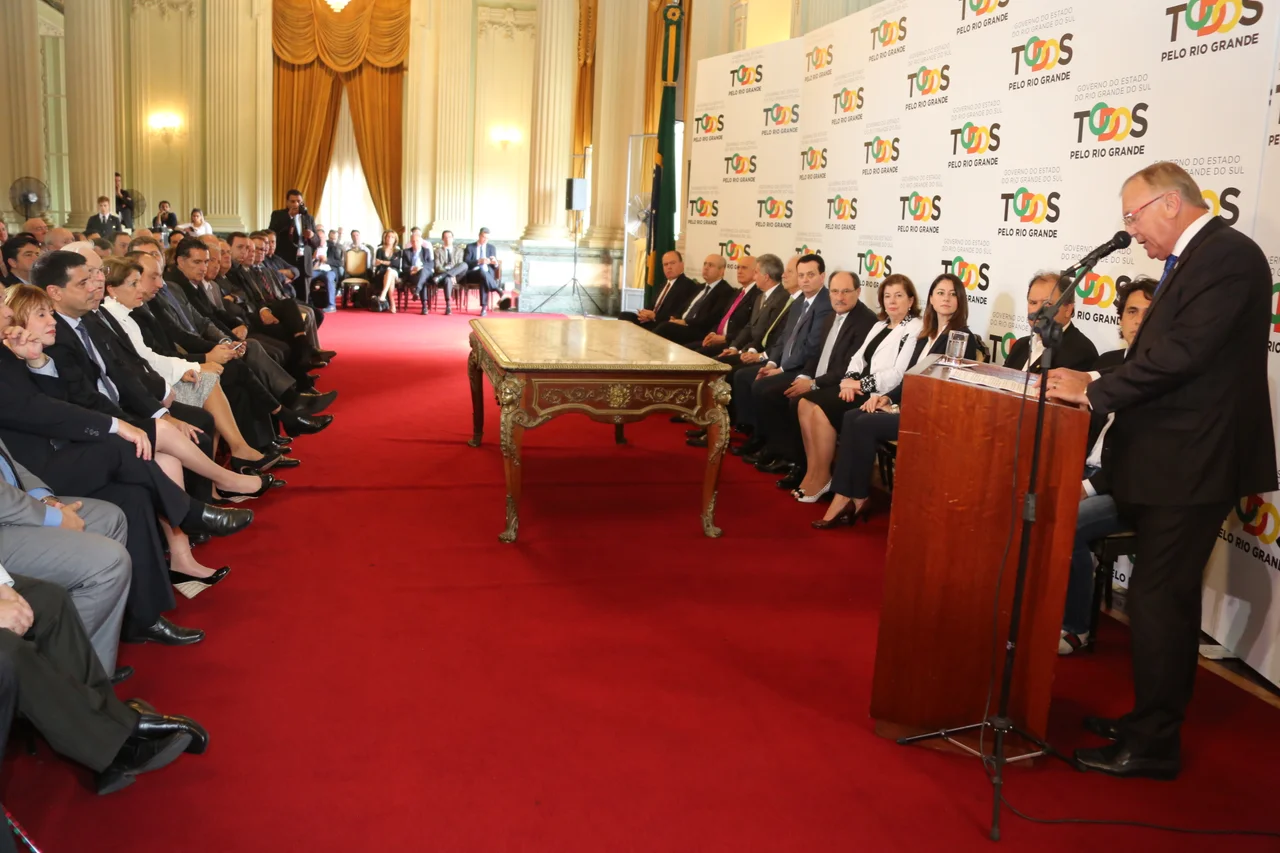
The interior was built to impress, and it succeeds with a kind of unapologetic luxury. Two facade sculptures of Agriculture and Industry came from Paul Landowski - the same sculptor who gave Rio de Janeiro its Christ the Redeemer. A staircase of French marble climbs to the governor's office, past a bust of Getulio Vargas by the Pelotas sculptor Antonio Caringi, whose statue O Lacador also stands here as a symbol of the city. In the Negrinho do Pastoreio and Alberto Pasqualini halls hang chandeliers modeled on those at Versailles. Italian painter Aldo Locatelli covered the walls with murals of the state's history. A gold-plated telephone, gifted to governor Borges de Medeiros, and a forty-two-square-meter carpet from 1930 survive among the rooms - small extravagances in a building that never did anything by halves.
Made by Unfree Hands
Not every craftsman who shaped the Piratini did so by choice. Part of the palace furniture was made by inmates of Porto Alegre's old House of Correction, and the sills and baseboards were carved from imported Carrara marble. It is a quiet, easily overlooked line in the building's history, but worth pausing on: the seat of state power was furnished in part by people the state had locked away, their skill poured into rooms they would never freely walk. The palace celebrates the governors who lived here - thirty-eight of them have made it their official residence - yet some of its most enduring details were the work of hands that history barely bothered to name.
Where the State Still Sits
The Piratini faces Marechal Deodoro Square, long known as the Mother Church Square, in the heart of Porto Alegre's historic center. It remains the working seat of the executive branch of Rio Grande do Sul - not a museum frozen in amber but a living office, listed as state heritage since 1986 and by the national heritage institute IPHAN in 2000. Stand before it and you are looking at the stage of the state's modern story: the slow ambition of its builders, the defiance of 1961, the daily business of governing one of Brazil's most distinctive regions. For all the marble and gilt, what gives the building its weight is everything that has been decided, and dared, inside it.
From the Air
The Piratini Palace stands at 30.0338 S, 51.2307 W on Marechal Deodoro Square in Porto Alegre's historic center, a low neoclassical block best identified by its position beside the old Mother Church square. Salgado Filho International Airport (ICAO: SBPA) lies about 6 km north-northeast; Canoas Air Force Base (ICAO: SBCO) is roughly 21 km north. Approach the centro from over the Guaiba waterfront to the west for the cleanest sightline. A viewing altitude of 1,500 to 2,500 feet AGL frames the palace within the surrounding square; winter radiation fog over the lake basin is common and can ground early-morning sightseeing flights.
Nearby Stories
- Itapuã State Park 22 km away
- Nova Petrópolis 37 km away
- Aparados da Serra National Park 77 km away
- Santa Cruz do Sul 77 km away
- Serra Geral National Park 111 km away
- 2009 Brasil de Pelotas Bus Disaster 161 km away
- Passo Fundo 176 km away
- Battle of the River Plate 446 km away