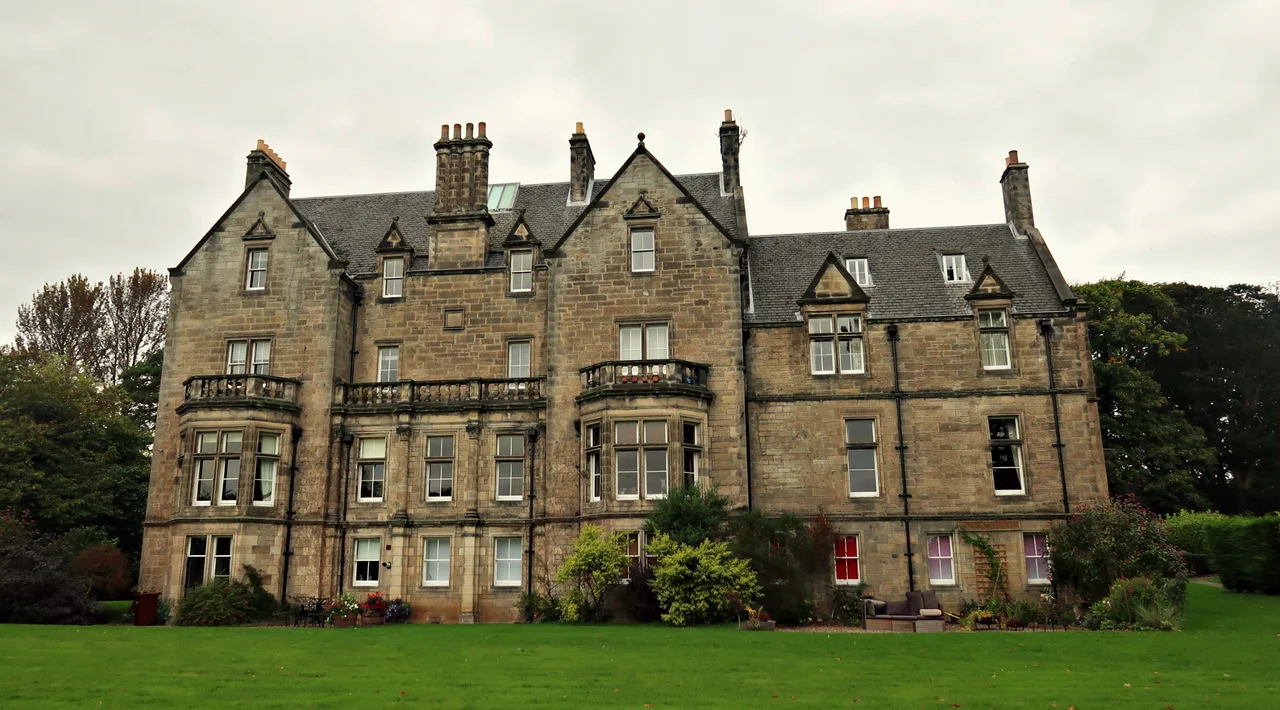

Pitreavie Castle
A group of Maclean Highlanders, bleeding from the Battle of Pitreavie, hammered on the doors of a Fife country house in July 1651 and begged for sanctuary. The family inside, the Wardlaws, refused. The Highlanders cursed the family before retreating to their deaths. Three centuries later, in 1938, the Air Ministry bought Pitreavie Castle for £12,306 and turned it into a wartime command centre. By the end of the Cold War, the cellars below this 17th-century country house were coordinating NATO operations across the entire North Atlantic. The castle is now apartments. Almost nothing about its story makes a straight line.
Christina Bruce's Estate
The Pitreavie estate, between Rosyth and Dunfermline in Fife, was held in the 14th century by Lady Christina Bruce, sister of King Robert the Bruce. In 1608 Henry Wardlaw of Balmule bought it for 10,000 Scottish merks. Wardlaw was Chamberlain to Queen Anne of Denmark, wife of James VI of Scotland; when James acceded to the English throne in 1603 and rode south to London, he left the nearby Dunfermline Palace in Wardlaw's care. Wardlaw built the present house starting in 1615, in a symmetrical style associated with Sir James Murray, the King's Master of Works. He was made a Baronet of Nova Scotia in 1631. His granddaughter Elizabeth Wardlaw is the reputed author of the ballad Sir Patrick Spens, one of the great medieval Scottish poems.
The Curse of the Macleans
On 20 July 1651 the Battle of Pitreavie was fought in the fields around the house. Oliver Cromwell's invasion of Scotland had reached the Forth, and an English force under Colonel Robert Overton clashed with a Scottish royalist army that included some 800 Highlanders of Clan Maclean. The battle was a Cromwellian victory of stunning lopsidedness: contemporary reports claim 2,000 Scots killed and 1,600 captured, against only 8 of Overton's troops dead. As the battle ended, a group of surviving Macleans fled to Pitreavie Castle seeking shelter. The Wardlaws turned them away. The Highlanders cursed the family before dying in the fields outside. The curse is one of the stories Pitreavie has carried ever since.
From Earls to Aviators
The Wardlaws sold the house in 1703 to Archibald Primrose, 1st Earl of Rosebery, and in 1711 it passed to Sir Robert Blackwood, later Lord Provost of Edinburgh. A succession of owners followed, with extensive remodelling in 1885 under Henry Beveridge, who added Victorian touches and reshaped the grounds. When Beveridge died in 1922, the castle was sold again. In 1938 the Air Ministry acquired it for the Royal Air Force as a coordination centre for the Royal Navy and RAF Coastal Command. Concrete outbuildings appeared - kitchens, a bar, a dining room, a bunker - and the old country house took on a second identity as RAF Pitreavie Castle, headquarters for maritime operations over the North Sea.
Cold War Command
After the Second World War, Pitreavie became the headquarters of NATO's North Atlantic Area, housing the commanders of air forces (No. 18 Group RAF) and naval forces across the entire North Atlantic. It was the operational centre for the Air Officer Scotland and Northern Ireland, known by the acronym AOSNI. As late as 1986, the large underground cellar of the original 17th-century building was still in active use as the Command and Control Centre for the RAF's Northern Command, dispatching search-and-rescue aircraft over the North Sea. The base finally closed in 1996. Maritime rescue coordination moved north to RAF Kinloss. Sixty years of military service ended, and the castle was sold again.
Apartments and Listings
Most of the wartime outbuildings have been demolished. The grounds were redeveloped as private housing and the Carnegie Campus business park. The castle itself was converted into apartments. It carries a Category A listing, the highest in Scotland, protecting the architecture if not the strangeness of its history. Stand in the courtyard now and try to hold both versions of the building in your head at once: a Jacobean country house whose master attended the Queen, and a Cold War bunker that watched the North Atlantic for Soviet submarines. The Wardlaws built for prestige. The RAF used for survival. The current residents do their grocery shopping.
From the Air
Coordinates 56.0484 N, 3.4183 W, in Fife between Rosyth and Dunfermline, about 9 nm northwest of Edinburgh. The house sits in a setting now largely surrounded by the Carnegie Campus business park and modern residential development. Edinburgh Airport (EGPH) is about 9 nm south-southeast. Dunfermline lies 1 nm north; the Forth bridges are about 3 nm south. As the former RAF Pitreavie Castle, the site has aviation heritage as a maritime command centre for the North Sea region. Best identified at lower altitudes by its position between the M90 motorway and the Carnegie Campus.
Nearby Stories
- Ardoch Roman Fort 2.2 km away
- Craignethan Castle 3.1 km away
- Haddington 3.8 km away
- Balvaird Castle 4.3 km away
- Battle of Kilsyth 9.4 km away
- Siege of St Andrews Castle 9.9 km away
- Neidpath Castle 11 km away
- Melrose Abbey 15 km away