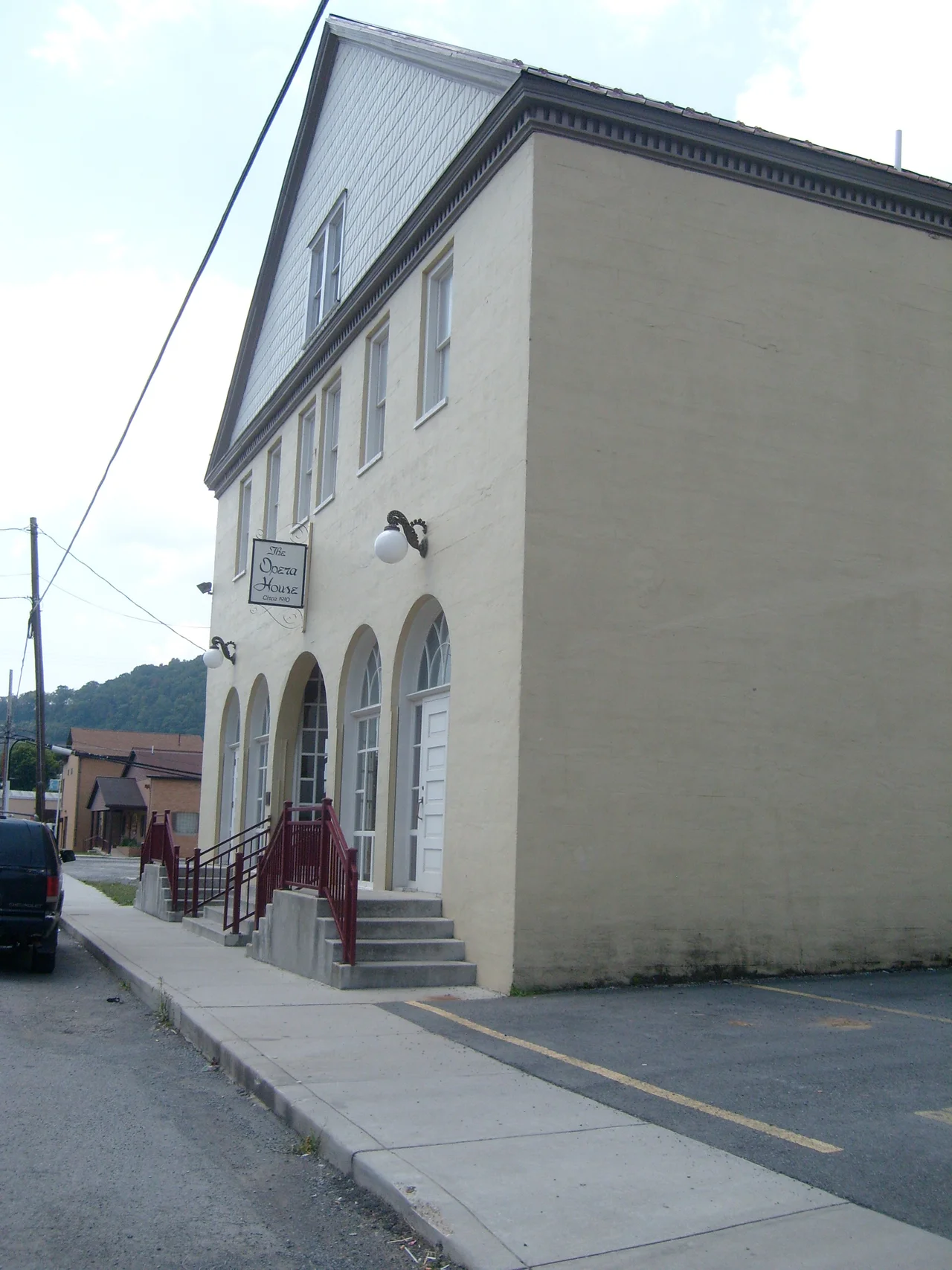

Pocahontas County Opera House
When the Pocahontas County Historic Landmarks Commission bought the old Opera House in 1991, there was no stage. There was no floor. The 1910 building in downtown Marlinton had spent the better part of a century cycling through other lives - a newspaper office, a roller rink, a lumberyard, a car dealership. Nobody was sure if it could be a theater again. Seven years and a great many community donations later, the Pocahontas County Opera House Foundation took over a fully restored hall. Touring musicians play it now. Square dancers fill it. A building that an Ohio court reporter put up during the height of the Marlinton lumber boom is back to doing what it was originally built to do.
Built for a Boom
J. G. Tilton built the original Opera House in 1907 and added the current building in 1910. He was a court reporter from Mount Vernon, Ohio, who had landed in Marlinton during its boom years - the brief decade when the town was the epicenter of West Virginia's lumber business. The Cass Scenic Railroad and the West Virginia Pulp and Paper Company had built mills, towns, and rail lines across Pocahontas County, and Marlinton was the financial center of all of it. Tilton was also a publisher; he ran the Marlinton Messenger, and in 1912, the newspaper itself was printed inside the Opera House. Groups from as far away as New York performed in the booming railroad town. County fairs, basketball games, and community events filled the building between performances.
What a Building Becomes When the Boom Ends
The lumber economy did not last. By the 1930s, the great forests of central West Virginia had been mostly cut over, and the rail lines that had served them were redundant. The mills closed. Marlinton's population shrank from its peak. Tilton sold the Opera House, and the building moved through a sequence of less glamorous tenants. A lumberyard. A car dealership. At some point a roller rink. Each new owner cut into the building, removing seats, repurposing the stage, ripping up flooring. By the time the Historic Landmarks Commission acquired the property in 1991, the interior had been so thoroughly stripped that recreating an opera house from what remained was less restoration than reconstruction. The original brick shell, mortared and parged on the outside, was most of what was left to work with.
Seven Years to a Stage
Restoration ran from 1991 to 1998. The Commission rebuilt the floor, the stage, the lighting, the seating. Community donations covered what state and federal grants did not. The work was the kind that small Appalachian towns become very good at - figuring out how to revive a historic building when there is no big-city foundation writing checks, but plenty of local money and local volunteer hours. The Pocahontas County Opera House Foundation formed in 1998 to take over the programming side. Its mission was to keep the lights on and the calendar full - to make sure the restored building did not slide back into the cycle of repurposing that had nearly destroyed it. In 2021, the building got another round of care, with patching of the mortar parging and new exterior paint by a company specializing in historic-building work.
Bluegrass to Salsa to Square Dance
The Foundation's performance series runs the kind of range you would not expect from a 222-seat hall in a county of about 8,000 people. Bluegrass, naturally - West Virginia has been one of the genre's heartlands since the music had a name. But also salsa, classical, and jazz, plus dance and theater. The Opera House also serves as a community center between performances. Local organizations host suppers, meetings, square dances, and weddings in the same hall where touring artists play. Movie nights and music jams fill out the calendar. A building that started life by importing entertainment from New York is now exporting Pocahontas County's own musical traditions - and importing back salsa from places its 1910 builders had never heard of. The mix would have surprised Tilton. It would not have displeased him.
From the Air
Located at 38.22 degrees north, 80.09 degrees west, in downtown Marlinton, West Virginia, on US-219 in the Greenbrier River valley. The opera house is a small brick building in a small downtown; best identified visually using the town itself rather than the structure. The closest airport is Marlinton Municipal (W99) just south. Greenbrier Valley (KLWB) is 30 nautical miles south at Lewisburg. The Green Bank National Radio Quiet Zone affects the airspace to the northeast. Watch for ridge turbulence and the valley fog that often holds in the Greenbrier drainage.
Nearby Stories
- Richwood, West Virginia 2.7 km away
- Fort Edward Johnson 11 km away
- Durbin and Greenbrier Valley Railroad 14 km away
- North Fork Mountain 19 km away
- Virginia Military Institute 20 km away
- Alleghany County, Virginia 21 km away
- Sutton, West Virginia 26 km away
- Monroe County, West Virginia 46 km away