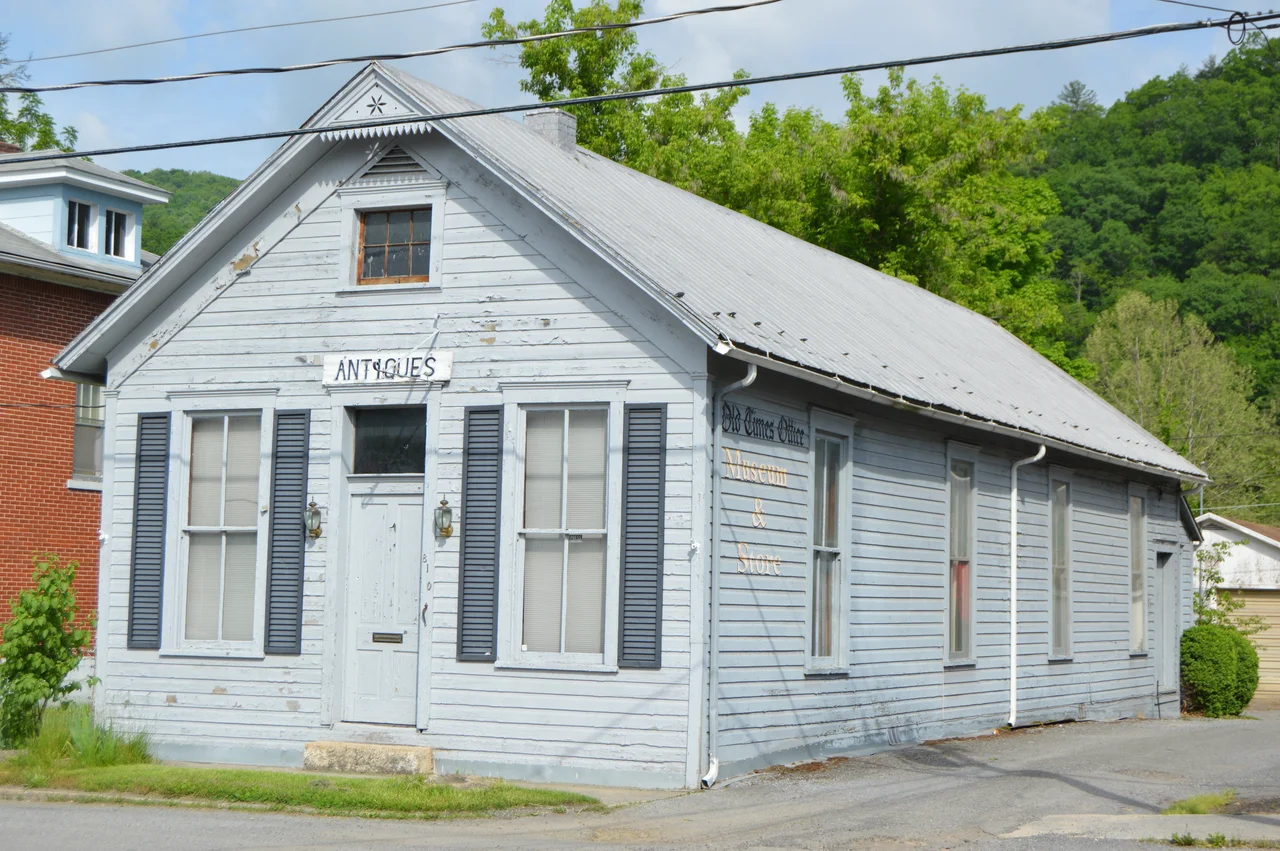

Pocahontas Times Print Shop
The numbers are small. The building measures roughly 21 feet by 75 feet - the footprint of a modest middle-class house. It is one story, framed in wood, rectangular and unadorned. But behind its plain front, a weekly newspaper has been put together in this Marlinton shop since 1900, using equipment that has barely changed since the early twentieth century. As recently as the 1970s, a paper folder and press installed around 1911 were still in use. The Pocahontas Times, which the shop was built to produce, has been published continuously since 1882 - one of the longest unbroken runs of any newspaper in West Virginia.
A Shop for a Boom-Town Paper
The Pocahontas Times was founded in 1882, a decade and a half before the Chesapeake and Ohio Railway reached Marlinton in 1899 and transformed the sleepy county seat into a railroad and lumber boom town. By 1900, when the print shop was built, the paper needed a permanent home commensurate with the volume of news a booming county was generating. The frame structure that went up that year was simple but purpose-built. It had to house the press, the type cases, the paper stock, and the staff who set type by hand from California-style cases - a craft that survived in small American print shops well into the twentieth century, long after big-city papers had moved on to Linotype. The building's modest dimensions tell you something about the scale of weekly papers in 1900: not much smaller than a one-man shop could manage.
Equipment from 1911
The press and paper folder installed around 1911 stayed in use for more than 60 years. As late as the 1970s, the shop was still producing the Times on equipment that had been new when the Wright Brothers were still figuring out flight. Small-town print shops were often the last places where 19th- and early 20th-century industrial machinery survived in active use, because the economics of replacement never quite penciled out: the old equipment worked, the parts could still be machined locally, and a weekly paper did not need the kind of throughput that justified buying new. When the technology of newspaper production finally shifted in the late 20th century - first to offset printing, then to digital - small papers like the Times made the transition reluctantly, sometimes after a generation longer than larger papers.
On the National Register, Still in Use
The Pocahontas Times Print Shop was listed on the National Register of Historic Places in 1977 - one of a small national category of industrial-printing buildings recognized for their role in local journalism history. Its peers on the Register include the Basin Republican-Rustler Printing Building in Wyoming and the Eagle Newspaper Office. None of these buildings is architecturally extraordinary. What is extraordinary is that they survive at all, and that some of them continue to produce the newspapers they were built for. The Pocahontas Times is still in print, with a paid circulation that reflects the size of its county - a few thousand subscribers, a website, and a small staff that knows the people in the stories they cover. In an era when several American counties have lost their last newspaper, the survival of the Times is not a small thing.
Why Weekly Newspapers Matter
The weekly community newspaper is one of the most distinctive American institutions, and the Pocahontas Times is among its longest-running examples. The paper covers school board meetings, county commission decisions, high-school sports, obituaries, weddings, and the kind of local stories that no national outlet would touch - because no national outlet has reporters who live in Pocahontas County. When a small bridge collapses, when a local family hits a milestone, when a county roads project goes over budget, the Times is where the story gets written. The 1900 building on the National Register is not just a historic structure. It is a working office that keeps printing a record of a county of fewer than 8,000 people. Without that work, the county would be substantially less visible to itself and to the world.
From the Air
Located at 38.22 degrees north, 80.09 degrees west, in downtown Marlinton, West Virginia, near the intersection of 8th Street and Main. The print shop is a small one-story frame building - identifiable only as part of the small downtown of Marlinton from the air. Best identified using the town itself rather than the structure. The closest airport is Marlinton Municipal (W99). Greenbrier Valley (KLWB) is about 30 nautical miles south. The Green Bank National Radio Quiet Zone affects airspace to the northeast - check NOTAMs for any radio restrictions. Watch for valley fog in the Greenbrier drainage.
Nearby Stories
- Richwood, West Virginia 2.7 km away
- Fort Edward Johnson 11 km away
- Durbin and Greenbrier Valley Railroad 14 km away
- North Fork Mountain 19 km away
- Virginia Military Institute 20 km away
- Alleghany County, Virginia 21 km away
- Sutton, West Virginia 26 km away
- Monroe County, West Virginia 46 km away