.jpg)
Polish Institute and Sikorski Museum
In 2006, a passer-by in Brixton stopped at a skip and reached in. What he pulled out were two thousand photographs taken by a man named Jan Markiewicz, documenting the early Polish community of 1950s South London. Someone had thrown away an archive of an entire diaspora. The photographs ended up at 20 Prince's Gate, a Grade II listed terrace facing Hyde Park, where they joined the regimental colours, the manuscripts of Adam Mickiewicz, the 17th-century hussar helmet, and the bronze bust of Wojtek the soldier bear. This is the Polish Institute and Sikorski Museum, and it exists because, in 1945, going home was not an option.
May 1945, and Nowhere to Return
The institute was founded on 2 May 1945, almost the moment the war in Europe ended. The timing matters. For Polish soldiers, airmen, sailors, and civilians scattered across the United Kingdom, victory came without homecoming. Under the Yalta Accords, one third of Poland's prewar territory had been ceded to the Soviet Union, and a communist government installed in Warsaw. The pilots who had fought in 303 Squadron during the Battle of Britain, the sailors who had hunted the Bismarck aboard the destroyer Piorun, the soldiers who had climbed Monte Cassino - many could not safely return. So they did the next best thing. They preserved what they had carried: witness testimonies from the Warsaw Uprising of 1944, regimental flags, medals, uniforms, the personal effects of statesmen and ordinary men and women. They built a memory of Poland in West London because the actual one had been taken away.
Named for a General Who Did Not Survive the War
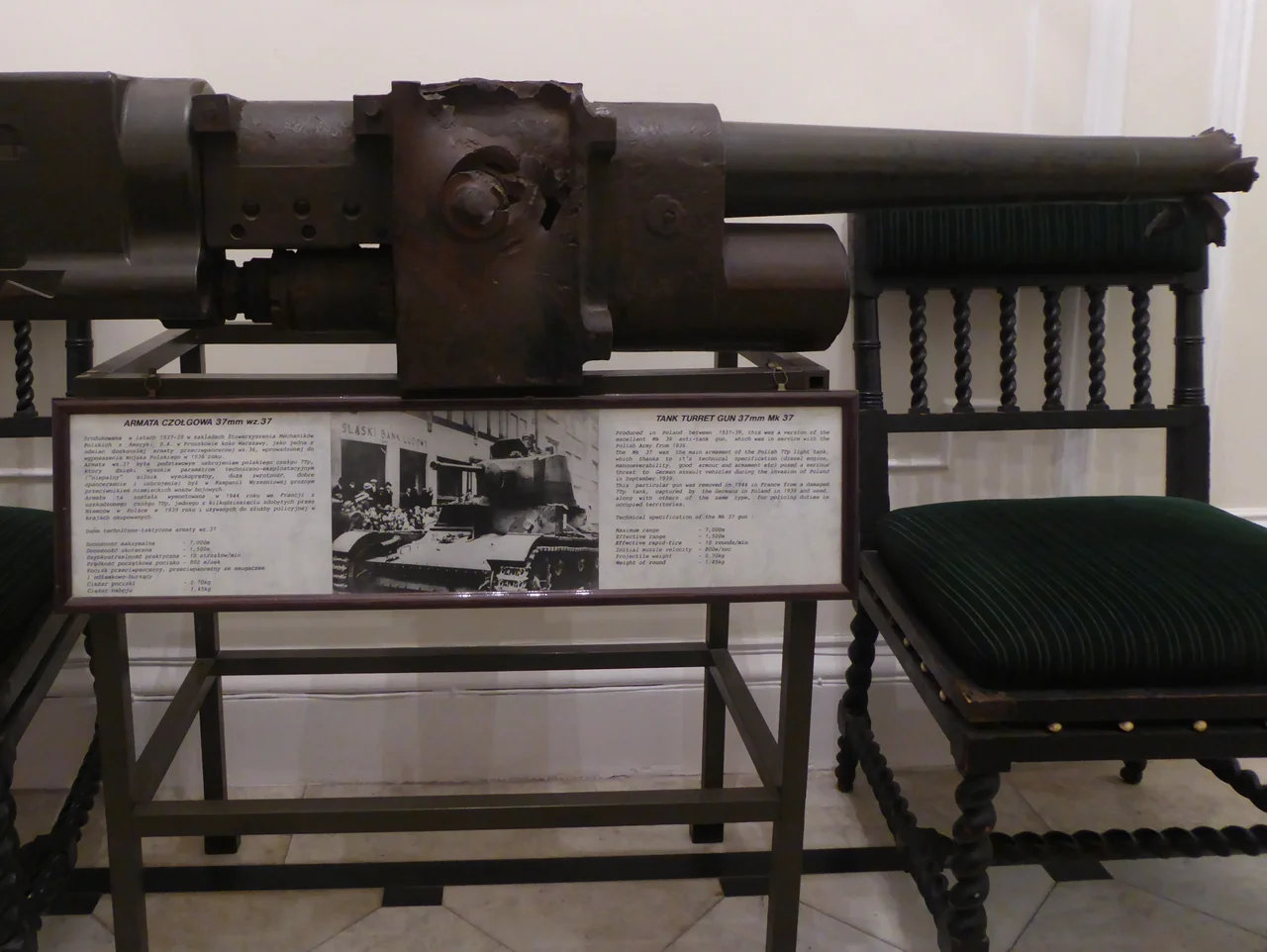
Władysław Sikorski was Poland's prime minister-in-exile and commander-in-chief of its armed forces in the West. He died in 1943 in a plane crash off Gibraltar, leaving the diaspora without its most prominent leader. Naming the institute after him was both tribute and statement: this was Sikorski's Poland, the one that had fought on through 1939, 1940, 1944, the Poland that would not be remade in Moscow's image. The walls hold a turret from a 7TP light tank used against the German invasion in September 1939 - later captured, used by the Germans in France, then recovered during the Allied advance of 1944 - a single artifact tracing the long arc of the war. Nearby, a memorial honors the thousands of Polish men, women, and children deported east and starved on Soviet soil.
The Underground Made Visible
In 1948, veterans led by General Tadeusz Bór-Komorowski - the man who had commanded the Warsaw Uprising - founded the Polish Underground Movement Study Trust, the Studium. For forty years it operated separately, gathering documents about the Polish Underground State, the largest clandestine resistance organization in occupied Europe. In communist Poland, this history was banned or censored. In Ealing, it was preserved. The two organizations merged in 1988, the year the Polish communist system began to collapse, as if the archive had outlasted the regime it documented. The Studium kept its internal autonomy, continuing its research from its Ealing base.
Across the Road from Empire
The building itself has a quiet irony. The Victorian terrace was built by Charles James Freake, the same developer who built the nearby Polish Hearth Club. Kensington Road faces Hyde Park - parade ground of empire, where coronations and jubilees have rolled past for two centuries. A few minutes' walk away sit the Royal Geographical Society, the Albert Memorial, the Albert Hall. The Polish Institute sits among these monuments to British grandeur, holding the story of a country Britain went to war to defend in 1939 and then, six years later, agreed at Yalta to leave on the Soviet side of the line. The institute's chairmen have included Count Edward Raczyński, Polish ambassador to the Court of St James's from 1932 to 1941, who lived to be a hundred and watched Poland become free again before he died.
Wojtek and the Things People Carried
Among the most visited exhibits is a bronze sculpture by David Harding of Wojtek - the Syrian brown bear adopted as a cub by Polish soldiers in Iran in 1942, who travelled with the 22nd Artillery Supply Company through Iraq, Egypt, and Italy, who carried artillery shells at Monte Cassino, and who lived out his retirement in Edinburgh Zoo. He was officially enlisted as a private to allow him passage on troop ships. The institute's collection has this kind of texture: a hussar helmet from the 17th century, a manuscript by the national poet Adam Mickiewicz, a bust of Jan Sobieski, the emblem of the 1st Polish Armoured Division. Over five thousand photographs were digitized by the Karta Center in 2005-6 and sent back to Poland for exhibitions and education. The objects went home even when the people could not.
From the Air
The Polish Institute and Sikorski Museum sits at 51.501°N, 0.173°W in West London, just within the City of Westminster on Kensington Road. The terrace faces the south edge of Hyde Park, with the Albert Memorial visible to the east and the Royal Albert Hall just beyond. Nearest major airports: London Heathrow (EGLL) 13nm west, London City (EGLC) 9nm east. From an aircraft overflying central London, the green expanse of Hyde Park and Kensington Gardens forms a clear landmark; the institute lies along its southern border.
Nearby Stories
- Battle of Britain, Northfleet 1.1 km away
- Bayham Old Abbey 5.4 km away
- Catharine Macaulay 6.4 km away
- Hatfield rail crash 8.8 km away
- Chequers 8.9 km away
- Chelmsford Cathedral 10 km away
- Queen Victoria Hospital 13 km away
- Fishbourne Roman Palace 36 km away