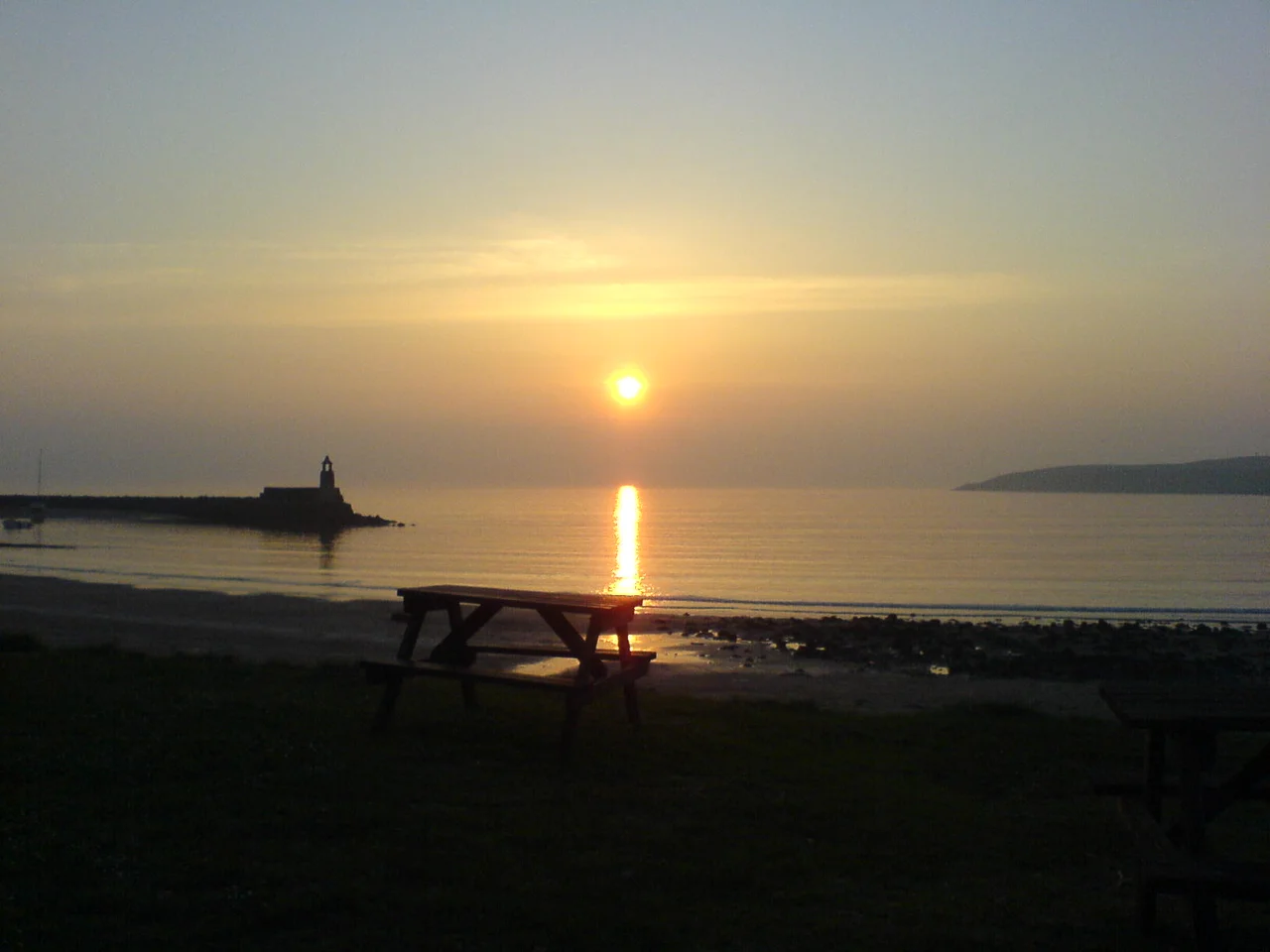

Port Logan
Colonel Andrew MacDowall, laird of Logan, built Port Logan in 1818 as an exercise in patrician imagination. He laid out a planned village along the curve of Port Nessock Bay, hired Thomas Telford - the same engineer who would dot Britain with bridges and harbours - to design a quay and a bell tower, and constructed a causewayed road leading out to them. The plan was tidy and complete. The existing villagers, who lived on the Lower Road (Laigh Row), were expected to relocate to a new Upper Road, freeing up the seaward view. Things did not go to plan. The villagers liked the shelter Telford's causeway gave them from the brisk onshore winds, and they stayed put. Most of them simply added a second storey to their cottages, so they could see over the new quay and out to sea again. It is one of the few cases in which a Scottish laird's grand design was politely declined by the people he was redesigning.
A Bay That Used To Be a Strait
Port Nessock Bay - the older name still survives in local use, and the Gaelic Port Neasaig is older still - is the last remnant of something larger. In post-glacial times, what is now the south end of the Rhins of Galloway was separated from the main peninsula by a narrow strait, with three smaller islands sitting off to the south. Sea level dropped, land rose, and the strait closed. The bay at Port Logan is the western end of that drowned channel. In 1790, the bay still held a ruined pier; the locals gathered kelp from the rocks and samphire from the coast just south. Telford's quay, completed in 1818, gave the village a deeper relationship with the sea than samphire-picking - and the bell tower at its end remains the village's signature silhouette, the first thing visible to anyone arriving by road or coming round the headland by boat.
The Fish Pond and the Botanic Garden
Colonel MacDowall's improvements ran beyond the quay. Around 1788, his father had begun the Logan Fish Pond - a tidal pool cut into the rocks just north of the village, intended as a fish larder for Logan House. It was completed around 1800, with a keeper's cottage and a bathing hut, and it survives today as the Logan Fishpond Marine Life Centre, where visitors can hand-feed sea bass and mullet that have grown habituated to people over generations. Nearby, the Logan Botanic Garden - now a branch of the Royal Botanic Garden Edinburgh - takes advantage of the Rhins' unusually mild Gulf-Stream climate to grow tree ferns, Chusan palms, and other subtropical species that ought, by Scottish latitude, to be entirely impossible. The combination is unlikely and characteristic: a Georgian fish pond, a botanic garden full of palms, and a single planned village stitching them together along the coast.
Two Thousand Acres of Sky
Between 2001 and 2003, the BBC adapted Port Logan into a different place entirely. The drama Two Thousand Acres of Sky, starring Michelle Collins, used the village as the fictional Hebridean island of Ronansay. Camera angles, careful editing and the village's natural isolation did the rest. A small Galloway harbour played a Highland island for three series and an enthusiastic following. In 2017, the village took another star turn, this time darker: Gerard Butler, Peter Mullan and Connor Swindells came to film The Vanishing, a thriller loosely inspired by the real-life Flannan Isles lighthouse mystery of 1900. The two productions, fifteen years apart, suggest something about Port Logan's screen appeal: a coastline, a bay, and architecture that can stand in for almost any place on the Atlantic edge of Scotland.
A Cliff Above the Bay
On 27 July 1944, the bay also became the site of a wartime tragedy that the village still remembers. Two Douglas C-47 Skytrains of the United States Army Air Forces - one bearing serial number 42-93038 - were flying north from Filton to Prestwick with wounded soldiers aboard, heading eventually for the United States. The aircraft encountered bad weather along the Galloway coast. The pilot of 42-93038 attempted to climb to clear the cliffs above Port Logan. He did not succeed. The aircraft struck the cliff side and all twenty-two passengers and crew - injured American servicemen on their way home, the men flying them, the medical staff - died on impact. They had come this far from whatever war had wounded them, and were lost on the last leg before the last leg. The cliff itself does not advertise what happened there, but the village has not forgotten.
From the Air
Port Logan sits at 54.723 deg N, 4.956 deg W on the western shore of the Rhins of Galloway, about 14 nm south of Stranraer. From the air, Port Nessock Bay forms a distinct semicircle of beach with Telford's causewayed quay running north - a sharp line of stone against the sand, the bell tower at its tip. Glasgow Prestwick (EGPK) is the nearest sizeable airport, roughly 65 nm north-east; West Freugh (EGOY) sits just north near Stranraer. Visual landmarks: Telford's bell tower, Logan Botanic Garden's tree canopies just inland, and the rocky tidal enclosure of the Logan Fish Pond to the north of the village.
Nearby Stories
- Glasserton 6 km away
- Battle of Glen Trool 9.5 km away
- Ballantrae Lifeboat Station 11 km away
- International Institute of Space Commerce 11 km away
- Bangor Abbey 12 km away
- Downpatrick and County Down Railway 20 km away
- Portavogie 23 km away
- Cushendall 29 km away