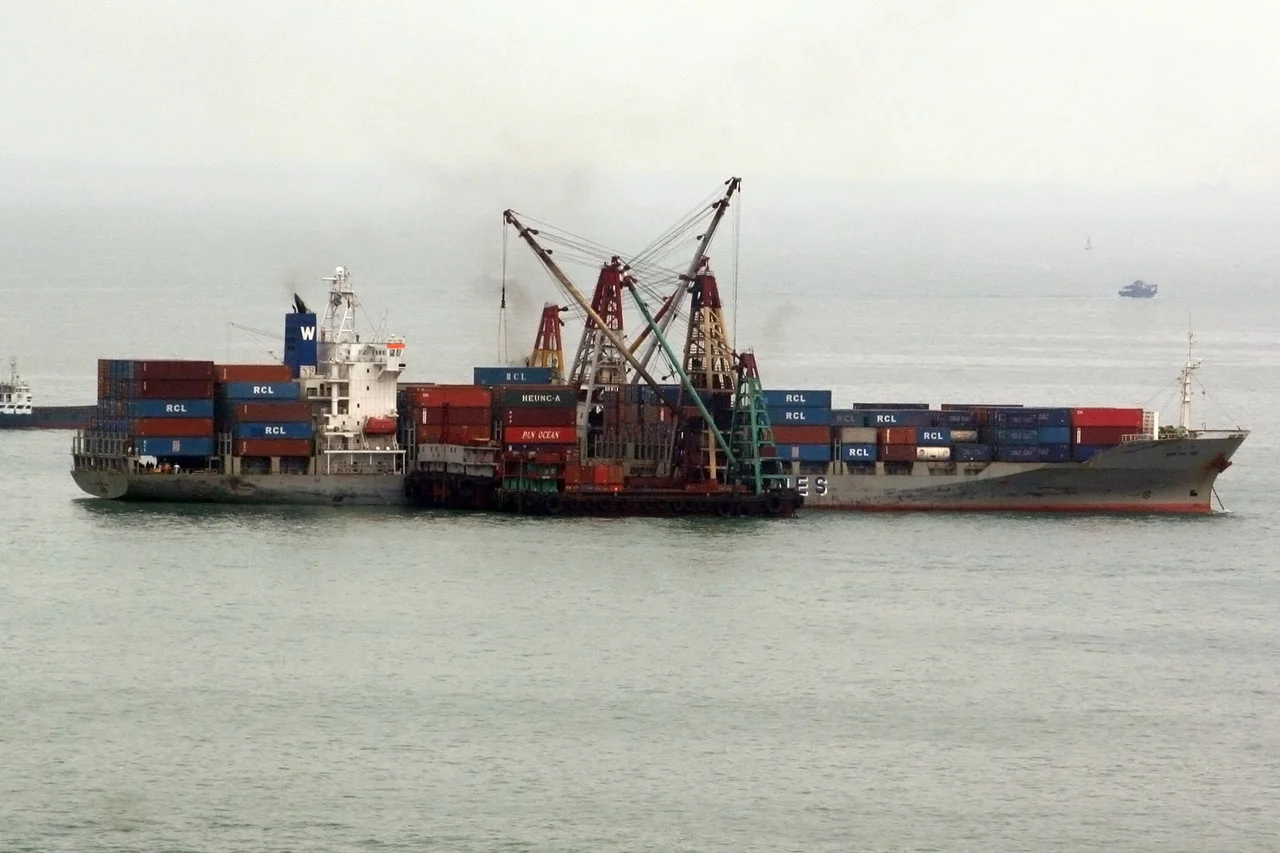

Port of Hong Kong
In 2007, this port moved 23.9 million TEUs — twenty-foot equivalent units of containers — in a single year. That figure, a record at the time, translates into something difficult to visualise: roughly 65,000 steel boxes arriving or departing every single day, loaded with electronics, textiles, machine parts, and thousands of other manufactured goods bound for or coming from every continent. The Port of Hong Kong did not happen by accident. Victoria Harbour is a natural deepwater anchorage, sheltered by geography and deep enough to receive the largest vessels afloat. What the port added to that foundation was organisation, speed, and the restless ambition of a city that has always understood its value as a threshold.
The Natural Threshold
Victoria Harbour, the body of water between Hong Kong Island and Kowloon, is what made a great port possible. Its depth — well over ten metres across much of its navigable area — means that even the largest container ships can enter and berth without dredging. The shelter provided by the surrounding hills reduces the impact of typhoons, though the port maintains 44 special typhoon mooring buoys for ships that must remain in the harbour during storms. The location is equally fortunate: positioned at the edge of the South China Sea, Hong Kong sits at the junction of major shipping lanes connecting Japan and Korea to the north with Southeast Asia and the Indian Ocean to the south, and the vast manufacturing heartland of the Pearl River Delta immediately behind it. These conditions — natural and geographic — existed long before the container age. The port simply grew into them.
Boxes That Changed Everything
Container shipping transformed the port from a traditional harbour into something closer to a logistics machine. The Kwai Tsing Container Terminals, located on the northwestern shore of the harbour, grew from a single facility into nine container terminals across Kwai Chung, Stonecutters Island, and Tsing Yi, operated by five separate companies — Modern Terminals, Hongkong International Terminals, COSCO, Dubai Ports International, and Asia Container Terminals. Together they provide 24 berths with approximately 7,794 metres of deep-water frontage across a terminal area of around 2.7 square kilometres. In July 2020, the HMM Gdansk made its maiden call at Kwai Tsing Terminal 7 — at that time the world's largest container vessel. Roughly 60 percent of Hong Kong's total container traffic passes through these terminals; the rest moves through the River Trade Terminal at Tuen Mun and through mid-stream operations unique to Hong Kong.
Mid-Stream: Something Found Nowhere Else
Hong Kong has developed something that exists nowhere else in the world at commercial scale: mid-stream cargo operations, in which containers are loaded and unloaded from ships not at a fixed berth but while anchored offshore, with barges and lighters carrying cargo between vessel and shore. High handling fees at the container terminals drove the practice, and it persists because it works. Eleven yard sites dedicated to mid-stream operations occupy 27.5 hectares of land with nearly 3,200 metres of waterfrontage. Watch the harbour from any elevated vantage point on Hong Kong Island and you will see the constant movement of flat-decked lighters threading between the moored vessels — a floating logistics network invisible to most accounts of how goods move through this city.
From Record-Holder to Gateway
The Port of Hong Kong was the world's busiest container port from 1987 to 1989, from 1992 to 1997, and from 1999 to 2004 — three distinct stretches of dominance in a competitive field. Since then, mainland Chinese ports, particularly Shanghai and Shenzhen, have surpassed Hong Kong in raw throughput volume. But the comparison misses the point of what Hong Kong's port does. It is not simply a volume handler; it is a gateway. The port is positioned on the Maritime Silk Road that runs from the Chinese coast through the Suez Canal to the Mediterranean and onward to Trieste, where rail connections carry cargo into Central and Eastern Europe. Hong Kong's shipping register — ships totalling 100 million gross tons owned or managed here — reflects the city's continuing role as a hub of maritime finance, management, and legal infrastructure, independent of who moves the most boxes in any given year.
The Infrastructure of Safety
Behind the visible activity of ships and cranes lies an infrastructure of coordination that most visitors never see. The Marine Department's Vessel Traffic Centre tracks up to 4,000 moving vessels plus 1,000 stationary targets in real time, covering 95 percent of Hong Kong's navigable waters. Traffic Separation Schemes govern the East Lamma Channel and Tathong Channel. Pilotage is compulsory for ships of 3,000 gross tons and above. The Maritime Rescue Co-ordination Centre monitors distress signals 24 hours a day. There are 58 mooring buoys for seagoing vessels, over 460 marine aids to navigation, and a Government Dockyard on Stonecutters Island with an 83,000-square-metre water basin and ship-hoists capable of drydocking vessels up to 750 tonnes. The port's scale is extraordinary; the machinery that keeps it functioning safely is equally so.
From the Air
The Port of Hong Kong is centred on Victoria Harbour at approximately 22.33°N, 114.12°E, with the Kwai Tsing Container Terminals visible at the northwestern edge of the harbour near 22.37°N, 114.13°E. From cruising altitude the distinctive geometry of the terminal — parallel rows of gantry cranes, stacked container yards, the deep-water berths — is unmistakable on the Kowloon side. Stonecutters Bridge spans the harbour nearby and serves as a visual landmark. The nearest airport is Hong Kong International Airport (VHHH) on Lantau Island, approximately 20 km to the west. Aircraft on approach to VHHH via the south overfly the outer harbour. Stonecutters Island (now a peninsula after reclamation) and Tsing Yi Island are visible to the northwest.
Nearby Stories
- Chapel of St. Francis Xavier 3.5 km away
- Cuiheng 4.1 km away
- 2015 Shenzhen Landslide 16 km away
- Shunde 31 km away
- Wanshan Archipelago 37 km away
- Nanxiong Formation 96 km away
- Heyuan 149 km away
- Checheng Fu'an Temple 629 km away