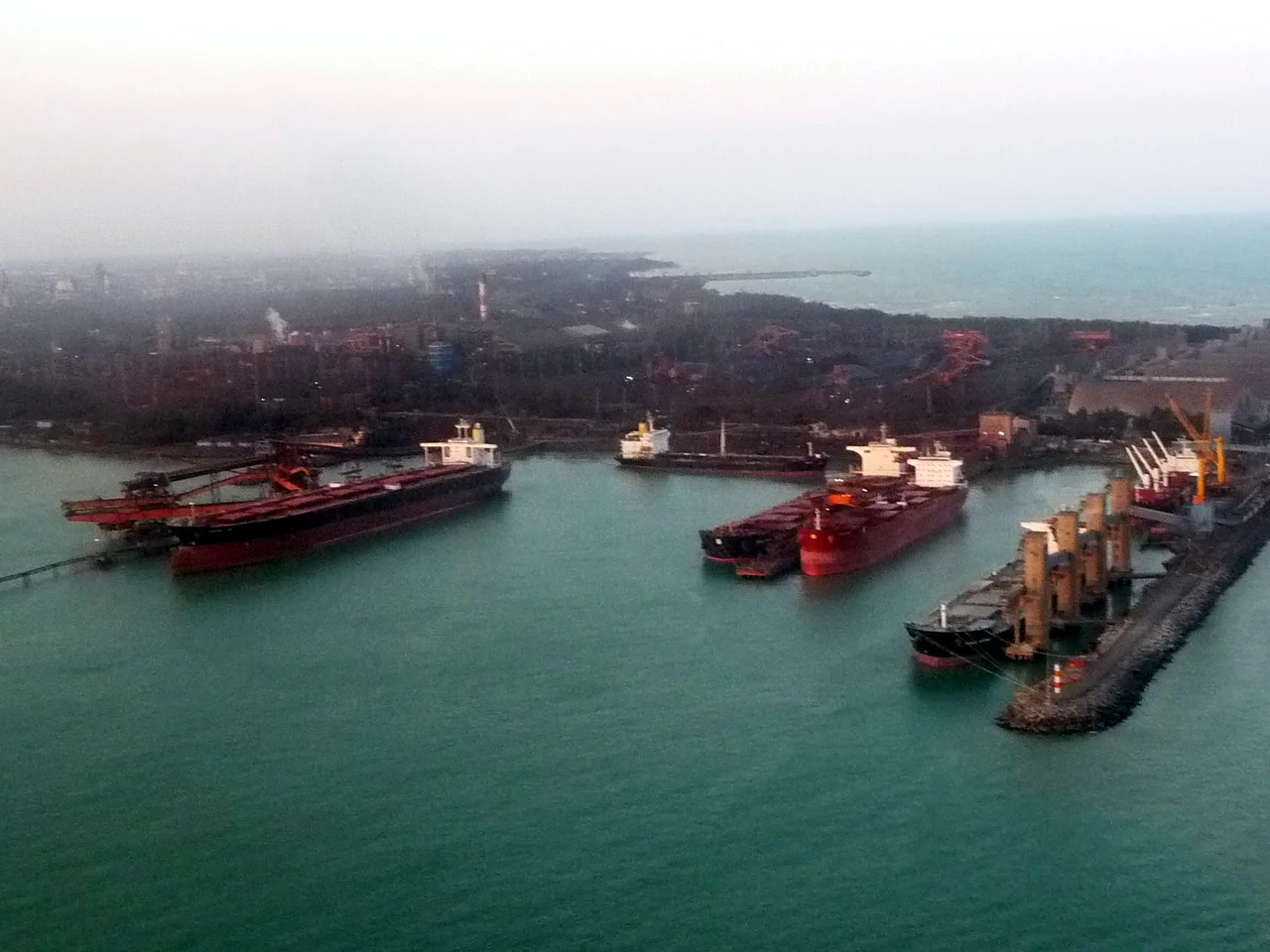

Port of Tubarão
A Brazilian engineer flew to Washington with iron ore contracts in his briefcase and came back empty-handed. The Ex-Im Bank of the United States would not lend Vale do Rio Doce a dollar to build a port nobody thought could exist for ships nobody had yet designed. Eliezer Batista returned to Rio and put the problem in front of Finance Minister San Tiago Dantas, who took off his black-rimmed glasses and said he would find a way. He printed the money. The Port of Tubarão rose on the coast of Espírito Santo in 1966, and for half a century after that, it shipped more iron ore than any port on Earth.
A Pioneer's Port
Construction began in 1962, the same year Vale signed its first long-term iron ore supply contracts with Japan and Germany. The National Treasury funded the project outright. Eliezer Batista designed Tubarão to accommodate ships that did not yet exist, bulk carriers of a size no shipyard had built. Japan, needing the ore, agreed to build the ships. The result reshaped global shipping. Batista called it the moment that transformed 'physical distance' into 'economic distance,' making it possible to move low-value bulk commodities across the entire planet profitably. The colossal ore carriers and oil tankers that now criss-cross the oceans are descendants of the thinking that built Tubarão.
The Iron Quadrangle's Outlet
Four hundred kilometers inland, the Iron Quadrangle of Minas Gerais holds one of the planet's richest concentrations of iron ore, the mineral Brazil built much of its modern economy extracting. The Vitória-Minas Railway connects those mines to the sea, and Tubarão is where the sea begins. The port complex sits north of Vitória, the capital of Espírito Santo, sprawling along a stretch of coast that loads ships at extraordinary speed. The nominal loading rate is 16,000 tonnes per hour; the average is 12,000. At these rates, a mid-sized ore carrier can be filled in under a day. In 2007, Tubarão shipped about 80 million metric tons of iron ore, which made it the largest iron ore embarking port in the world. The ore goes to Japan, China, Germany, everywhere steel is made.
A Flood of Investment
The port's inauguration in 1966 did more than handle cargo. It turned Brazil from an extractor of raw materials into a partner in global industrial supply chains, and it attracted foreign capital on a scale the country had not seen before. Celulose Nipo Brasileira, the joint Brazilian-Japanese pulp operation, came. So did Companhia Siderúrgica de Tubarão (now owned by ArcelorMittal), Albrás-Alunorte for alumina and aluminum, and Nova Era Silicon. A joint venture with Kawasaki produced California Steel Industries, Vale's first major overseas project. The Japanese in particular found Tubarão to be a proof of concept for their whole postwar industrial strategy: secure raw materials at distance, build the ships to move them, bind trading partners into decades-long supply relationships. San Tiago Dantas's printed money, the original sin of the project, looked more and more like monetary wisdom as the years went on.
The Complex Today
Tubarão now handles far more than iron ore. The complex includes eight pelletizing factories that turn powdered ore into firm pellets for blast furnaces, plus operations for shipping pellets, agricultural products like soybeans, and unloading coal from abroad. At least 60 different commodities move through the site. Roughly 905 kilometers of railway feed it, accounting for about 40 percent of Brazil's rail freight tonnage. In 2016, on its 50th anniversary, the port was responsible for 13 percent of the gross domestic product of the entire state of Espírito Santo. Around it, an industrial corridor has grown: the Vitória Industrial Center opened in Serra after 1966; Aracruz Celulose, now Suzano Papel e Celulose, arrived to make pulp from eucalyptus plantations; the whole region's economy was reshaped by the port's existence.
Viewed From Above
From a cruising altitude over the Atlantic, the Tubarão complex reads as a blunt geometric intrusion into the coastline north of Vitória. Ore ships queue offshore, patient black shapes against the ocean. Long conveyor piers extend into deep water. Rust-red stockpiles of ore sit in ridges on shore, waiting to be loaded. Trains move in and out constantly. The port is not beautiful in the way beaches and mountains are beautiful. It is the kind of infrastructure that rarely appears on postcards and yet quietly underwrites the world. The steel in every car, every skyscraper, every appliance built from Japanese or European plates in the last half-century carries some trace of iron that passed through here.
From the Air
Coordinates 20.29°S, 40.24°W. Recommended viewing altitude 3,000-5,000 ft AGL to see the full port complex north of Vitória with offshore ore carriers and inland stockpiles. The rusty-red ore piles are visible for tens of kilometers. Nearest airport: Eurico de Aguiar Salles International Airport, Vitória (SBVT, VIX), roughly 8 km southwest of the port. The access channel to Tubarão is in open sea with heavy shipping traffic.
Nearby Stories
- Pedra Azul State Park 28 km away
- Guarapari 29 km away
- Mutum, Minas Gerais 74 km away
- Linhares 74 km away
- Paraiba do Sul 119 km away
- Petrobras 36 167 km away
- Itaúnas 180 km away
- Caraíva 393 km away