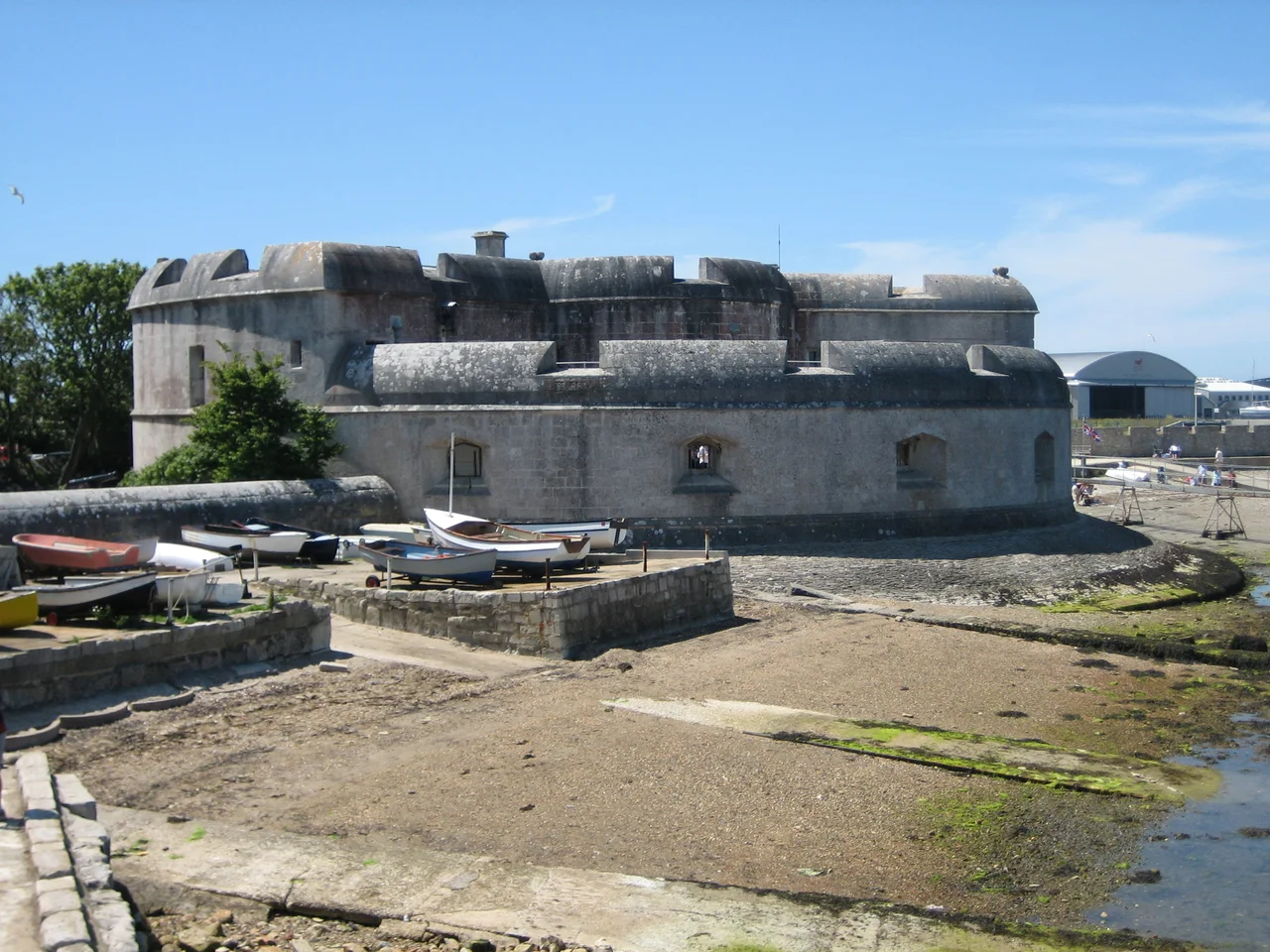

Portland Castle
When Henry VIII annulled his marriage to Catherine of Aragon in 1533, he made a personal enemy of one of the most powerful men in Europe. Catherine was the aunt of Charles V, the Holy Roman Emperor. By 1538, France and the Empire had declared an alliance against England, and Pope Paul III was actively encouraging both kingdoms to invade. Henry's response was the most ambitious coastal defence programme any English king had ever attempted. Lord Russell rode along the Dorset coast in 1539 and concluded that two castles were needed to defend the Portland Roads anchorage. One of them, oddly fan-shaped and built of the local grey stone, was finished by 1541 for the sum of £4,964. The invasion never arrived. The castle has been quietly useful ever since.
A King's Device
Coastal defence had traditionally been left to local lords - the Crown rarely paid for fortifications outside major ports. The 1539 device changed that completely. The king's instructions for the defence of the realm in time of invasion called for a chain of new artillery forts along the south coast, designed specifically for the era of gunpowder. Old castle architecture - tall walls, square towers, vertical battlements - was useless against cannon. The new device forts were low, thick-walled, and built around the geometry of their guns. Portland was designed in a fan shape: a curved central tower facing the sea, two angular wings flanking it, and a gun battery positioned to rake any ship trying to enter the Portland Roads anchorage. Its sister fort at Sandsfoot, directly opposite across the water, would catch any vessel the Portland guns missed. Eleven artillery pieces went into Portland Castle shortly after completion.
Neglect and Renovation
The invasion fear that had built Portland Castle dissolved almost as soon as the masons had finished. Thomas Mervin was appointed the first captain with a tiny garrison of four gunners and two other men. By 1574, just thirty years after its completion, a royal survey reported the castle in poor condition - and similar concerns were repeated in 1583. When Spain became the new enemy and war broke out in 1585, Henry's investment paid off: £228 was hastily spent on renovations and the castle stood ready. A 1623 survey listed three culverins, nine demi-culverins and a saker - sturdy mid-sized cannons - but warned that sea erosion was already eating the foundations. By the time of the Civil War, the garrison had grown to a captain and twelve men, and the castle was about to see the only siege action of its long career.
Two Sieges and a Trick
In 1643, a small group of Royalist sympathisers gained entry to Portland Castle by pretending to be Parliamentary soldiers - exactly the kind of low-stakes deception that produced most of the smaller engagements of the English Civil War. The castle was now Royalist, and as the King's fortunes collapsed in the southwest, Parliament tried to take it back. Forces besieged the castle for four months in 1644 and again the following year. Both attempts failed. The castle finally surrendered to Parliament only in 1646, when the wider war was already over. During the Interregnum, Portland Castle housed both a garrison and political prisoners - a unit of 103 men was attached to it in 1651 - before drifting back into peacetime neglect. Reports in 1702 and 1715 complained that the sea had washed away 112 feet of foundation, and the castle's artillery had dwindled to seven guns.
A House for Mr Penn
By 1779 the castle was a maintenance afterthought, with three caretaker garrisons and eight guns that hadn't been repaired in thirty years. The Napoleonic Wars brought a brief upgrade to fourteen guns, but the castle was already obsolete. After 1815 it became a private house. The Manning family took it over in the 1830s and converted an adjacent gunner's quarters into a comfortable property they called the Captain's House. When Portland Harbour was rebuilt as an artificial deep-water anchorage in the 1840s, surrounded by purpose-built Victorian forts on the Verne heights and along the new breakwaters, the old castle suddenly looked quaint. It became, in essence, the senior officers' quarters - house accommodation for the adjutants of the modern forts.
Museum, Garden, Five Centuries
During both World Wars the castle housed ordnance stores, offices, and accommodation for British and American troops. After 1945 the War Office finally let go, and in 1949 the building passed to the Ministry of Works. By 1955 it was open to the public. The decision was made to strip away most of the nineteenth and twentieth century additions and present the interior as a Tudor artillery fort - so today the kitchen still has its sixteenth-century fireplace, the gun room still echoes with the embrasures from which Henry's culverins once pointed, and the great hall remains a Tudor space rather than a Victorian dining room. The Governor's Garden alongside was redesigned by the horticulturist Christopher Bradley-Hole in 2002 with circular maritime motifs and Portland stone. Historic England now considers Portland Castle one of the best preserved and best known examples of King Henry's forts. It received 30,000 visitors in 2023, the highest annual count in its history. Five centuries after the invasion that never came, the castle is busier than ever.
From the Air
50.5684°N, 2.4468°W on the northern shore of the Isle of Portland, facing into Portland Harbour. The fan-shaped artillery fort is unmistakable from the air: a low curved keep with two angular wings, a walled courtyard, and the Captain's House to the west. Nearest aviation reference is Bournemouth (EGHH) about 30 nm east. Best viewed at 1,500-2,500 ft AGL on a southerly approach over Weymouth and Portland Harbour; the castle sits at the harbour's southern shore, with the breakwaters and the Verne Citadel further up the hill to the south. The contrast between Henry VIII's curved Tudor masonry and the angular Victorian fortifications around it is one of the most striking aerial views in southern Dorset.
Nearby Stories
- Needles Lighthouse 18 km away
- Lyme Bay Canoeing Disaster 19 km away
- HMS Formidable (1898) 19 km away
- National Motor Museum, Beaulieu 22 km away
- Sherborne Castle 22 km away
- Muchelney Abbey 24 km away
- German Submarine U-672 29 km away
- Battle of Cherbourg (1864) 58 km away