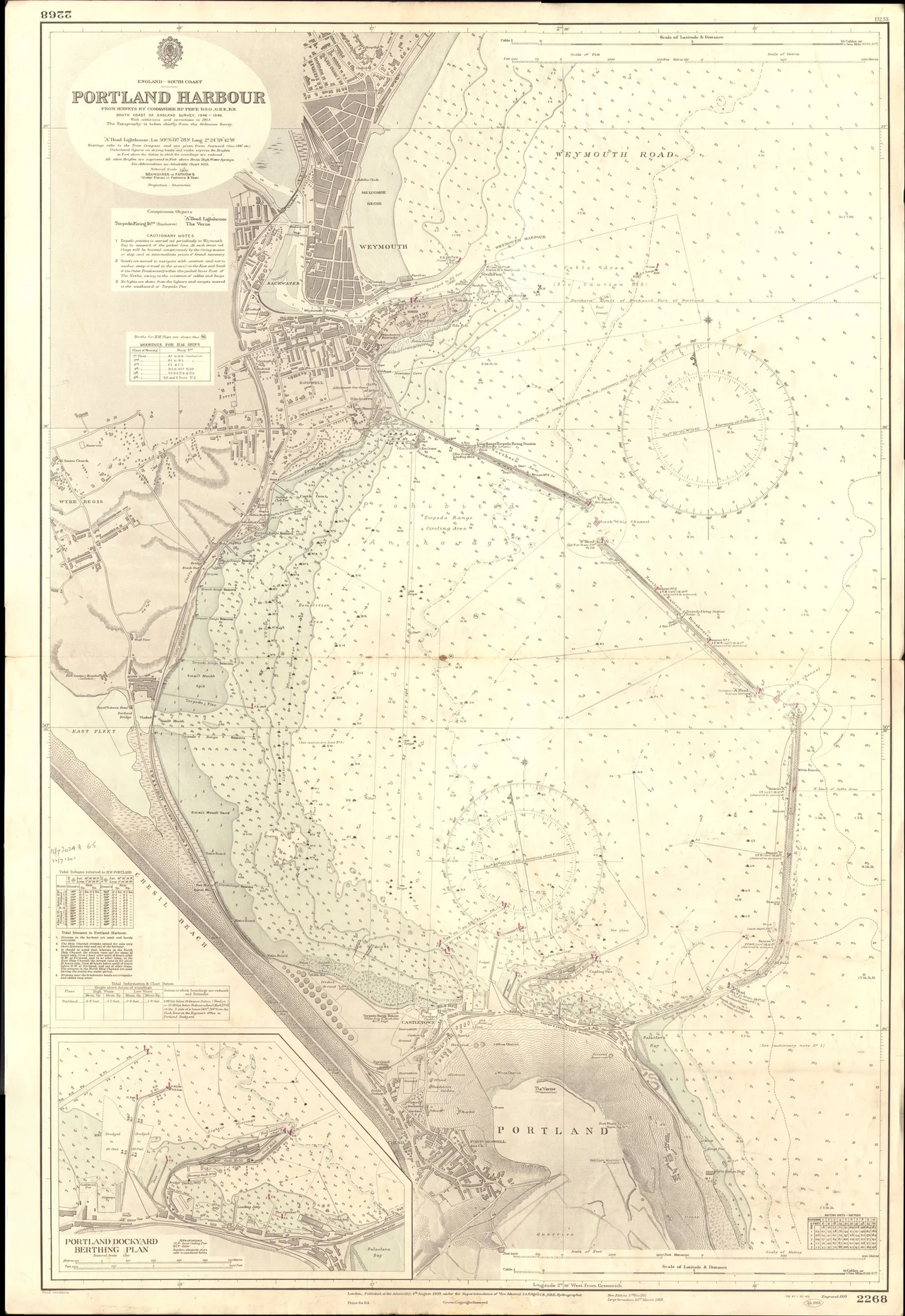

Portland Harbour
Ten thousand tons of stone, every week, for twenty-three years. That was the rhythm that built Portland Harbour - the quiet, relentless tonnage hauled from the Admiralty Quarries by men in the chain gangs of HM Prison Portland, set up in 1848 expressly to provide the labour. When Prince Albert laid the foundation stone on 25 July 1849, the British Empire was answering a French question: Cherbourg, just across the Channel, was expanding into a serious naval base. By 1872, when Edward, Prince of Wales declared the breakwaters complete, the answer covered 520 hectares - the largest man-made harbour in the world.
A Question Posed in Cherbourg
The harbour exists because of geography and anxiety. The Royal Navy's two great bases sat at Portsmouth and Devonport, with nothing between them. France, across the narrow water, was busy turning Cherbourg into a fortified port for the new steam navy. Parliament approved a refuge harbour at Portland in 1844, and a base for the fleet was established the year after that. Engineer James Meadows Rendel drew the design - two long arms of stone reaching into the Channel, sheltered already by Chesil Beach to the west and the Isle of Portland to the south. It would be the first British anchorage designed from the start for ships that burned coal rather than canvas. Similar refuges followed at Alderney, Dover, Holyhead, and later at Peterhead. None reached Portland's scale.
The Quarries and the Convicts
The breakwaters required stone in volumes that ordinary contracts could not supply, so the Admiralty made its own labour force. HM Prison Portland opened in 1848 with the explicit purpose of providing convict workers for the Admiralty Quarries on the island above. The men sentenced to Portland - many of them serving long terms - cut stone from the cliffs at ten thousand tons a week and watched it tipped seaward to form the breakwater spine. The work became Dorset's greatest tourist draw of its era; visitors came to see the spectacle of empire being built. The men doing the building rarely appear in those accounts. Rendel died in 1856 before the work was finished. Civil engineer John Towlerton Leather carried it on; John Coode was resident engineer on the site. Twenty-three years after Albert's foundation stone, the breakwaters were declared complete.
Forts on Every Headland
A harbour this important needed defences, and the Victorians built them with conviction. The Verne Citadel rose on the hill above the dockyard between 1860 and 1881, a 23-hectare fortress for a thousand troops with guns facing the sea on three sides. Below it, the East Weare Battery watched the eastern approach. The Nothe Fort completed in 1872 closed off the Weymouth side. The Breakwater Fort sat circular and squat on an outer arm of stone. When torpedoes and submarines changed the calculus of naval warfare, the answer was more breakwater: two northern arms were added between 1893 and 1906, and the Portland Breakwater Lighthouse went up in 1905. It still operates today, the only one of these structures still doing its original job.
The Day the Foylebank Burned
On 4 July 1940, the anti-aircraft ship HMS Foylebank lay at anchor inside the harbour when Stuka dive-bombers came down on her. Among the gunners was Leading Seaman Jack Foreman Mantle, posted to a 20mm Pom-Pom on the starboard side. Mantle was hit early - his left leg crushed, then further wounds as the attack continued - but he stayed at his gun, firing manually after the power failed, until he died at his post. He was twenty-three. The Victoria Cross was awarded posthumously, only the second ever given for action inside the United Kingdom. He is buried in Portland's Royal Naval Cemetery on the hill that overlooks the water where Foylebank sank. The wreck is still down there. Divers visit her.
After the Navy
The Navy left in stages. Portland Dockyard closed in 1959; Flag Officer Sea Training kept the base humming as the world's premier work-up centre, training Royal Navy and NATO crews. RNAS Portland grew into the largest naval helicopter airfield in Europe. Then on 21 July 1995, the last warship sailed, and on 29 March 1996 the harbour itself was sold. What replaced the warships was sport. The Royal Yachting Association had wanted these waters for decades - reliable winds from every direction, sheltered chop, deep berths. In 1999 the Weymouth and Portland National Sailing Academy was set up in old naval buildings on Osprey Quay. Six years later, the 2012 London Olympics chose it as the sailing venue. Today the harbour sits as the fourth largest human-made port on earth, behind Jebel Ali, Ras Laffan, and the Cherbourg that started it all.
From the Air
Portland Harbour at 50.585 N, 2.445 W on the south coast of Dorset. The harbour is unmistakable from altitude: four breakwater arms enclosing a near-rectangle of sheltered water, with the comma-shaped Isle of Portland hanging south on its tied-island causeway and the long pale curve of Chesil Beach trailing northwest toward Bridport. The Portland Breakwater Lighthouse marks the southern tip of the northeast arm. Nearest controlled airfields are Bournemouth (EGHH) about 50 km east and Exeter (EGTE) roughly 95 km west; the closest field is the grass strip at Compton Abbas (EGHA) north of Shaftesbury. Recommended cruise 3,000-5,000 ft for a clear view of the breakwater geometry. Watch for the active Portland Heliport on the eastern shore.
Nearby Stories
- Needles Lighthouse 18 km away
- Lyme Bay Canoeing Disaster 19 km away
- HMS Formidable (1898) 19 km away
- National Motor Museum, Beaulieu 22 km away
- Sherborne Castle 22 km away
- Muchelney Abbey 24 km away
- German Submarine U-672 29 km away
- Battle of Cherbourg (1864) 58 km away