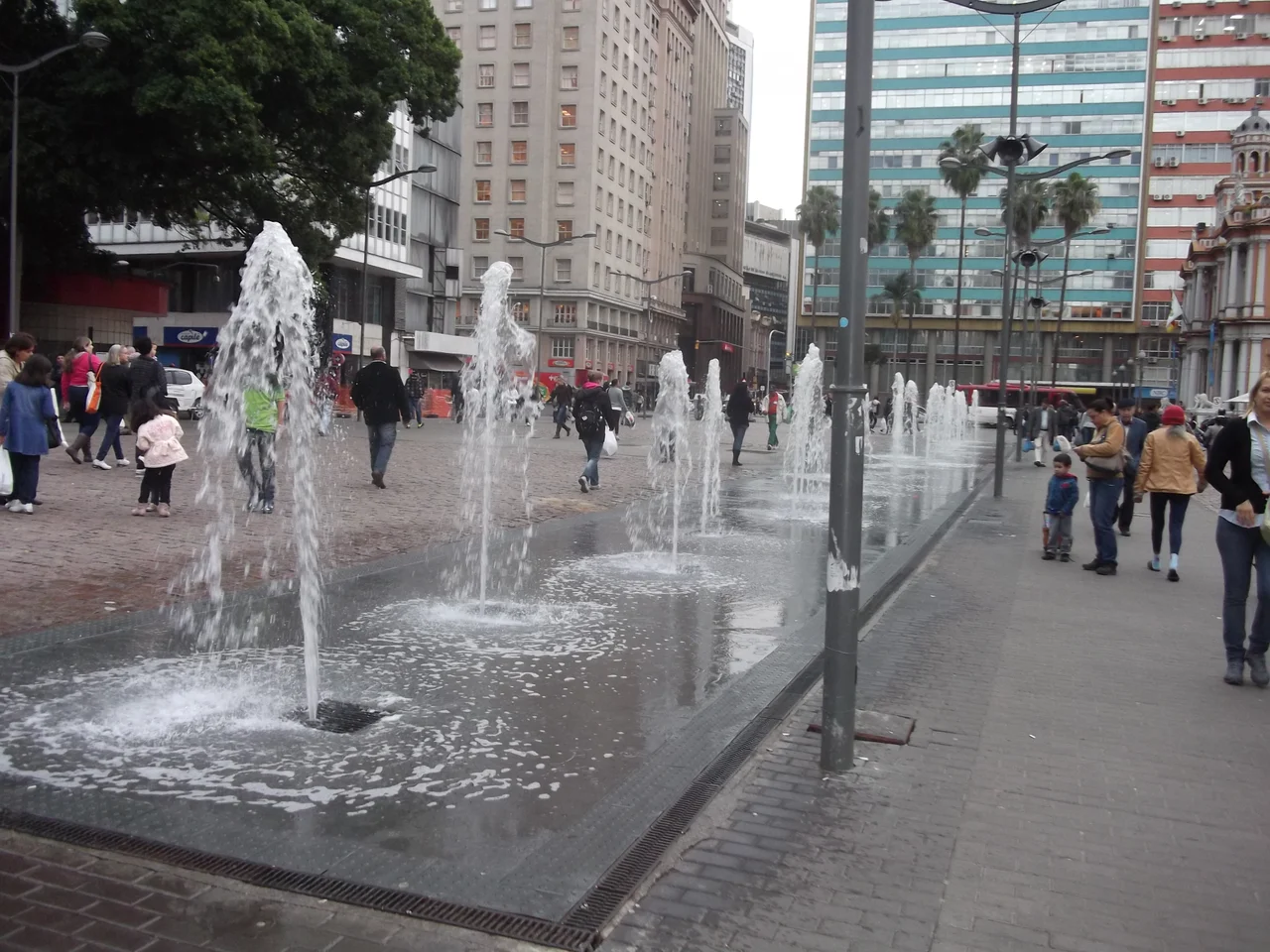

Porto Alegre Public Market
The smell hits first - roasting coffee, grilled meat, the sweetness of an ice cream counter that locals have lined up at for generations. The Mercado Publico has been Porto Alegre's stomach and meeting place since the nineteenth century, a single block where a banker and a dockworker might both stop for a draft beer at the same century-old bar. Around 109 shops crowd its two floors. People come not just to buy fish or yerba mate but to be here, in the noise and the steam, in the oldest public market in the country. It has been the city's living room for so long that Porto Alegre keeps rebuilding it every time fire or water tries to take it away.
Built and Rebuilt
Construction began on 29 August 1864, over the bones of a smaller market, to a design by Frederico Heydtmann that was altered and enlarged before it was done. The market opened on 3 October 1869. Shops filled the inner yard in 1886. Then came the long argument between the building and catastrophe. In 1912, during a renovation, fire destroyed every stall in the inner area. A second floor was added in 1913. Fire returned in 1976, in 1979, and again in 2013, when flames believed to have started on the upper floor consumed roughly thirty percent of the structure - though, remarkably, no one was hurt. At one low point the market was nearly demolished altogether, and only public outcry kept the wrecking crews away.
Banca 40 and the Navy Bar
What makes the Mercado matter is not its architecture but its institutions, the stalls that became landmarks. There is the Banca 40, an ice cream counter woven into the city's traditions, and the restaurant Gambrinus, and Bar Naval - the Navy Bar - a fixture of more than a century. These are the kinds of places where a regular has a usual order and the person behind the counter knows it. A 1990 restoration finally gave the market the protection its loyalty deserved, threading a steel-and-glass roof over the great inner yard and turning the old offices upstairs into restaurants, snack bars, and coffee shops. The work cost nine million reais; most of it came from the city, the rest from the market's own fund and other sources.
The Water of 2024
Then came the worst flood in the city's recorded history. In early May 2024, the Guaiba breached its banks and rose to a level no one alive had seen - higher even than the devastating flood of 1941, which had stood as the benchmark of disaster for eighty years. Inside the market, the water reached about 1.7 meters, swallowing the ground-floor stalls. The Mercado closed on 3 May. Some 760 people worked there daily before the flood; their losses ran to an estimated thirty million reais. For a city that measures itself by this building, the sight of it standing in brown water was a wound. But Porto Alegre has rebuilt this market before, and it did so again.
Open Again
After 41 days under water and weeks of cleaning and disinfection, the Mercado came back in stages. On 14 June 2024 it partially reopened, restaurants on the second floor and street-facing shops first. By 18 June both floors were trading again, with dozens of stores and stalls serving the public from morning to evening. A plaque now marks how high the 2024 water climbed, set above the old 1941 line - a sober record kept by a building that refuses to be a ruin. The Mercado faces the Chale da Praca XV and stands beside the town hall, exactly where it has always been, doing exactly what it has always done: feeding the city and giving it a place to gather.
From the Air
The Porto Alegre Public Market sits at 30.0275 S, 51.2281 W in the historic center, close to the Guaiba waterfront and the city's town hall - a square, two-story block near Praca XV. The nearest field is Salgado Filho International Airport (ICAO: SBPA), about 5 to 6 km north-northeast; Canoas Air Force Base (ICAO: SBCO), roughly 21 km north, took over civilian flights when Salgado Filho flooded in 2024. Approach low from over the lake to the west for the cleanest view of the centro. A viewing altitude of 1,500 to 2,500 feet AGL holds the market and the waterfront together. Watch for winter fog rolling off the Guaiba, which routinely delays early flights.
Nearby Stories
- Itapuã State Park 22 km away
- Nova Petrópolis 37 km away
- Aparados da Serra National Park 77 km away
- Santa Cruz do Sul 77 km away
- Serra Geral National Park 111 km away
- 2009 Brasil de Pelotas Bus Disaster 161 km away
- Passo Fundo 176 km away
- Battle of the River Plate 446 km away