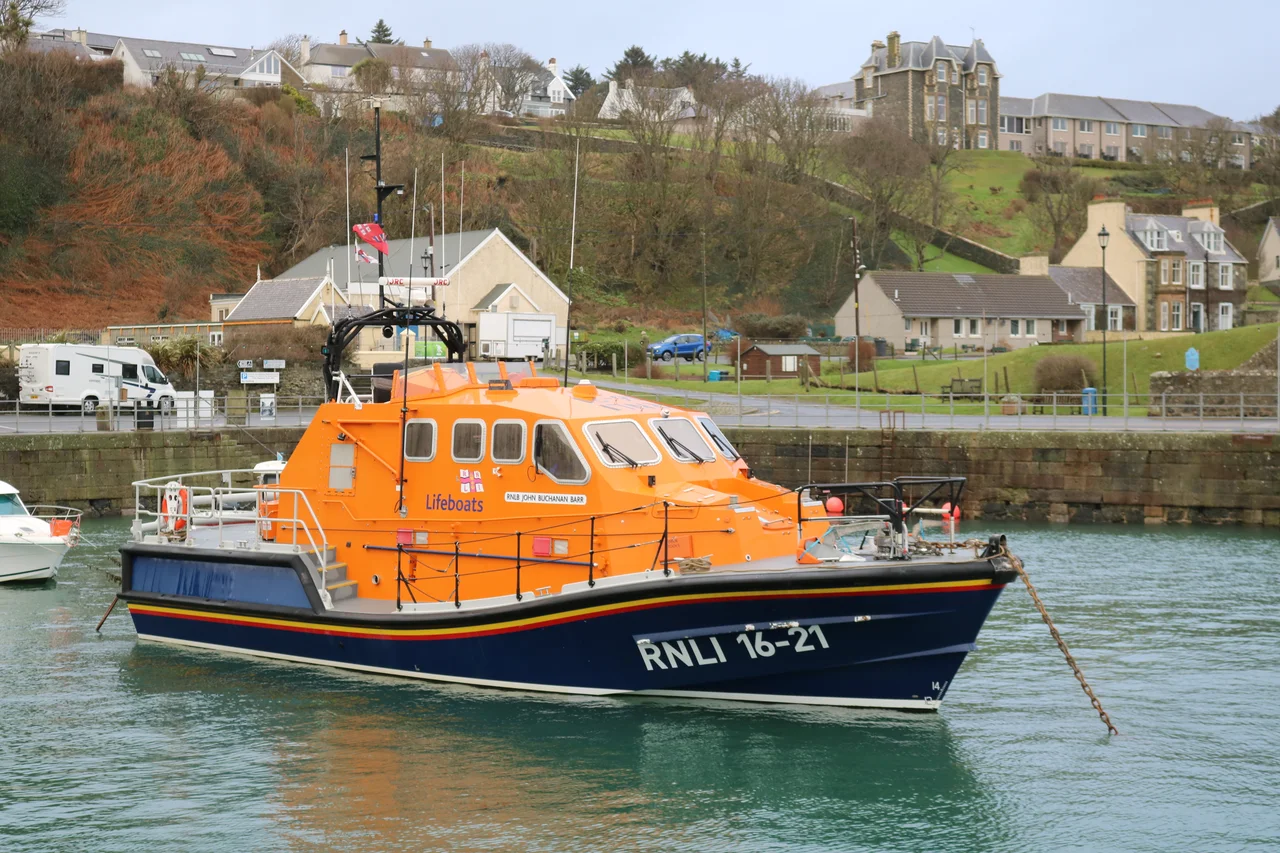

Portpatrick Lifeboat Station
The morning of 31 January 1953 began like any other crossing for the Princess Victoria. She was a stern-loading car ferry, modern for her time, and she made the run between Stranraer and Larne every day - 35 miles across the North Channel between Scotland and Northern Ireland. A storm was building as she cleared more open water that morning. Heavy waves stove in her stern doors. Water began to come aboard. By two o'clock that afternoon, with a hurricane now blowing, she sank. Of the 127 passengers and 49 crew who had boarded at Stranraer, only a small fraction survived. The Portpatrick lifeboat reached the wreck more than an hour after the ferry went down - there had been confusion about her precise position - and pulled two people from the sea. The lifeboat from Donaghadee in Northern Ireland saved another thirty-one. The disaster is still ranked among the worst in British coastal waters in the twentieth century. The Portpatrick lifeboat returned to her station on the afternoon of 1 February, more than a day after launching into the storm. Her coxswain, William McConnell, was awarded an RNLI Bronze Medal and a British Empire Medal.
A Boathouse Opened in 1877
Portpatrick is a working RNLI station that has been answering calls from the North Channel for nearly a century and a half. It opened on 15 December 1877 - placed deliberately between two existing stations to cover a stretch of coast where vessels passing the port, and the village's own fishing boats, were repeatedly being overtaken by sudden gales. A boathouse went up at a cost of £280, and the first lifeboat was launched by being lowered from a davit, the same swinging arm used on ships. That arrangement nearly cost the station its boat almost immediately: in 1899 the lifeboat fell from the davit and was wrecked. The early Portpatrick boats were 'pulling and sailing' - rowed or sailed, no engine. Steam was never tried here, but the RNLI began experimenting with petrol motor lifeboats in the early 1900s, and the Maria, one of the first, came to Portpatrick in 1922 after serving elsewhere since 1910. In the 1930s, diesel engines were trialled and Portpatrick was one of the comparison stations - useful, hands-on data being collected at a small Galloway harbour for the benefit of the whole national service.
The Camlough Service
On the night of 12 January 1932, the SS Camlough developed engine trouble near the Isle of Man. Her captain decided to run for his home port of Belfast, but a gale rose overnight and blew the disabled ship east toward the Scottish coast instead. Another vessel got a line aboard her and tried to tow, but the line kept parting. The Portpatrick lifeboat reached the Camlough and stood by - watching, waiting, ready. When the tow broke again, the Camlough dropped anchors. They did not hold. The ship drifted onto rocks. The lifeboat closed in, and the crew of ten was taken off. One man slipped between the lifeboat and the ship as he transferred; the coxswain, John Campbell, hauled him to safety before he could be crushed. The lifeboat was away from Portpatrick for twelve hours. Campbell received an RNLI Bronze Medal for the service - the standard, dispassionate language of a medal citation covering a night of extraordinary judgement under pressure.
Fishermen, Storms, and a Force 10
On 23 November 1995, the Portpatrick crew launched into a Force 10 gale to reach a sinking fishing vessel with three crew aboard. They got all three off, and brought them in alive. The whole crew received a collective Framed Letter of Thanks signed by the Chairman of the RNLI - the institution's way of acknowledging service that was beyond what was expected but did not, on this occasion, single out one person for a medal. It is the kind of routine the modern station performs without much fanfare: an inshore lifeboat at a nearby station for shorter calls, an all-weather lifeboat at Portpatrick for the heavy work, both ready to launch in conditions that would keep most other boats firmly tied to the pier. The current boat, the John Buchanan Barr, takes her place in a list that runs back to that first 1877 davit boat - each name a donor, a bequest, or a public subscription that funded the service for another generation.
Why Here
Portpatrick faces almost due west into the North Channel, the strip of sea between Scotland and Northern Ireland that funnels Atlantic weather and shipping in equal measure. Ferries cross to Larne; cargo runs in and out of Belfast, Liverpool, Glasgow, the Clyde. Fishing boats work the same water. The Mull of Galloway lies to the south, the Mull of Kintyre to the north; in between, vessels embayed by a westerly storm have little room to run. The Princess Victoria disaster of 1953 became the defining shock of British post-war ferry safety - new rules followed, stern-door designs changed, watertight subdivision was improved. The Portpatrick boathouse, the people who have crewed her boats, and the small grey memorial to the Princess Victoria all sit on a coast that has asked very specific things of those who live near it.
From the Air
Portpatrick Lifeboat Station sits at the harbour at approximately 54.842 deg N, 5.120 deg W on the south-west coast of Scotland. From the air, Portpatrick's tight little harbour - tucked into a notch in the cliffs - is unmistakable, with Dunskey Castle's ruined silhouette half a mile south on its sea-cliff promontory. Open North Channel stretches west toward Northern Ireland, visible roughly 21 nm distant on clear days. Glasgow Prestwick (EGPK) is the nearest major airport, about 55 nm north-east; West Freugh (EGOY) sits 9 nm east near Stranraer. Visual landmarks: Portpatrick harbour itself, Dunskey Castle's grey shell on the cliff to the south, Killantringan Lighthouse a few miles north.
Nearby Stories
- Glasserton 6 km away
- Battle of Glen Trool 9.5 km away
- Ballantrae Lifeboat Station 11 km away
- International Institute of Space Commerce 11 km away
- Bangor Abbey 12 km away
- Downpatrick and County Down Railway 20 km away
- Portavogie 23 km away
- Cushendall 29 km away