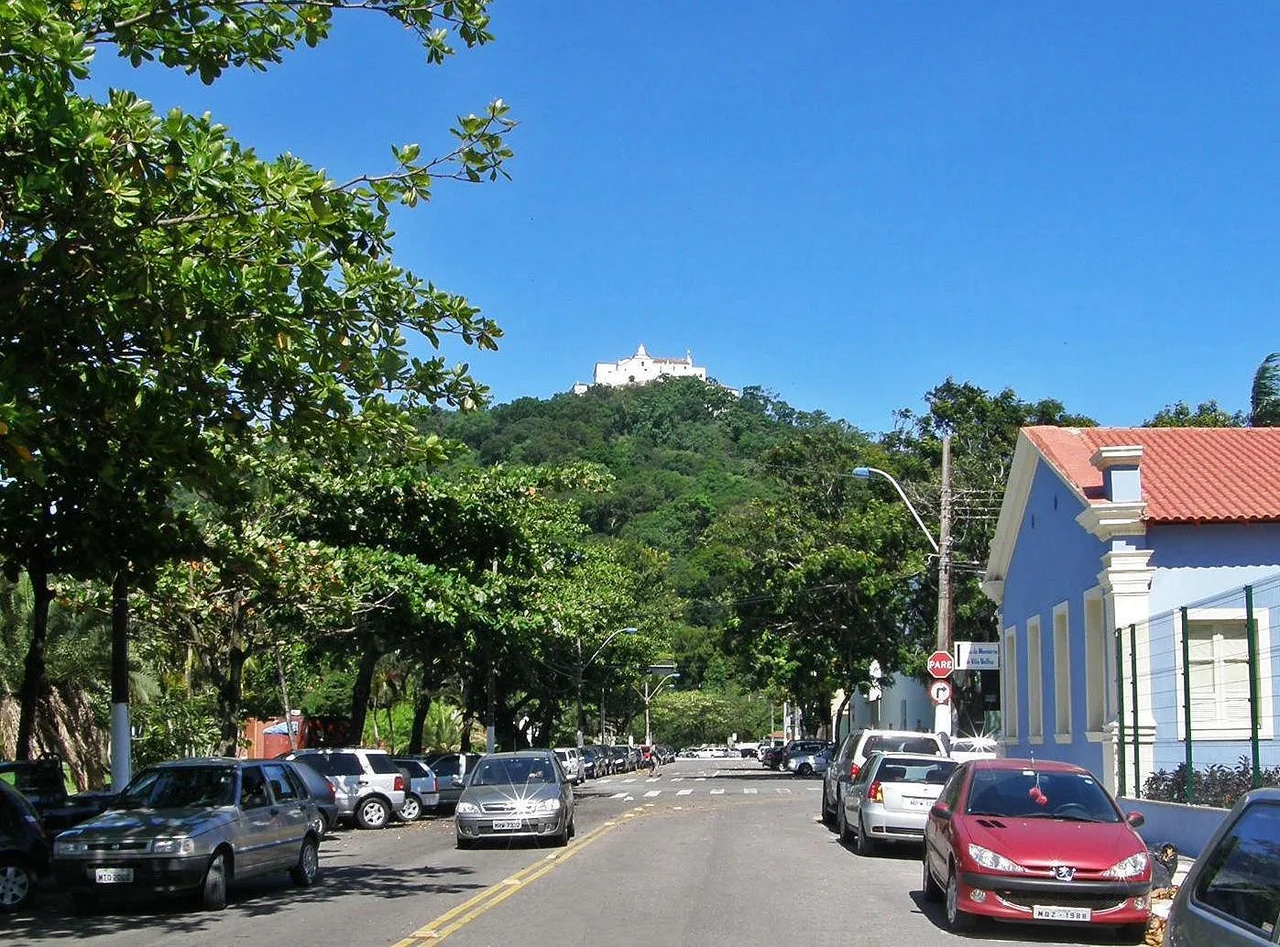

Prainha Historic Site
The Portuguese came ashore on a small beach in 1535, on a date the records preserve precisely: May 23. Prainha means 'little beach,' a diminutive that undersells the consequences of what happened here. A man named Vasco Fernandes Coutinho, granted an enormous captaincy that stretched along this stretch of Atlantic coast, stepped off his ship and claimed the land. Within months there was a church. Within decades there was a village. Within centuries the city of Vila Velha had grown around the landing site. The little beach outlasted all of them.
The Captaincy Arrives
In 1534 the Portuguese crown granted Vasco Fernandes Coutinho the Captaincy of Espírito Santo, one of the hereditary divisions by which Portugal tried to colonize Brazil on the cheap. Coutinho did not land immediately. When he finally arrived on May 23, 1535, probably right at Prainha, he chose the spot as the seat of the captaincy. The settlement was called Vila do Espírito Santo, the village of the Holy Spirit, and it was the original core of what would become Vila Velha, literally 'Old Village.' Coutinho had no local guides, no formal maps, no knowledge of the indigenous peoples who lived along the bay. He had a royal charter and a ship, which the empire considered sufficient.
The First Church
Within months of landing, construction began on the Church of Our Lady of the Rosary, at Coutinho's request. That makes it one of the oldest churches in Brazil, begun in 1535 on a patch of ground overlooking the beach where the Portuguese had come ashore. The building has been rebuilt and modified over nearly five centuries, but its foundations mark the beginning of European religious presence in Espírito Santo. From this tiny stone anchor, the new captaincy expanded outward across the bay. A few years after Coutinho's arrival, the Portuguese moved their headquarters across the water to a fortified island, founding what would become Vitória, the present state capital. Vila Velha kept the old church, and with it, its claim as the older of the two cities.
The Friar's Grotto
In 1558, Friar Pedro Palácios arrived and began building the Penha Convent on a granite outcrop above Prainha. The convent and the Church of the Rosary together form the oldest group of buildings at the historic site; both appear on a Portuguese map from around 1612, which also shows other churches that have since disappeared: a Mother Church, a Church of Saint Catherine. Before the convent was finished, Palácios lived in a grotto on the outcrop, and preached from there. The grotto is preserved as part of the historic site today. The Penha Convent itself became, and remains, one of the most significant Catholic pilgrimage destinations in southeast Brazil, drawing thousands of penitents who climb the rocky path each Easter.
A Historic Site, Finally
For most of the 20th century, Prainha was just another Vila Velha neighborhood, bordered by what was left of its colonial past. In 2015, the state of Espírito Santo finally passed a law officially creating the Prainha Historic Site, after discussions that had gone on since the early 2000s. The original proposal was ambitious and a little odd: it included plans for an amphitheater designed by Oscar Niemeyer, the famed Brazilian modernist architect, and an aquarium highlighting local marine flora and fauna. Niemeyer died in 2012 at 104; the amphitheater did not get built. What exists now is a preservation zone protecting the genuinely old structures, not the dreamed-of additions.
What Remains
The Casa da Memória Museum, operated by the Historic and Geographic Institute of Vila Velha, anchors the site with collections that cross five centuries. Its holdings include photographs, flags, navigation instruments, statues, and one particularly beloved artifact: Tram 42, a surviving example of the streetcars that carried Vila Velha residents around their city in 1930. The museum sits near the Church of Our Lady of the Rosary and the grotto of Friar Palácios, so a walk through Prainha becomes a walk through layered time. Colonial Portugal, 19th-century Catholicism, early-20th-century public transport, all compressed into a few hundred meters of coastline. The ships have changed; the beach has not.
From the Air
Coordinates 20.33°S, 40.29°W. Recommended viewing altitude 2,000-4,000 ft AGL to see the historic waterfront at Vila Velha with the Penha Convent on its granite outcrop, clearly visible from the air. Nearest airport: Eurico de Aguiar Salles International Airport, Vitória (SBVT, VIX), roughly 7 km north. The site sits on the protected western shore of Vitória Bay.
Nearby Stories
- Pedra Azul State Park 28 km away
- Guarapari 29 km away
- Mutum, Minas Gerais 74 km away
- Linhares 74 km away
- Paraiba do Sul 119 km away
- Petrobras 36 167 km away
- Itaúnas 180 km away
- Caraíva 393 km away