
Prestonpans
Eighty-one women were executed for witchcraft at Prestonpans at the end of the 16th century. The town was one of the worst-affected places in early modern Scotland. In 2004, more than four hundred years later, the Barons Courts of Prestoungrange and Dolphinstoun issued an Absolute Pardon. Every 31 October the town remembers them by name. This is a place that has chosen not to forget what was done here - not the witch trials, not the battle fought just outside town in 1745, not the centuries of salt panning and coal mining that built it. The town's famous murals tell those stories on its walls, where they cannot be ignored.
Salt and Coal
Legend says a shipwrecked traveller named Althamer founded the place in the 11th century. What history records is more useful. By 1198 monks from Newbattle and Holyrood were boiling seawater in iron pans on the shore to make salt - and the name Althamer became Prestonpans, the priests' pans. The monks also discovered something else. Around 1210 they began mining coal here, arguably the first instance of coal mining in Britain. By the 15th century the town had ten salt works producing 800 to 900 bushels weekly. Coal sustained the town for the next seven hundred years. The Fowler family built the oldest brewery in 1720; it ran into the 20th century. Fishing boats sailed from Morrison's Haven, where herring was the prize catch and oysters made fortunes until the early 20th century. Prestonpans was never just one industry. It was many, all of them hard.
Fifteen Minutes at Gladsmuir
Just before dawn on 21 September 1745, a Jacobite army led by Charles Edward Stuart - Bonnie Prince Charlie - attacked the Hanoverian army of Sir John Cope on flat ground east of Prestonpans. The battle was the first major conflict of the second Jacobite Rising. It lasted about fifteen minutes. The Highland charge broke the government line so completely that Cope's reputation never recovered. The dead numbered in the hundreds on both sides. Colonel James Gardiner, a Hanoverian commander mortally wounded on the field, was carried to nearby Bankton House to die. His monument, erected in 1853 near where he lived, is larger and more impressive than any memorial to the victors - a quiet rebuke from a town that had to live afterward with both sides. A modest cairn marks the Jacobite victory. A parish church plaque commemorates John Stuart of Phisgul, killed by Highlanders near the end of the fighting.
The Pardoned Women
Between 1590 and 1597 alone, the North Berwick witch trials swept across East Lothian, encouraged by King James VI himself. Eighty-one women from Prestonpans and the surrounding area were accused and executed. Most were strangled and then burned. They had names, families, lives. They were midwives, healers, neighbours, women with grudges held against them, women suspected for reasons no one alive can now reconstruct. John Fian, a schoolmaster from Prestonpans, was executed in 1591 as the supposed leader of the North Berwick witches - tortured until he confessed, then burned at Castlehill in Edinburgh. The 2004 pardon was symbolic but not empty. A memorial statue stands in the town. The annual commemoration on 31 October refuses to let the women be forgotten in the way history so often forgets victims of the powerful. These were not curiosities or footnotes. They were people.
Tapestry and Murals
In 2010, the Prestonpans Tapestry was unveiled - 104 panels, each a metre long, embroidered by over 200 volunteers. It depicts Prince Charlie's journey from Eriskay to the battlefield. At roughly 100 feet longer than the Bayeux Tapestry that inspired it, it has since toured Scotland, England, and France, sharing exhibition space with the Bayeux itself in 2013. The murals around town are smaller in scale but no less ambitious: paintings on walls and gable ends depicting witches, soldiers, miners, salt-pan workers, fishermen. Prestonpans has spent its money and time turning history into something visible and walkable. The notable residents reflect the same range - John Davidson the 16th-century reformer who built the original church; Tam Paton, manager of the Bay City Rollers; Josh Taylor, the first Scotsman to hold all four boxing world titles. The town tells its story plainly, in cloth and paint and stone.
From the Air
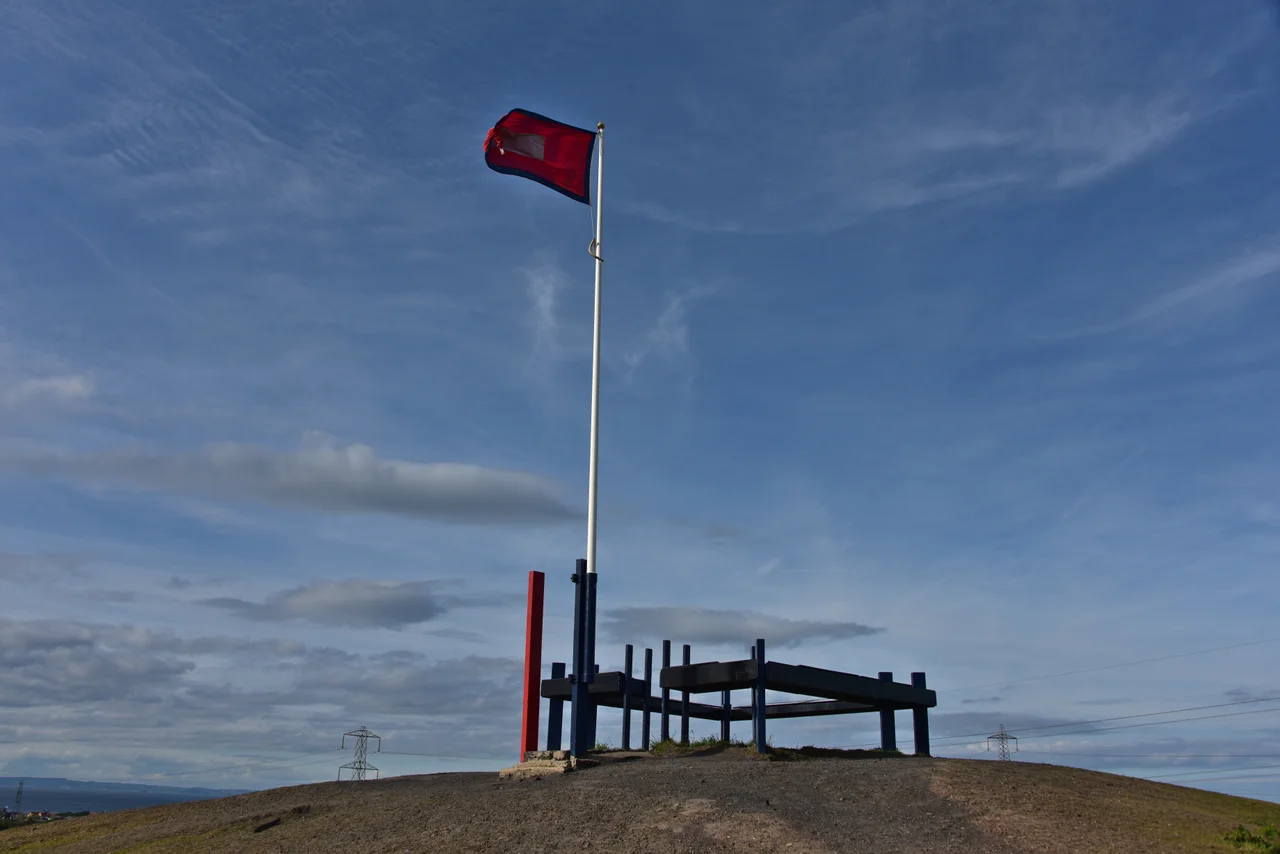
Prestonpans sits at 55.96N, 2.96W, eight miles east of Edinburgh on the southern shore of the Firth of Forth. Best viewed at 2,000-3,000 feet to take in the town, the battlefield viewpoint at Meadowmill (a pyramid sculpted from an old coal bing), and Cockenzie just to the east. Edinburgh Airport (EGPH) lies 15 miles to the west. Look for Prince Charlie's battle flag flying atop the Meadowmill pyramid.
Nearby Stories
- Blackness Castle 2.2 km away
- Skateraw Lifeboat Station 2.8 km away
- RAF Charterhall 5.6 km away
- Ochil Hills 6.3 km away
- Innerleithen 12 km away
- Falkland Palace 14 km away
- New Lanark 18 km away
- Bell Rock Lighthouse 21 km away