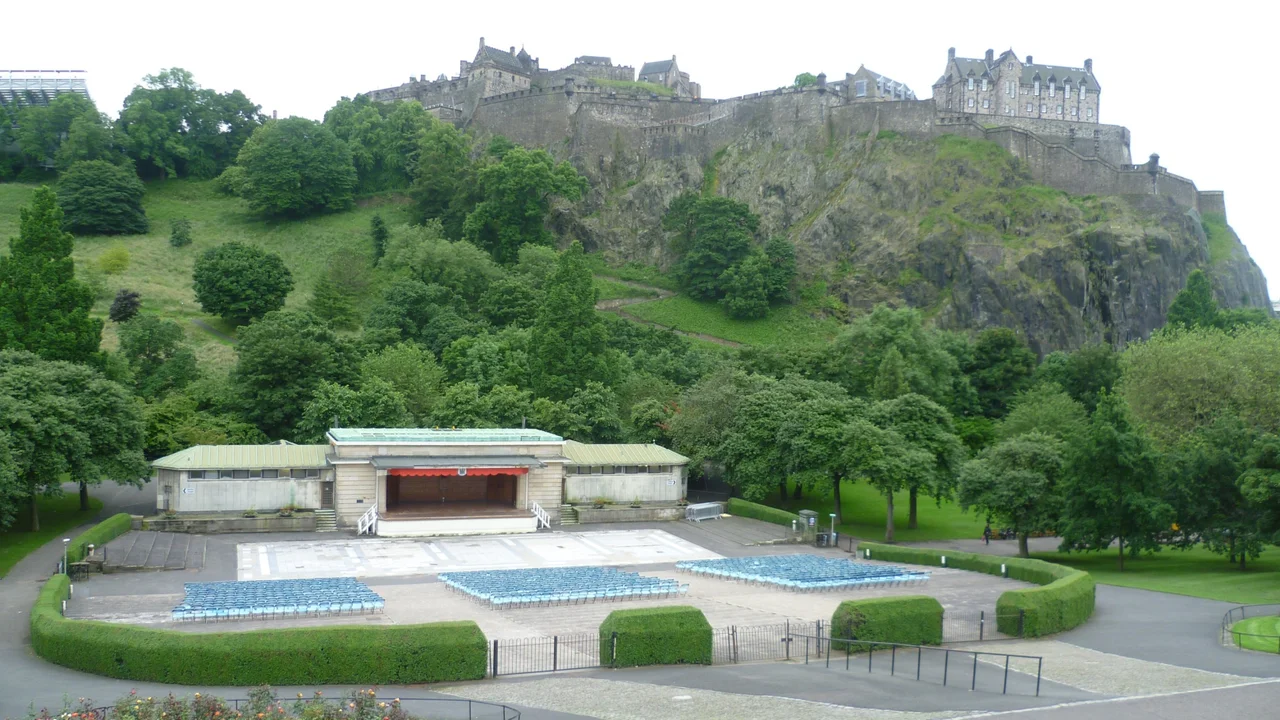

Princes Street Gardens
There was a loch here once, and it was infamous. The Nor Loch had been built in the 15th century as a defensive moat on the north side of Edinburgh's Old Town, but by the 18th century it had become an open sewer, fed by waste draining downhill from the tenements above. People drowned in it. People drowned witches and other accused in it on purpose. When the New Town was planned in the 1760s, the loch had to go. Workers drained it slowly, foot by foot. The valley they uncovered became Princes Street Gardens, and what was once Edinburgh's most disgusting feature is now its most photographed park.
Two Gardens, Divided by Art
The park is actually two parks, divided by The Mound. East Princes Street Gardens cover 8.5 acres, running from The Mound east to Waverley Bridge. West Princes Street Gardens, the larger half at 29 acres, stretch from The Mound west toward Lothian Road. The dividing line is the artificial earth ridge of The Mound itself, which was dumped between Old Town and New Town starting in the 1780s. On top of it sit the National Gallery of Scotland and the Royal Scottish Academy, both designed by William Henry Playfair in the Greek Revival style that gave Edinburgh its 19th-century nickname, the Athens of the North.
The Scott Monument
Rising 200 feet above the East Gardens is the Scott Monument, a Gothic Revival spire built between 1840 and 1844 to honour Sir Walter Scott, the novelist whose Waverley novels defined the modern image of Scotland. The monument was designed by George Meikle Kemp, a self-taught architect who won the commission in an open competition. Kemp drowned in 1844 in the Union Canal before he could see his monument completed. The structure is the largest monument to a writer anywhere in the world. Visitors can climb 287 steps to the top, where the view sweeps Edinburgh in every direction. The sandstone has darkened over time to a deep, smoky grey, giving the spire a Gothic gravity that lighter stone would have lost.
Wojtek the Bear
Among the statues in the West Gardens is one of the most unusual war memorials in Britain. It depicts Wojtek, a Syrian brown bear adopted as a cub by Polish soldiers in Iran during the Second World War. Wojtek travelled with the 22nd Artillery Supply Company of the II Polish Corps, was enlisted as a private to comply with regulations, and famously helped carry ammunition crates at the Battle of Monte Cassino in 1944. After the war, Wojtek lived out his days at Edinburgh Zoo. He died in 1963. The bronze statue, unveiled in 2015, shows him walking beside a Polish soldier, an unlikely soldier of an unlikely army at peace at last in a Scottish park.
The Bandstand and the Fountain
The Ross Bandstand, a 1935 open-air theatre in the centre of the West Gardens, hosts the Festival Fireworks Concert each summer and the Hogmanay concert each Hogmanay. It is named for William Henry Ross, chairman of the Distillers Company, who gifted the first bandstand on the site in 1877. At the western end of the gardens stands the Ross Fountain, a cast-iron Victorian extravagance gifted by the Edinburgh gunsmith Daniel Ross and installed in 1872. After more than a century of weather it was nearly derelict; a 2018 restoration by the Ross Development Trust brought it back to working order. A proposed replacement of the bandstand with a contemporary pavilion designed by architects wHY collapsed during the COVID pandemic over funding and heritage concerns.
The First Floral Clock
At the eastern entrance to the West Gardens, a working clock is planted in the ground each spring. Its face is a circular flowerbed; its hands are real moving hands driven by a clockwork mechanism. The Floral Clock dates from 1903, when it was designed by John McHattie, the Park Superintendent. It was the world's first floral clock, and each summer it carries a different theme picked out in living colour. There are now floral clocks in cities around the world, but this one is the original. The early rules of West Princes Street Gardens, established when they were still private property in 1821, prohibited dogs, cricket, perambulators, and smoking. People using bath-chairs needed a doctor's certificate confirming their ailment was not contagious. The gardens were public on Christmas Day, New Year's Day, and one other day a year. The town council reclaimed them for public use in 1876.
From the Air
Coordinates 55.9500 N, 3.2030 W, running roughly east-west along the valley between the Old Town (south) and the New Town (north) in central Edinburgh. The gardens form a distinctive green strip beneath Edinburgh Castle's north face, divided into east and west sections by The Mound (carrying the National Gallery of Scotland and Royal Scottish Academy). The Scott Monument's blackened Gothic spire is the most prominent landmark, rising 200 ft from East Princes Street Gardens. Edinburgh Airport (EGPH) is about 8 nm west. Best altitudes for orientation 2,000 to 4,000 feet AGL. The deep cutting carries the rail line from Waverley to Haymarket through tunnels under The Mound.
Nearby Stories
- Ardoch Roman Fort 2.2 km away
- Craignethan Castle 3.1 km away
- Haddington 3.8 km away
- Balvaird Castle 4.3 km away
- Battle of Kilsyth 9.4 km away
- Siege of St Andrews Castle 9.9 km away
- Neidpath Castle 11 km away
- Melrose Abbey 15 km away