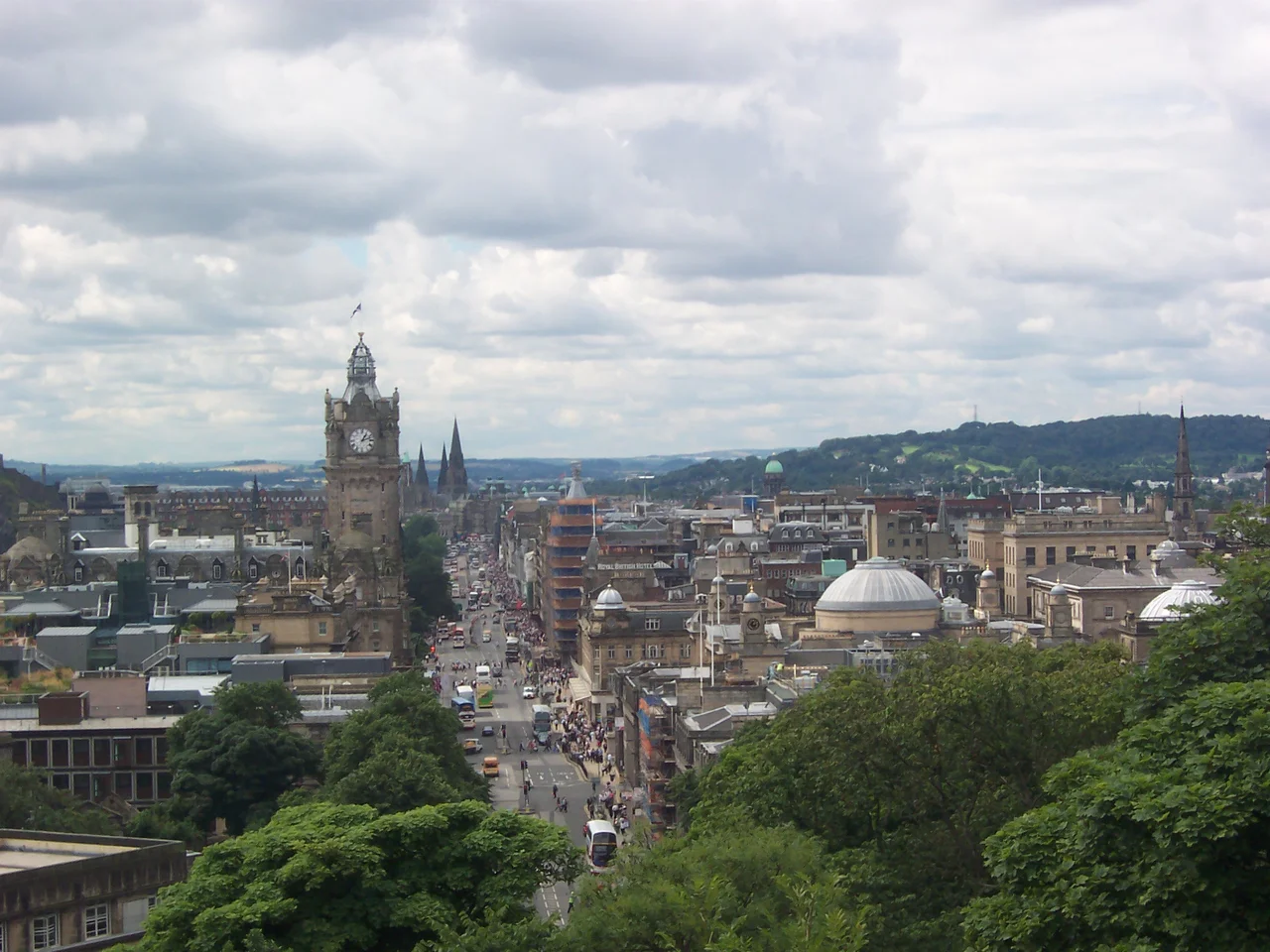

Princes Street
When the New Town was first laid out in the 1760s, the architect James Craig pencilled in a name for the southernmost street: Saint Giles Street, after Edinburgh's patron saint. King George III saw the drawing and refused. He associated Saint Giles with the notorious London slum of the same name and would not have it. At the suggestion of Sir John Pringle, the street was renamed for the King's eldest son, Prince George, Duke of Rothesay - the future George IV. Princes Street, three quarters of a mile of Edinburgh's most famous frontage, takes its name from a royal whim about a London bad neighbourhood.
The One-Sided Street
Princes Street is famous for what it does not have. The south side is almost empty of buildings. Instead it looks across Princes Street Gardens to Edinburgh Castle and the Old Town beyond. The reason is legal. In 1771, when the city council started feuing the land south of Princes Street for development, the original New Town proprietors took the council to court for breaking the implicit terms of their plan, which had presumed open ground south of the street. The case ran up to the House of Lords. The eventual judgment allowed the existing buildings (including the future Balmoral Hotel) to be completed but mandated that the ground westwards remain pleasure grounds in perpetuity. Princes Street may be one of the only streets in Britain with an Act of Parliament protecting its view.
Hotels at Either End
Two enormous railway hotels anchor the street. At the east end, looming above Waverley Station, stands the Balmoral - originally the North British Hotel when the North British Railway built it in 1902. Its clock tower is famously kept three minutes fast to nudge travellers toward their trains. At the west end, on the corner of Lothian Road, sits the Caledonian, built by the rival Caledonian Railway for their now-vanished Princes Street Station. The Caledonian is now the Waldorf Astoria Edinburgh. The Princes Street railway lines closed in the 1960s; the hotel stayed. Between the two anchors, the Royal British, Old Waverley, and Mount Royal hotels still operate, surviving relics of an age when railway companies treated their terminus hotels as floating advertisements.
Jenners and Joyride Architecture
Princes Street was the great Scottish shopping street. Jenners, founded in 1838 and rebuilt in 1893-1895, was the Harrods of the north - a department store whose ornate stone facade carried its own architectural reputation. Forsyth's opened in 1906-1907. Through the 20th century, the street drifted between elegance and chaos. The 1949 Abercrombie Plan tried to impose order. The 1967 Princes Street Panel went further, proposing a Modernist redevelopment with a first-floor walkway along the entire street that would theoretically double the shopping frontage. Seven old buildings came down; seven new ones went up; the scheme was abandoned in the 1970s. The walkway was never properly built, surviving only as isolated balconies. Then in January 2021, on a single brutal day, the closures came: Jenners after 183 years, Debenhams, Topshop. The street has been visibly hollowed out since.
Darwin's Rockfield
The young Charles Darwin studied at the University of Edinburgh between 1825 and 1827, walking down Princes Street regularly. Years later, during the voyage of the Beagle, he encountered a stone run on East Falkland in the South Atlantic - a long ribbon of broken rock left behind by periglacial weathering. It was about four miles long and reminded him so much of the cobblestone setts of Princes Street that he named it Princes Street. The name still appears on Falkland Islands maps. It is roughly 8,000 miles from the original. In 1970, the composer James H. Howe wrote a military march called Pride of Princes Street. In the New Zealand city of Dunedin - Dùn Èideann being the Gaelic form of Edinburgh - the main shopping street is also named Princes Street, after this one.
The Battle of Princes Street
In July 2005, during the 31st G8 summit at Gleneagles, anti-globalisation protests in Edinburgh turned violent. Rioters clashed with police along Princes Street; the press christened the events the Battle of Princes Street. The opening scene of Danny Boyle's 1996 film Trainspotting, with Mark Renton sprinting from shop security guards along the pavement, captured the street in another mode entirely: scruffy, energetic, a backdrop for a generation. Sylvain Chomet's 2010 animated film The Illusionist set scenes here as the street looked in the late 1950s, when the architecture was mixed and the department stores still ruled. Most of Princes Street is now restricted to trams, buses, and taxis. Only the eastern third remains open to general traffic.
From the Air
Coordinates 55.9513 N, 3.2009 W, running east-west for about 1.2 km (0.75 mi) as the southernmost street of Edinburgh's New Town. The street's open south side and one-sided north frontage create a distinctive visual gap immediately north of Edinburgh Castle and Princes Street Gardens. The Scott Monument's Gothic spire mid-street is a key landmark; the Balmoral Hotel's clock tower marks the east end above Waverley Station; the Caledonian (now Waldorf Astoria) anchors the west end. Edinburgh Airport (EGPH) is about 8 nm west. Best viewed at 2,000 to 4,000 feet AGL in clear conditions, with morning light striking the north-facing facades.
Nearby Stories
- Ardoch Roman Fort 2.2 km away
- Craignethan Castle 3.1 km away
- Haddington 3.8 km away
- Balvaird Castle 4.3 km away
- Battle of Kilsyth 9.4 km away
- Siege of St Andrews Castle 9.9 km away
- Neidpath Castle 11 km away
- Melrose Abbey 15 km away