,_Istanbul_2.jpg)
Prinkipo Greek Orthodox Orphanage
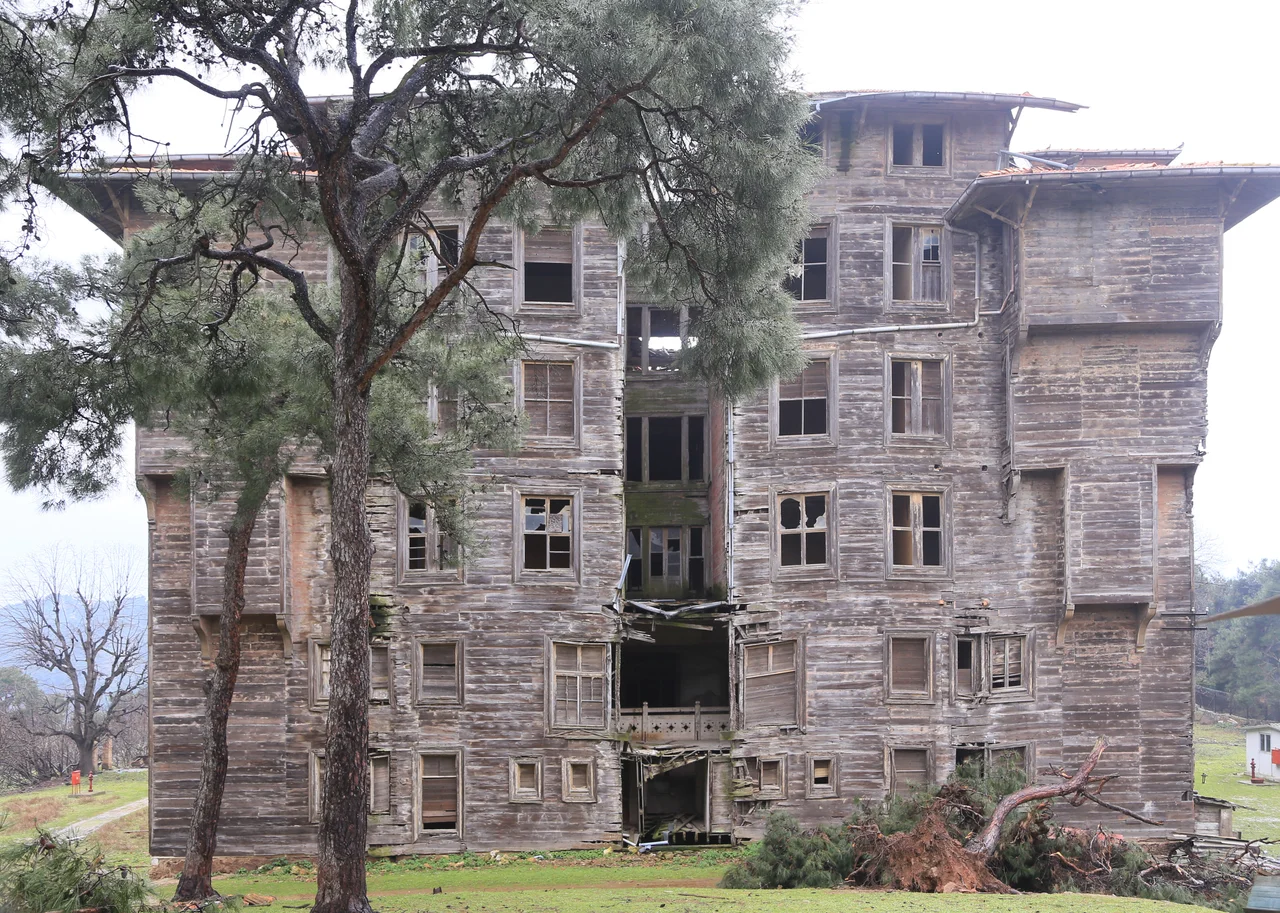
Stand on the forested hillside of Büyükada and look southeast, and you will see it: a vast wooden palace rising six stories above the pines, its balconies stacked in ornate layers, its silhouette unmistakable. The Prinkipo Greek Orthodox Orphanage was built to be a luxury hotel. It never hosted a single paying guest. What it hosted instead were generations of children — Greek Orthodox orphans who grew up within its 206 rooms, studied in its school, learned trades in its workshops, and looked out from its wide verandahs across the Sea of Marmara. The building is considered the largest wooden structure in Europe, and it has stood empty and decaying since 1964.
A Grand Hotel That Never Opened
French-Ottoman architect Alexander Vallaury designed the building in 1898 for the Compagnie Internationale des Wagons-Lits — the company that operated the Orient Express — as a luxury hotel and casino to be called Prinkipo Palace. The design was ambitious: a sprawling wooden complex with ornate neoclassical detailing, perched on a pine-covered hillside on Büyükada, the largest of the Princes' Islands. But Sultan Abdul Hamid II refused to issue a permit for its operation, and the grand hotel never opened. By 1903 the property had been purchased by Eleni Zarifi, wife of a prominent Greek banker, who donated it to the Ecumenical Patriarchate of Constantinople. The building that was built to serve wealthy travelers across Europe instead opened its doors to children who had no family to turn to.
Sixty Years of Children
From 1903 to 1964, the orphanage sheltered 5,800 children. Boys and girls from the Greek Orthodox community of Istanbul grew up within these walls, attending the primary school, learning trades in the vocational workshops, sleeping in dormitories where the Marmara breeze came through the windows in summer. The building's scale — 20,000 square meters, 206 rooms — meant that it was never just an orphanage in the narrow sense; it was a self-contained world. The community that sustained it was itself substantial: in the early 20th century, Greeks were one of Istanbul's largest minority groups, and the Ecumenical Patriarchate, headquartered in Constantinople since the Byzantine era, provided for those left without family. The children who grew up here were not footnotes; they were the center of a living community's deepest commitments.
Closure, Seizure, and the Long Legal Fight
On April 21, 1964, during a period of heightened tension over the Cyprus conflict and state pressure on Istanbul's Greek population, the General Directorate of Foundations forcibly closed the orphanage. The building fell into disuse; a fire in 1980 severely damaged parts of the structure. In 1997, the Turkish state seized the property outright. The Ecumenical Patriarchate contested the seizure through Turkish courts, arguing that the property had been legitimately donated to the Patriarchate under Ottoman law. The Supreme Administrative Court dismissed the claims, ruling that the foundation had lost its function and become a seized asset. In 2005, the Patriarchate took the case to the European Court of Human Rights. The court ruled in favor of the Patriarchate, and in 2010 Turkey restored legal title to the Ecumenical Patriarchate. Two years later, in 2012, the building was physically returned — but in a condition far worse than when it had been taken. The Greek community was blunt: restoration would require approximately 65 million euros, an impossible sum for a community whose Istanbul population had by then shrunk to around 2,000 people.
What Remains and What Was Lost
The story of the Prinkipo Orphanage is inseparable from the story of Istanbul's Greek community. In the early 20th century, Greeks numbered in the hundreds of thousands in the city. A combination of population exchanges, economic discrimination, and the events of 1955 — when anti-Greek riots devastated property in Istanbul — steadily reduced that number. The 1964 closure of the orphanage and the concurrent expulsion of Greek nationals from Turkey marked another turning point. By the time the building was returned in 2012, the community whose identity and history it embodied had been reduced to a fraction of its former size. In 2018, Europa Nostra and the European Investment Bank placed the orphanage on the list of Europe's Seven Most Endangered cultural heritage sites. The building stands as evidence: not only of architectural ambition and the remarkable generosity of Eleni Zarifi's donation, but of a community's shrinking and of the children who deserved better than an empty, decaying monument where their lives once unfolded.
A New Chapter, Still Contested
In May 2026, Ecumenical Patriarch Bartholomeos announced that decades of effort to convert the building into an interfaith dialogue center had failed, and that the Patriarchate had decided instead to pursue its transformation into a hotel. The plan calls for a long-term lease, with the lessee funding the restoration to ecological standards. The announcement drew concern from members of the Greek diaspora, who questioned whether converting a place of orphan care into a luxury hospitality venue was the right use of the building's legacy. Others saw it as the only realistic path to saving a structure that would otherwise collapse. What is not in dispute is that the building is at a crossroads: more than a century after it was designed for guests who never arrived, the possibility of guests finally returning has become the most viable argument for its survival.
From the Air
The Prinkipo Greek Orthodox Orphanage sits at approximately 40.8608°N, 29.1233°E on the wooded hillside of Büyükada, the largest of the Princes' Islands. From the air at 2,000 feet, the six-story wooden structure is visually distinctive among the pine-covered slopes — the largest building on the island by a considerable margin, its ornate multi-tiered balconies visible on clear days. The nearest airport is LTFJ (Sabiha Gökçen International), approximately 22 km to the northeast on the Asian mainland; LTFM (Istanbul Airport) lies roughly 55 km to the northwest. The island sits in the eastern Sea of Marmara, separated from the Asian shore by about 15 km of open water.
Nearby Stories
- Second Battle of Çatalca 1.5 km away
- Tarabya 4.1 km away
- Şile 7.9 km away
- Hereke Carpet 12 km away
- Battle of Melantias 19 km away
- Bursa 47 km away
- Bandırma 51 km away
- 2025 Kartalkaya Hotel Fire 192 km away