
Prittlewell Priory
On a quiet morning in 1321, the monks of Prittlewell were celebrating Mass when an armed party from the priory of Lewes in East Sussex burst through the doors. They had come for their prior. William le Auvergnat - who had been accused of corruption nearly a decade earlier, who had been ordered to resign by the King himself in 1318, and who had then returned and reoccupied the building with his loyalists - was struck a fatal blow at his own altar. The killing ended one of the strangest internal disputes in medieval English monasticism. The man Lewes had wanted to install all along, James de Cusancia, finally became prior. Eight centuries later, you can stand on the spot. The priory is a public park, donated to Southend-on-Sea by a local jeweller, and the medieval stones speak quietly of the violence they once held.
A Cell of Lewes
Prittlewell Priory was founded in the 12th century as a daughter house - a 'cell' in monastic terms - of the great Cluniac Priory of St Pancras at Lewes. It was never grand. At its peak the community housed no more than eighteen monks, who lived simply on this gently sloping ground north of the Thames Estuary. The mother house at Lewes appointed each prior, which is what gave the 1311 election of William le Auvergnat its strange political weight, and what made the conflict that followed possible. In 1536, the dissolution of the monasteries under Henry VIII swept Prittlewell up with the rest. Much of the priory was torn down. What survived was patched together into a country house, altered through the 18th century, then altered again in the early 20th when the refectory was rebuilt. A 12th-century doorway with chevron and dog-tooth ornamentation still stands - small but unmistakably Romanesque, a thumbprint of the original community pressed into the stone.
The Scrattons and Their Walled Garden
Daniel Robert Scratton inherited the priory in 1842. With his wife Maria he renovated it into a comfortable family home - a hunter's portrait of him by Stephen Pearce now hangs in Southend Museum, the priory visible in the background. In 1869 he moved to West Ogwell in Devon, where he died in 1902, and the building only truly became a family seat when William Howell Scratton purchased it back in 1887. The Scrattons built a walled kitchen garden complete with hot houses and a melon pit, planted on what had once been the monks' burial ground. Today that garden is purely ornamental - roses and herbaceous borders growing where Cluniac brothers were laid to rest. The juxtaposition is typical of how English country houses absorb their own histories: the Victorian family enjoying their melons above the medieval dead.
The Jeweller's Gift
Robert Arthur Jones - R. A. Jones to his customers - made his money selling jewellery in Southend. He spent it making the town better. In 1917 he bought the priory and a large tract of surrounding land from the Scrattons and gave the whole estate to the people of Southend as a public park. On 14 July 1920 the Duke of York - later King George VI, the stammering monarch who would steady Britain through the Second World War - formally opened Priory Park. R. A. Jones died in 1925 and was buried in the priory grounds, which feels exactly right: a man who gave a town its first museum and its largest park sleeping under the trees he planted for everyone else. The priory building itself, restored in 2012 with Heritage Lottery funding, was the first museum to open in Southend and remains Grade I listed, with the surrounding medieval ruins protected as a scheduled monument.
What the Stones Hold
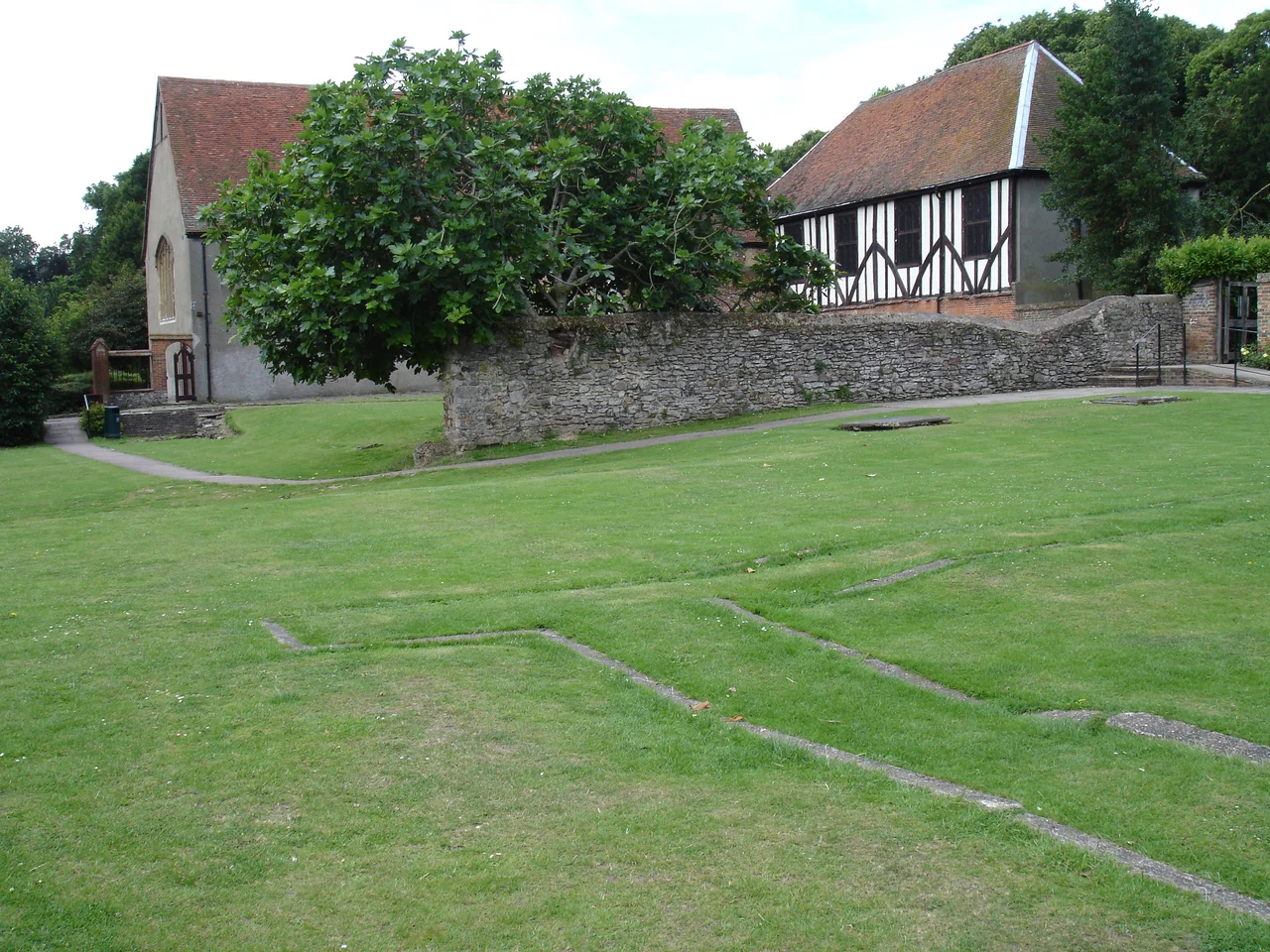
Walking the grounds today, you can read the priory's whole history in layers. Outside, the marked-out footings of the priory church show how the building once extended into the lawn - a ghost-plan in pale stone, the geometry of Cluniac worship preserved at ankle height. Inside the surviving house, the 12th-century arch sits at one end of a corridor that passes through Tudor brickwork, Georgian panelling, and Victorian fireplaces before opening into the modern visitor centre. An exhibition on the Scratton family fills the upstairs rooms. Children chase each other across the lawn where the cloister used to be. Somewhere nearby is the spot where William le Auvergnat was killed at his altar in 1321 - the only act of violence the priory's stones never quite let go of, even as the rest of its quiet centuries blur into the long English afternoon.
From the Air
Located at 51.554°N, 0.706°E in the Prittlewell suburb of Southend-on-Sea, Essex. The priory lies in Priory Park, an obvious green rectangle within the urban grid, just south of the A127 and west of Southend Victoria railway station. London Southend Airport (EGMC) is roughly 1.5 nm to the east. From the air, look for the park's tree canopy and the silver glint of the Thames Estuary about 1.5 miles to the south.
Nearby Stories
- Port of Ramsgate 0.7 km away
- Faversham Munitions Explosion Memorial 2.6 km away
- St John's Abbey, Colchester 3.7 km away
- Brentwood Cathedral 4.4 km away
- Maunsell Forts 6.7 km away
- Tilty Abbey 6.9 km away
- Shipbourne 9.9 km away
- Broadstairs 26 km away